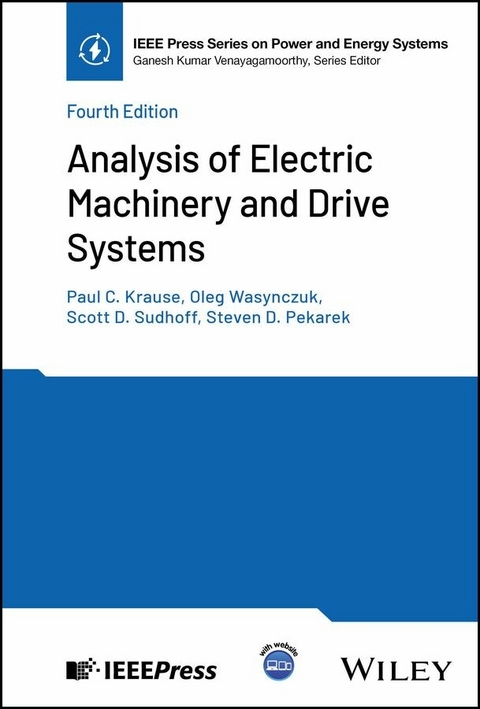
Analysis of Electric Machinery and Drive Systems (eBook)
784 Seiten
Wiley-IEEE Press (Verlag)
978-1-394-29387-2 (ISBN)
New edition of the popular reference on machine analysis, focusing on reference frame theory with techniques for derivation of equations
Analysis of Electric Machinery and Drive Systems covers the concepts needed to understand the evolution of electrical and magnetic variables for designing the power-electronic circuits that supply or extract electrical energy from a variety of machines, comprehensively addressing the varied needs of readers in the electric machinery, electric drives, and electric power industries.
This fourth edition has been extensively revised and updated to include nine new or updated chapters on symmetrical three-phase stators, symmetrical induction machines, brushless DC machines, synchronous machines, neglecting electric transients, eigenvalues and voltage-behind-reactive machine equations, direct current machine and drive, and torque control of permanent-magnet and synchronous reluctance machines.
Introductory concepts related to the subject have also been expanded upon, detailing stationary magnetically coupled circuits, energy balance relationships, energy in coupling field, and steady-state and dynamic performance of electromechanical systems. The fourth edition also includes illustrations of the free-acceleration characteristics of induction and brushless dc machines viewed from various reference frames and many other topics.
With problems at the end of each chapter to reinforce learning, the book explores additional topics including:
- Operational impedances and time constraints of synchronous machines, covering Park's equations in operational form and parameters from short-circuit and frequency-response characteristics
- Fully controlled three-phase bridge converters, covering six-step, sine-triangle, space-vector, hysteresis, and delta modulations, along with open- and closed-loop voltage and current regulations
- Motor drives, covering volts-per-hertz, constant slip current, field-oriented, and direct torque control as well as slip energy recovery drives
- Brushless DC motor drives, covering average-value analysis, steady-state performance, and transient and dynamic performance of voltage-source inverter drives
Analysis of Electric Machinery and Drive Systems, Fourth Edition, is a perfect resource for electrical engineering students and an essential, up-to-date reference for electrical and mechanical engineers working with drives.
Paul C. Krause is a former Professor at Purdue University School of Electrical and Computer Engineering. He is the founder of PC Krause and Associates Inc. and recipient of the 2010 IEEE Nikola Tesla Award.
Oleg Wasynczuk is a Professor Emeritus of Electrical and Computer Engineering at Purdue University. He also served as Chief Technical Officer of PC Krause and Associates Inc. and is the recipient of the 2008 IEEE PES Cyril Veinott Electromechanical Energy Conversion Award.
Scott D. Sudhoff is the Michael and Katherine Birck Distinguished Professor of Electrical and Computer Engineering at Purdue University. He is a former Editor-in-Chief of the IEEE Transactions on Energy Conversion and recipient of the 2024 IEEE Nikola Tesla Award.
Steven D. Pekarek is the Edmund O. Schweitzer, III, Professor of Electrical and Computer Engineering at Purdue University. He has served as an Editor of the IEEE Transactions on Energy Conversion and the IEEE Transactions on Power Electronics, and is the recipient of the 2018 IEEE PES Cyril Veinott Electromechanical Energy Conversion Award.
New edition of the popular reference on machine analysis, focusing on reference frame theory with techniques for derivation of equations Analysis of Electric Machinery and Drive Systems covers the concepts needed to understand the evolution of electrical and magnetic variables for designing the power-electronic circuits that supply or extract electrical energy from a variety of machines, comprehensively addressing the varied needs of readers in the electric machinery, electric drives, and electric power industries. This fourth edition has been extensively revised and updated to include nine new or updated chapters on symmetrical three-phase stators, symmetrical induction machines, brushless DC machines, synchronous machines, neglecting electric transients, eigenvalues and voltage-behind-reactive machine equations, direct current machine and drive, and torque control of permanent-magnet and synchronous reluctance machines. Introductory concepts related to the subject have also been expanded upon, detailing stationary magnetically coupled circuits, energy balance relationships, energy in coupling field, and steady-state and dynamic performance of electromechanical systems. The fourth edition also includes illustrations of the free-acceleration characteristics of induction and brushless dc machines viewed from various reference frames and many other topics. With problems at the end of each chapter to reinforce learning, the book explores additional topics including: Operational impedances and time constraints of synchronous machines, covering Park s equations in operational form and parameters from short-circuit and frequency-response characteristicsFully controlled three-phase bridge converters, covering six-step, sine-triangle, space-vector, hysteresis, and delta modulations, along with open- and closed-loop voltage and current regulationsMotor drives, covering volts-per-hertz, constant slip current, field-oriented, and direct torque control as well as slip energy recovery drives Brushless DC motor drives, covering average-value analysis, steady-state performance, and transient and dynamic performance of voltage-source inverter drives Analysis of Electric Machinery and Drive Systems, Fourth Edition, is a perfect resource for electrical engineering students and an essential, up-to-date reference for electrical and mechanical engineers working with drives.
1
Introductory Concepts
1.1 Introduction
This chapter is a review for most since the material is covered in undergraduate courses in the analysis of electromechanical devices [1]. The material is presented to start everyone with the same background. The chapter begins with coupled circuits (transformers) where the phasor equivalent circuit is established. Since phasors are not always taught the same, they are covered briefly in Appendix B to make sure everyone understands the concept of phasors as used in this text. Although we will give several approaches for the calculation of torque of electric machines; Section 1.1-3 sets forth a method of calculating force and torque that is generally taught at the undergraduate level.
Some instructors may choose to skip some material and/or select topics that were not covered in undergraduate courses at their school. As mentioned, the material will be a review for most and can be covered rather fast. On the other hand, Chapter 2 dives into machine analysis that contains new material and can be taught at a much slower pace.
1.2 Stationary Magnetically Coupled Circuits
Magnetically coupled electric circuits are central to the operation of transformers and electromechanical motion devices. In the case of transformers, stationary circuits are magnetically coupled for the purpose of changing the ac voltage and current levels. The two windings shown in Fig. 1.2-1 consist of turns N1 and N2, and they are wound on a common core, which is a ferromagnetic material with a permeability large relative to that of air. The magnetic core is illustrated in two dimensions.
Figure 1.2-1 Magnetically coupled circuits.
The flux produced by each winding can be separated into two components: a leakage component denoted by the subscript l and a magnetizing component denoted by the subscript m. Each of these components is depicted by a single streamline with the positive direction determined by applying the right‐hand rule to the directions of current flow in the winding. The leakage flux associated with a given winding links only that winding, whereas the magnetizing flux, whether it is due to current in winding 1 or winding 2, links both windings.
The flux linking of each winding may be expressed as
The leakage flux Φl1 is produced by current flowing in winding 1, and it links only the turns of winding 1. Likewise, the leakage flux Φl2 is produced by current flowing in winding 2, and it links only the turns of winding 2. The flux Φm1 is produced by current flowing in winding 1, and it links all turns of windings 1 and 2. Similarly, the magnetizing flux Φm2 is produced by current flowing in winding 2, and it also links all turns of windings 1 and 2. Both Φm1 and Φm2 are called magnetizing fluxes. With the selected positive directions of current flow and the manner in which the windings are wound, the magnetizing flux produced by positive current flowing in one winding can add to or subtract from the magnetizing flux produced by positive current flowing in the other winding. Thus, the mutual inductance can be positive or negative. In Fig. 1.2-1, it is positive.
It is appropriate to point out that this is an idealization of the actual magnetic system. It seems logical that all of the leakage flux will not link all the turns of the winding producing it; hence, Φl1 and Φl2 are “equivalent” leakage fluxes. Similarly, all of the magnetizing fluxes of one winding may not link all of the turns of the other winding.
The voltage equations may be expressed as
In matrix form,
The resistances r1 and r2 and the flux linkages λ1 and λ2 are related to windings 1 and 2, respectively. Since it is assumed that Φ1 links the equivalent turns of winding 1 (N1) and Φ2 links the equivalent turns of winding 2 (N2), the flux linkages may be written as
where Φ1 and Φ2 are given by (1.2-1) and (1.2-2), respectively.
If we assume that the magnetic system is magnetically linear (i.e., core losses and saturation are neglected), we may apply Ohm's law for magnetic circuits to express the fluxes. Thus, the fluxes may be written as
where k = 1 or 2 and and are the reluctances of the leakage paths, and is the reluctance of the path of magnetizing fluxes. Typically, the reluctances associated with leakage paths are much larger than the reluctance of the magnetizing path. The reluctance associated with an individual leakage path is difficult to determine exactly, and it is usually approximated from test data or by using the computer to solve the field equations numerically. On the other hand, the reluctance of the magnetizing path of the core shown in Fig. 1.2-1 may be computed with sufficient accuracy.
For the iron
where li is the length of the path in iron, μr is the relative permeability of iron, μ0 is the permeability of free space, and Ai is the cross‐sectional area of the flux in the iron. In electromechanical devices, we will find that the magnetizing flux must transverse air gaps and
Substituting (1.2-8) and (1.2-9) into (1.2-1) and (1.2-2) yields
Substituting (1.2-12) and (1.2-13) into (1.2-6) and (1.2-7) yields
When the magnetic system is linear, the flux linkages are generally expressed in terms of inductances and currents. We see that the coefficients of the first two terms on the right‐hand side of (1.2-14) depend on N1 and the reluctance of the magnetic system, independent of the existence of winding 2. An analogous statement may be made regarding (1.2-15) with the roles of winding 1 and winding 2 reversed. Hence, the self‐inductances are defined as
where Ll1 and Ll2 are the leakage inductances and Lm1 and Lm2 are the magnetizing inductances of windings 1 and 2, respectively. From (1.2-16) and (1.2-17), it follows that the magnetizing inductances may be related as
which is .
The mutual inductances are defined as the coefficient of the third term on the right‐hand side of (1.2-14) and (1.2-15). In particular,
We see that L12 = L21 and, with the assumed positive direction of current flow and the manner in which the windings are wound as shown in Fig. 1.2-1, the mutual inductances are positive. If, however, the assumed positive directions of the current or the direction of the windings were such that Φm1 opposed Φm2, then the mutual inductances would be negative.
The mutual inductances may be related to the magnetizing inductances. Comparing (1.2-16) and (1.2-17) with (1.2-19) and (1.2-20), we see that
The flux linkages may now be written as
where L11 and L22 are defined by (1.2-16) and (1.2-17), respectively, and L12 and L21 by (1.2-19) and (1.2-20), respectively. The self‐inductances L11 and L22 are always positive; however, the mutual inductances L12(L21) may be positive or negative, as previously mentioned.
Although the voltage equations given by (1.2-3) and (1.2-4) may be used for purposes of analysis, it is customary to perform a change of variables that yields the well‐known equivalent T circuit of two windings coupled by a linear magnetic circuit. To set the stage for this derivation, let us express the flux linkages from (1.2-22) and (1.2-23) as
With λ1 in terms of Lm1 and...
| Erscheint lt. Verlag | 24.3.2025 |
|---|---|
| Reihe/Serie | IEEE Press Series on Power and Energy Systems |
| Sprache | englisch |
| Themenwelt | Technik ► Elektrotechnik / Energietechnik |
| Schlagworte | design of electric machines • electric drives for generation • Electric Machines • machine parameter identification • Synchronous Machines • winding functions |
| ISBN-10 | 1-394-29387-9 / 1394293879 |
| ISBN-13 | 978-1-394-29387-2 / 9781394293872 |
| Informationen gemäß Produktsicherheitsverordnung (GPSR) | |
| Haben Sie eine Frage zum Produkt? |
 EPUB (Adobe DRM)
Kopierschutz: Adobe-DRM
Adobe-DRM ist ein Kopierschutz, der das eBook vor Mißbrauch schützen soll. Dabei wird das eBook bereits beim Download auf Ihre persönliche Adobe-ID autorisiert. Lesen können Sie das eBook dann nur auf den Geräten, welche ebenfalls auf Ihre Adobe-ID registriert sind.
Details zum Adobe-DRM
Dateiformat: EPUB (Electronic Publication)
EPUB ist ein offener Standard für eBooks und eignet sich besonders zur Darstellung von Belletristik und Sachbüchern. Der Fließtext wird dynamisch an die Display- und Schriftgröße angepasst. Auch für mobile Lesegeräte ist EPUB daher gut geeignet.
Systemvoraussetzungen:
PC/Mac: Mit einem PC oder Mac können Sie dieses eBook lesen. Sie benötigen eine
eReader: Dieses eBook kann mit (fast) allen eBook-Readern gelesen werden. Mit dem amazon-Kindle ist es aber nicht kompatibel.
Smartphone/Tablet: Egal ob Apple oder Android, dieses eBook können Sie lesen. Sie benötigen eine
Geräteliste und zusätzliche Hinweise
Buying eBooks from abroad
For tax law reasons we can sell eBooks just within Germany and Switzerland. Regrettably we cannot fulfill eBook-orders from other countries.
aus dem Bereich