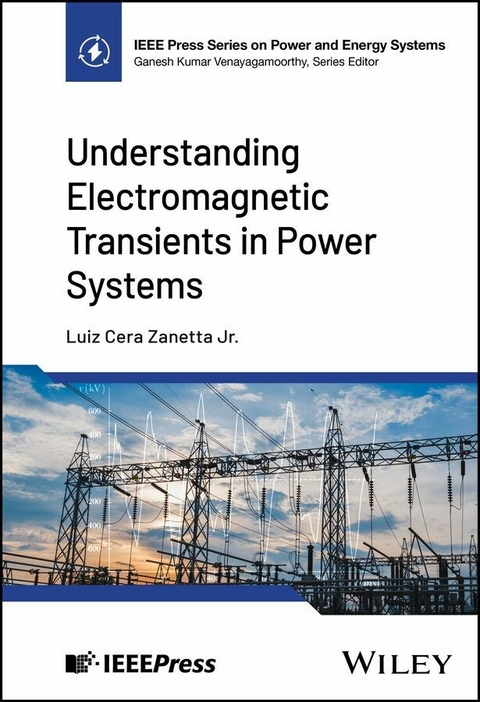
Understanding Electromagnetic Transients in Power Systems (eBook)
1140 Seiten
Wiley-IEEE Press (Verlag)
978-1-394-24056-2 (ISBN)
Understand transients and their roles in linear systems with this essential guide
Electromagnetic transients are a fundamental aspect of linear power systems, and therefore a key knowledge area for electrical engineers. Understanding Electromagnetic Transients in Power Systems provides a comprehensive but accessible overview to transients, their underlying theory and mathematics, and their impact in electrical power system design. Its detailed but clear presentation makes it a must-own for students and working engineers alike.
Readers of Understanding Electromagnetic Transients in Power Systems will also find:
- Deep consideration of the relationship between foundational concepts, mathematical calculations, and impacts on equipment
- Detailed discussion of topics including time and frequency domain analysis, basic transforms, fundamentals of electrical circuit transients and traveling waves, overvoltage, insulation coordination, and many more
- Dozens of solved simple examples to facilitate understanding
Understanding Electromagnetic Transients in Power Systems is ideal for electrical engineers and professionals in utilities and equipment manufacturing, as well as for graduate and advanced undergraduate students learning about transients, electrical circuits, and related subjects.
Luiz Cera Zanetta, Jr., PhD, is a Senior Member of IEEE and a full professor at University of São Paulo. His numerous publications and R&D projects for utilities have played a key role in advancing and solidifying the area of electromagnetic transient analysis and equipment specifications for major power plant projects and long-distance interconnections in Brazil. His interests range from electromagnetic transients to Flexible AC Transmission Systems, including dynamic stability analysis, in research domains that are challenging for achieving consistency. Currently his primary interest is to contribute to the enhancement of engineering education.
Understand transients and their roles in power systems with this essential guide Electromagnetic transients are a fundamental aspect of power systems, and therefore a key knowledge area for electrical engineers. Understanding Electromagnetic Transients in Power Systems provides a comprehensive but accessible overview to transients, their underlying theory and mathematics, and their impact in electrical power system design. Its detailed but clear presentation makes it a must-own for students and working engineers alike. Readers of Understanding Electromagnetic Transients in Power Systems will also find: Deep consideration of the relationship between foundational concepts, mathematical calculations, and impacts on equipment Detailed discussion of topics including time and frequency domain analysis, basic transforms, fundamentals of electrical circuit transients and traveling waves, overvoltage, insulation coordination, and many more Dozens of solved simple examples to facilitate understanding Understanding Electromagnetic Transients in Power Systems is ideal for electrical engineers and professionals in utilities and equipment manufacturing, as well as for graduate and advanced undergraduate students learning about transients, electrical circuits, and related subjects.
Preface
First and foremost, we clarify that the use of the term understanding in the book's title is meant to offer a gentle introduction to a complex subject, rather than an arrogant claim.
This is mainly addressed to the student who intends to begin his training in electromagnetic transients, but it can also be useful for the professional who seeks the maturation of his evolving and as yet unresolved ideas.
The book retains the essence of its first edition, originally published in Portuguese in 2003, but only recently we have been able to release an English version, incorporating adaptations to the chapters along with some timely updates.
This book arose from the author’s desire to share his experiences with transmission line and high-voltage equipment projects, drawing from his work in the electrical power industry and later in academia, with the hope that these insights can be valuable to both students and professionals in power systems. Some of the interpretations gathered here can also be found in the literature, and the contribution of this collection lies in bringing together and organizing this information. We apologize in advance if we did not adequately credit any sources for the results we used.
The aim of this book is to present the fundamentals of transients step-by-step, providing the necessary background for understanding the topic while minimizing the need for external references. Though it does not seek to exhaustively cover the subject, it is designed to make the material more accessible, helping to clarify the relationship between fundamental transient concepts, their calculations, and their impact on equipment.
Our intention is not to explore the general aspects of electromagnetic transients theory, but rather to focus on circuits and on the analysis of wave propagation in transmission lines. This book also does not cover the evolving technological features of substation equipment in detail, as we believe specialized publications are more appropriate for in-depth information on these topics. However, when discussing transients, it is inevitable to consider their effects on the equipment components that make up a power system. We do this without straying from the core principles, always aiming to deepen the understanding of the key concepts behind transients.
Although the topic seems at first sight a bit dry, we try to present it in simple language, so as to expeditiously cover phenomena that change rapidly in time.
We aim, whenever possible, to supplement the text with detailed examples to clarify the theoretical explanations. It's clear that complex networks involving many differential equations can only be analyzed with the help of electromagnetic transient programs. However, our focus on the analytical treatment of these transients comes from the need to understand the underlying principles, at least on a qualitative level.
In the opening Chapters 1 and 2, we present basic concepts of electrical circuits and wave propagation, which may seem very basic at first glance, but we believe they are relevant not only for students but also for professionals who do not use them frequently.
In Chapter 1, the essential information for addressing transients in electrical circuits has been condensed, and the Laplace transform is introduced as a powerful method for converting differential equations into algebraic equations, enhancing the understanding of transients through pole-residue analysis. In Chapter 2, we present the fundamental concepts of wave propagation in single-phase transmission lines, which serve as a smooth introduction to understanding multiphase lines. The relationships between voltages and currents are explained, along with key transmission line characteristics, and an analysis of discontinuities is also presented. The Thévenin equivalent, an important concept, is also approached and recurs throughout the book.
The relationship between multiphase voltage and current waves in transmission lines is analyzed in Chapter 3, in both the phase and modal domain. This approach is useful to understand basic transmission line models in EMT programs, which, although simplified, perform effectivelly in standard studies.
In Chapter 4, we introduce the most efficient numerical method applied in electromagnetic transient calculations. The elementary formulation of an EMTP using nodal analysis, while much simpler than existing commercial or free softwares, aims to introduce students to the core of developing an electromagnetic transient calculation program. Numerical examples with simple networks were prepared, detailing some integration steps that clarify nodal solutions and the updating of history terms.
Chapter 5 addresses the representation of frequency-dependent parameters of transmission lines, a subject that, to this day, can still benefit from further contributions despite much effort and sophisticated models. We show how rational functions are fitted in the frequency domain to enable efficient recursive convolutions in the time domain, aiming to make more advanced transmission line models in electromagnetic transient programs more accessible. To complement the modeling of transmission lines, the use of the nodal admittance matrix is approached, as well as the frequency dependent network equivalents (FDNEs).
The role of power electronic converters, specifically voltage source converters (VSCs), connected to the power grid is addressed in Chapter 6. The elements of power electronics complement the information on three-phase voltage sources interacting with the power system. The chapter reviews the basic equations, starting from thyristor-based converters to the latest developments in VSCs and modular multilevel converters (MMCs). We focus on the basic elements of space-vector control and the synchronization device phase-locked loop (PLL), which are still not straightforward for power system students, in order to clarify the control structure of VSCs.
Chapters 7–9 deal with the basic overvoltages in power systems. Chapter 7 approaches the temporary overvoltages and steady-state conditions on an electrical grid in situations in which there are topological changes in the network caused by maneuvers or short circuits. Mastery of these conditions is essential for analyzing transient phenomena because they are part of the overall transient solution right from the start. In this chapter, we also deal with saturation in transformers and introduce the complex ferroresonance phenomenon in power systems.
The sizing of transmission lines and substations is largely determined by the influence of switching and lightning surges, which significantly impact the dimensions and costs of these installations. Consequently, it is essential to thoroughly analyze these transients, with the core analysis presented in Chapters 8 and 9.
In Chapter 8, we present a general description of the main transient phenomena in transmission lines, related to slow wavefronts (switching surges). The chapter analyzes the primary cases of overvoltages and also discusses the mitigation measures for controlling them as surge arresters, pre-insertion resistors, and controlled switching in circuit breakers. Chapter 9 addresses fast wavefronts (lightning surges) that affect the lightning performance of transmission lines and the insulation levels of substation equipment. The chapter provides information on modeling lightning currents and their probabilistic behavior, along with models for transmission lines, towers, and grounding systems. It presents the methodology for calculating lightning surges caused by direct strokes and backflashovers, analyzes the effects of line arresters, and covers the calculation of induced overvoltages. Additionally, the procedure for calculating lightning surges on substation equipment is also discussed.
In Chapters 10 and 11, we address basic transients involving shunt and series capacitors. In Chapter 10, the analysis of shunt capacitor switching focuses primarily on high-frequency transients, such as energization, restrike, back-to-back switching, and inrush currents. The chapter examines high-frequency stresses on equipment, emphasizing key considerations for equipment specification. In Chapter 11, electromagnetic transient studies are presented to define protection level settings for both the capacitor bank and the MOV protection scheme. These settings are specified to respond effectively to both internal and external faults related to the line where the bank is installed.
Chapter 12 examines topics related to the opening of circuit breakers due to faults, focusing on transient recovery voltages (TRVs). The main parameters influencing TRVs are explained using basic models that clarify the principles governing these voltages. After calculating the TRV, the chapter discusses the appropriate selection of circuit breakers in line with IEEE or IEC standards.
Surge arresters are studied in Chapter 13 due to their importance in overvoltage control and their frequent mention throughout the book. The chapter clarifies the principles of interaction between surge arresters and transmission lines for both switching and lightning surges, along with the appropriate rating selection based on standards' recommendations.
In Chapter 14, we supplement the previous chapters addressing overvoltages by detailing the engineering procedure for establishing insulation levels for equipment, referred to as insulation coordination. Both deterministic and statistical methods are discussed, applicable to insulations classified as...
| Erscheint lt. Verlag | 26.3.2025 |
|---|---|
| Reihe/Serie | IEEE Press Series on Power and Energy Systems |
| Sprache | englisch |
| Themenwelt | Technik ► Elektrotechnik / Energietechnik |
| Schlagworte | EMTP • Insulation Coordination • integral transforms • lightning surge • Power Systems • series capacitor • shunt capacitor • State Space • Surge arrester • switching surge • temporary overvoltage • transient recovery voltages |
| ISBN-10 | 1-394-24056-2 / 1394240562 |
| ISBN-13 | 978-1-394-24056-2 / 9781394240562 |
| Informationen gemäß Produktsicherheitsverordnung (GPSR) | |
| Haben Sie eine Frage zum Produkt? |
 EPUB (Adobe DRM)
Kopierschutz: Adobe-DRM
Adobe-DRM ist ein Kopierschutz, der das eBook vor Mißbrauch schützen soll. Dabei wird das eBook bereits beim Download auf Ihre persönliche Adobe-ID autorisiert. Lesen können Sie das eBook dann nur auf den Geräten, welche ebenfalls auf Ihre Adobe-ID registriert sind.
Details zum Adobe-DRM
Dateiformat: EPUB (Electronic Publication)
EPUB ist ein offener Standard für eBooks und eignet sich besonders zur Darstellung von Belletristik und Sachbüchern. Der Fließtext wird dynamisch an die Display- und Schriftgröße angepasst. Auch für mobile Lesegeräte ist EPUB daher gut geeignet.
Systemvoraussetzungen:
PC/Mac: Mit einem PC oder Mac können Sie dieses eBook lesen. Sie benötigen eine
eReader: Dieses eBook kann mit (fast) allen eBook-Readern gelesen werden. Mit dem amazon-Kindle ist es aber nicht kompatibel.
Smartphone/Tablet: Egal ob Apple oder Android, dieses eBook können Sie lesen. Sie benötigen eine
Geräteliste und zusätzliche Hinweise
Buying eBooks from abroad
For tax law reasons we can sell eBooks just within Germany and Switzerland. Regrettably we cannot fulfill eBook-orders from other countries.
aus dem Bereich