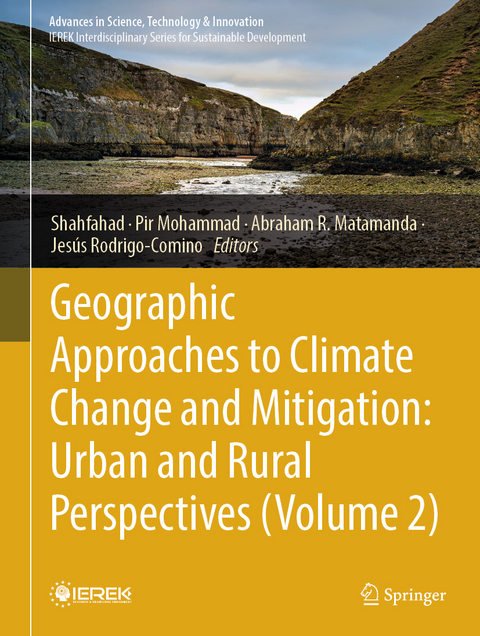
Geographic Approaches to Climate Change and Mitigation: Urban and Rural Perspectives (Volume 2)
Springer International Publishing (Verlag)
978-3-031-92114-8 (ISBN)
This book provides an exploration of innovative geographic approaches to address the challenges posed by climate change, focusing on solutions across urban and rural contexts. Offering actionable insights, it bridges diverse disciplines to highlight practical strategies and evidence-based policies for a more sustainable and resilient future. The volume is organized into key themes that address global issues: sustainable governmental policies, urban planning, rural land use practices, transportation systems, food security, heritage conservation, and the socio-environmental impacts of climate change. From implementing nature-based solutions in African cities to reforestation practices in rural landscapes, and from reducing meat consumption to preserving cultural heritage at risk from rising sea levels, each chapter provides real-world case studies and forward-thinking strategies. The book addresses the importance of integrating diverse perspectives, emphasizing the need for cohesive policies and innovative solutions to mitigate climate impacts while fostering sustainable development. Topics like participatory democracy in climate action, the nexus between tourism and the environment, and leveraging shared electric vehicles for transit sustainability illustrate the multifaceted approach required to tackle global challenges. By examining methodologies such as fuzzy logic for territorial planning, innovative urban design for sustainable education environments, and advanced logistics for freight transportation, the book sets out to solve complex problems related to resource management, community resilience, and climate adaptation. It also sheds light on the socioeconomic and cultural dimensions of climate change, underscoring the importance of interdisciplinary collaboration and global action.
Dr. Shahfahad is Assistant Professor of Geography at Department of Geography, Institute of Science, Banaras Hindu University (BHU). Before joining BHU, Dr. Shahfahad worked as Assistant Professor of Geography at Department of Geography, Faculty of Sciences, Jamia Millia Islamia during 2023-24. He completed his B.A. (H) Geography in 2015, M.A. Geography in 2017 and Ph.D. in 2022 from the Department of Geography, Jamia Millia Islamia, New Delhi. He has also done Post-Graduate Diploma in Geoinformatics from Centre for Distance and Online Learning, Jamia Millia Islamia during 2022-23. He was awarded prestigious National Post Doctoral Fellowship (N-PDF) by Science and Engineering Research Board (SERB) of Department of Science and Technology (DST) in 2024. He was junior research fellow (JRF) during 2017 2019 and senior research fellow (SRF) during 2019 2022 in the Department of Geography, Jamia Millia Islamia. His core areas of research are urban expansion, climate change, urban hydrology as well as applications of geospatial techniques and artificial intelligence in urban studies and natural hazards. He has extensively studied the climate pattern and change over the metropolitan cities of Indian subcontinent. He has published two edited book volume and more than 80 scientific research articles in the journals of international repute such as Habitat International, Urban Climate, Journal of Environmental Management, Scientific Reports, Ecological Indicators, Remote Sensing, Geocarto International and Ecological Informatics. Beside this, he is currently editorial board member of two internal journals. Also, he has served as the reviewer for several reputed international journals.
Pir Mohammad is currently working as a postdoctoral fellow in the Department of Land Surveying and Geo-Informatics at The Hong Kong Polytechnic University, Hong Kong. He earned his Ph.D. in remote sensing, specializing in urban heat island studies over Indian cities from the Department of Earth Sciences, Indian Institute of Technology Roorkee, India, in 2021. He received the Excellence in Doctoral Research Award for his outstanding Ph.D. work in the science stream under the category of fundamental research. His area of research interest includes remote sensing, urban climate, urban heat island, and land use land cover change. He has authored a total of 20 SCI journal publications in the peer reviewed journal of high repute, including GI Sciences & Remote Sensing, Science of the Total Environment, Urban Climate, Building & Environment etc., one of which was selected as a highly cited paper in Quaternary International journal as per the Web of Science. Pir also serves as the reviewer for more than 40 different SCI journals and reviewed more than 200 papers till now. He has also presented papers at various national and international conferences. Besides, his research has also been covered by various Indian newspapers like The Times of India, and Bharat Times. Moreover, he is also able to contribute to the town planning policy document of the Ahmedabad city of India, published by the World Bank Group in 2020. He is also a life member of Indian Society of Remote Sensing (ISRS), Indian Society of Geomatics (ISG), and Indian Science Congress Association (ISCA).
Abraham R. Matamanda (PhD Urban & Regional Planning) is an NRF Y2-rated Urban and Regional Planner. Abraham lectures at the University of Free State (UFS) and is also the Deputy-Chair of the SARChI Chair on City Region Economies in the faculty of Economic and Management Sciences at UFS. Currently, he serves as the co-editor of the Town Planning Journal published by UFS and serves on the academic editorial board of Plos Water Journal. Abraham is also the current Chairperson of the Free State Chapter of the South African Planning Institute (SAPI). He is a fellow of the Department of Higher Education and Training (DHET) F
.- Topic 1 Sustainable Governmental Policy and Leadership.- 1 Science in the city: implementation of evidence based green policies in urban environments.- 2 Public Policy Best Practices for Energy Communities- Pyrgos Community: A Case Study.- 3 Destination management and integrated approaches to mountain tourist destinations.- 4 Fostering Green Consensus: A World Café Approach to Participatory Democracy and Climate Action in Local Communities, etc.
| Erscheinungsdatum | 28.09.2025 |
|---|---|
| Reihe/Serie | Advances in Science, Technology & Innovation |
| Zusatzinfo | XV, 367 p. 184 illus., 166 illus. in color. |
| Verlagsort | Cham |
| Sprache | englisch |
| Maße | 210 x 279 mm |
| Themenwelt | Technik ► Architektur |
| Schlagworte | agroforestry • carbon mitigation • Climate Action • climate adaptation • climate change • Environmental impact • food security • Green policies • Heritage Conservation • land use • nature-based solutions • renewable energy • resilient communities • rural development • sustainable cities • Sustainable Growth • Tourism and Climate • Transportation Systems • Urban mobility • urban planning |
| ISBN-10 | 3-031-92114-3 / 3031921143 |
| ISBN-13 | 978-3-031-92114-8 / 9783031921148 |
| Zustand | Neuware |
| Informationen gemäß Produktsicherheitsverordnung (GPSR) | |
| Haben Sie eine Frage zum Produkt? |
aus dem Bereich