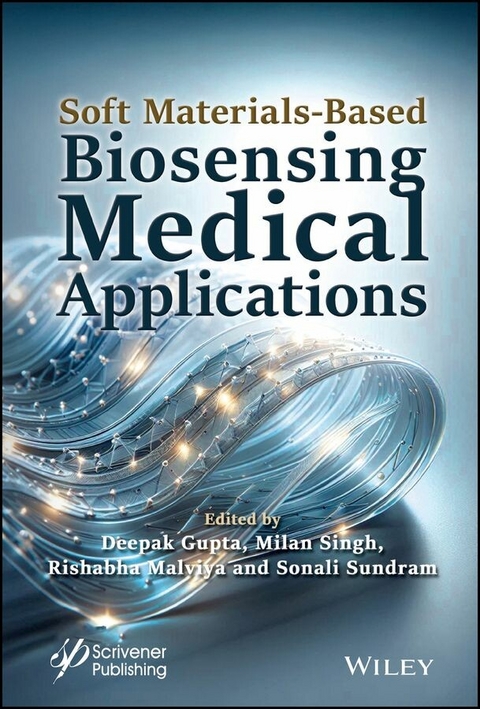
Soft Materials-Based Biosensing Medical Applications (eBook)
522 Seiten
Wiley-Scrivener (Verlag)
978-1-394-21474-7 (ISBN)
The book offers a comprehensive, interdisciplinary overview of how innovative soft materials are revolutionizing biosensing technologies, making it an essential read for anyone interested in cutting-edge advancements in biomedical research and healthcare.
Soft materials include granular materials, foams, gels, polymers, surfactants, functional organics, and biological molecules. These structures can be altered by thermal or mechanical stress due to their ability to self-organize into mesoscopic physical structures. They are becoming increasingly significant as functional materials for broader applications because of their rich surface chemistry and versatile functions.
A biosensor is an analytical tool for chemical compound detection that combines a biological element with a physicochemical detector. Sensitive biological components, such as proteins, carbohydrates, tissue, bacteria, and enzymes, are collected from a biomimetic element that interacts and binds with the analyte under investigation. In biosensors, soft matter may function as both a sensing and transducing component. The interplay of soft matter with biomolecular analytes results in cell signaling pathways, diagnostic tests for applications in low-resource environments, prospective drug development, molecular biodetection, chemical sensors, and biological sensors. Understanding these biomolecular interactions in the context of acute illnesses is critical for biomedical research and healthcare. This has fueled efforts to create a biosensor that is effective, low-cost, and label-free.
Several approaches using soft materials to functionalize and tailor structures have greatly advanced science, including chemistry, physics, pharmaceutical science, materials science, and engineering. Soft Materials-Based Biosensing Medical Applications summarizes recent advances in soft materials with unique physicochemical properties that synergistically promote biosensing systems.
Audience
The book will be read by researchers, materials scientists, electronic and AI engineers, as well as pharmaceutical and biomedical professionals interested in the uses of biosensing.
Deepak Gupta, PhD, is an assistant professor in the School of Basic and Applied Sciences at Galgotias University, India. He has two patents to his credit, has published more than nine research papers, and has attended and organized more than 20 national and international conferences and workshops. His areas of interest include liquid crystals, molecular electronics, soft matter computation, and computational chemistry.
Milan Singh, PhD, is an assistant professor in the Department of Physics, School of Basic and Applied Sciences, Galgotias University, with more than six years of research experience. She has published 12 articles in international journals of repute. Her areas of interest include energy storage devices, supercapacitors, Li-ion batteries, nanoscience, nanotechnology, nanofibers, and nanocomposites.
Rishabha Malviya, PhD, is an associate professor in the Department of Pharmacy, School of Medical and Allied Sciences, Galgotias University, with over 12 years of research experience. He has authored more than 150 research papers for national and international journals of repute, edited twelve books, and has been granted 15 patents, with 40 more under evaluation. He also serves as an editorial board member for more than 40 journals. His areas of interest include formulation optimization, nanoformulation, targeted drug delivery, artificial intelligence in healthcare, localized drug delivery, and natural polymers as pharmaceutical excipients.
Sonali Sundram, PhD, is a researcher in Galgotias University, Greater Noida, India. She has worked as a research scientist at King George's Medical University, Lucknow. Her PhD (Pharmacy) work was in the area of neurodegeneration and nanoformulation and her area of interest is neurodegeneration, clinical research, and artificial intelligence. She has authored/edited more than 30 books and has more than eight patents national and international in her credit.
The book offers a comprehensive, interdisciplinary overview of how innovative soft materials are revolutionizing biosensing technologies, making it an essential read for anyone interested in cutting-edge advancements in biomedical research and healthcare. Soft materials include granular materials, foams, gels, polymers, surfactants, functional organics, and biological molecules. These structures can be altered by thermal or mechanical stress due to their ability to self-organize into mesoscopic physical structures. They are becoming increasingly significant as functional materials for broader applications because of their rich surface chemistry and versatile functions. A biosensor is an analytical tool for chemical compound detection that combines a biological element with a physicochemical detector. Sensitive biological components, such as proteins, carbohydrates, tissue, bacteria, and enzymes, are collected from a biomimetic element that interacts and binds with the analyte under investigation. In biosensors, soft matter may function as both a sensing and transducing component. The interplay of soft matter with biomolecular analytes results in cell signaling pathways, diagnostic tests for applications in low-resource environments, prospective drug development, molecular biodetection, chemical sensors, and biological sensors. Understanding these biomolecular interactions in the context of acute illnesses is critical for biomedical research and healthcare. This has fueled efforts to create a biosensor that is effective, low-cost, and label-free. Several approaches using soft materials to functionalize and tailor structures have greatly advanced science, including chemistry, physics, pharmaceutical science, materials science, and engineering. Soft Materials-Based Biosensing Medical Applications summarizes recent advances in soft materials with unique physicochemical properties that synergistically promote biosensing systems. Audience The book will be read by researchers, materials scientists, electronic and AI engineers, as well as pharmaceutical and biomedical professionals interested in the uses of biosensing.
| Erscheint lt. Verlag | 21.3.2025 |
|---|---|
| Sprache | englisch |
| Themenwelt | Naturwissenschaften ► Chemie |
| Technik ► Maschinenbau | |
| ISBN-10 | 1-394-21474-X / 139421474X |
| ISBN-13 | 978-1-394-21474-7 / 9781394214747 |
| Informationen gemäß Produktsicherheitsverordnung (GPSR) | |
| Haben Sie eine Frage zum Produkt? |
 PDF (Adobe DRM)
Kopierschutz: Adobe-DRM
Adobe-DRM ist ein Kopierschutz, der das eBook vor Mißbrauch schützen soll. Dabei wird das eBook bereits beim Download auf Ihre persönliche Adobe-ID autorisiert. Lesen können Sie das eBook dann nur auf den Geräten, welche ebenfalls auf Ihre Adobe-ID registriert sind.
Details zum Adobe-DRM
Dateiformat: PDF (Portable Document Format)
Mit einem festen Seitenlayout eignet sich die PDF besonders für Fachbücher mit Spalten, Tabellen und Abbildungen. Eine PDF kann auf fast allen Geräten angezeigt werden, ist aber für kleine Displays (Smartphone, eReader) nur eingeschränkt geeignet.
Systemvoraussetzungen:
PC/Mac: Mit einem PC oder Mac können Sie dieses eBook lesen. Sie benötigen eine
eReader: Dieses eBook kann mit (fast) allen eBook-Readern gelesen werden. Mit dem amazon-Kindle ist es aber nicht kompatibel.
Smartphone/Tablet: Egal ob Apple oder Android, dieses eBook können Sie lesen. Sie benötigen eine
Geräteliste und zusätzliche Hinweise
Buying eBooks from abroad
For tax law reasons we can sell eBooks just within Germany and Switzerland. Regrettably we cannot fulfill eBook-orders from other countries.
aus dem Bereich