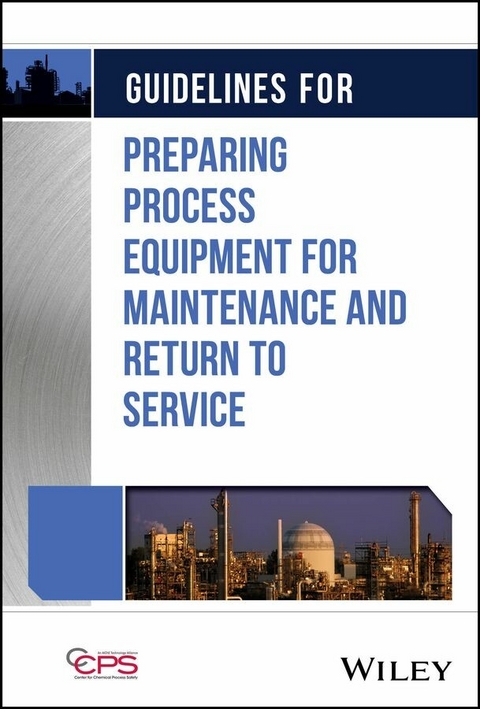
Guidelines for Preparing Process Equipment for Maintenance and Return to Service (eBook)
308 Seiten
Wiley-AIChE (Verlag)
978-1-394-23791-3 (ISBN)
This book contains comprehensive information and methodologies for preparing process equipment for maintenance and, ultimately, return to service. Specifically, this book addresses two phases of equipment handovers, providing information and tools to help personnel at manufacturing sites reduce their risks. The first phase is isolating and preparing equipment for maintenance. The second phase is returning the equipment back to service, applying specified operational readiness plans in addition to a traditional pre-startup safety review (PSSR).
Topics include understanding the unique types of hazards personnel might be exposed to, planning for and executing decontamination and de-energization plans, and safely recommissioning the equipment for its return to service. Case studies, examples, and incident investigation discussions provide the reader with invaluable practical learnings that, when applied, help reduce the likelihood of another similar operational incident from occurring at their facility.
The Center for Chemical Process Safety (CCPS) has been the world leader in developing and disseminating information on process safety management and technology since 1985. The CCPS, an industry technology alliance of the American Institute of Chemical Engineers (AIChE), has published over one hundred books in its process safety guidelines and process safety concepts series. Also, CCPS has helped develop over a hundred courses, including 33 training modules in its Safety in Chemical Engineering Education (SAChE) series. CCPS is supported by the contributions and voluntary participation of more than 225 companies globally.
This book contains comprehensive information and methodologies for preparing process equipment for maintenance and, ultimately, return to service. Specifically, this book addresses two phases of equipment handovers, providing information and tools to help personnel at manufacturing sites reduce their risks. The first phase is isolating and preparing equipment for maintenance. The second phase is returning the equipment back to service, applying specified operational readiness plans in addition to a traditional pre-startup safety review (PSSR). Topics include understanding the unique types of hazards personnel might be exposed to, planning for and executing decontamination and de-energization plans, and safely recommissioning the equipment for its return to service. Case studies, examples, and incident investigation discussions provide the reader with invaluable practical learnings that, when applied, help reduce the likelihood of another similar operational incident from occurring at their facility.
GLOSSARY
| Term | Definition |
|---|
| Air‐gapping | Removal of pipe or spool piece between process and work area (Physical disconnection) |
| Barrier | A control measure or grouping of control elements that on its own can prevent a threat developing into a top event (prevention barrier) or can mitigate the consequences of a top event once it has occurred (mitigation barrier). A barrier must be effective, independent, and auditable (CCPS 2019). For the subject matter of this book, this may include a closed valve, a blinded or blanked line, electrical lock‐out or a safety procedure relating to a check before a line is opened. |
| Blank Flange or Blanking Plate | See Blind Flange. |
| Blind/Line Blind | A blind is a solid plate, usually fitted with a tab to aid identification, handling, and removal, inserted between two flanges to achieve a form of positive isolation. Also referred to as a Spade. See Figure 4‐1. Note: Not considered as secure as physical disconnection due to potential hidden corrosion of blind. |
| Blind Flange | Circular plate bolted to flange at end of line and fitted with gasket to achieve positive isolation (physical disconnection). Also referred to as a Blank Flange. |
| “Bump Start” | See Try‐Out. |
| Cap | A female screwed fitting (typically small bore) that achieves positive isolation (physical disconnection) by screwing onto an externally threaded section at the end of a pipe, on a drain/bleed valve, or on a piece of equipment. See Plug. |
| Car Seal | A metal or plastic cable attached to a piece of equipment (typically a valve) that shows it should not be moved without proper authorization. While it is intended to be strong enough to prevent operation of the valve, it is not as robust as, for example, a padlock. See LOTO. |
| Checklist | A list of items or steps requiring verification of completion; typically, a procedure format in which each critical step is marked off (or otherwise acknowledged/verified) as it is performed (CCPS 2019). |
| Decontamination | Process of removal of substance(s) from equipment so that it can be worked on/disassembled without presenting a safety risk to personnel or the environment. |
| Decommissioning | Completely de‐inventorying all materials from a process unit and permanently removing the unit from service (CCPS 2019). |
| De‐isolation | Removing the items/devices that are excluding the sources of energy at defined points. |
| Design Pressure | The maximum pressure that the equipment is designed to contain, used by the mechanical designer to size the pressure‐containing parts. This will typically be at or above the maximum operating pressure of the equipment. |
| Double Block and Bleed (DB&B) | Closure of two valves with a valved vent or drain between them. This configuration allows for the release of trapped pressure, fluid, or gas between the two blocked valves, providing an added assurance of isolation. |
| Energy Source | In the context of isolation from an energy source for maintenance, this could include electricity, hazardous chemicals, water, steam, pneumatic pressure, hydraulic pressure, temperature (high and low), mechanical or potential energy, radioactive materials, among others. |
| Energy Isolation Plan (EIP) | A document that shows steps to be taken and verifications required to prevent the accidental release of energy when work is to be conducted on a process, plant, or equipment. |
| First Line Break | Initial, controlled opening of a line or vessel that may contain a source of energy. |
| Flammable | Subject to combustion if exposed to an ignition source. Per NFPA: Capable of burning with a flame. Dusts, gases, and vapors if in a confined area, can potentially explode. |
| Hazard Identification and Risk Analysis (HIRA) | A collective term that encompasses all activities involved in identifying hazards and evaluating risk at facilities, throughout their life cycle, to make certain that risks to employees, the public, or the environment are consistently controlled within the organization's risk tolerance (CCPS 2019). |
| Inspection, Testing and Preventive Maintenance (ITPM) | Scheduled proactive maintenance activities intended to (1) assess the current condition and/or rate of degradation of equipment, (2) test the operation/ functionality of equipment, and/or (3) prevent equipment failure by restoring equipment condition. |
| Isolation | Means of preventing a release of energy beyond a defined point. |
| Job Safety Analysis (JSA) | A procedure that systematically identifies: 1) job steps, 2) specific hazards associated with each job step, and 3) safe job procedures associated with each step to minimize accident potential. Also called job hazard analysis (CCPS 2019). |
| Lock‐Out‐Tag‐Out (LOTO) | A safe work practice in which energy sources are positively blocked away from a segment of a process with a locking mechanism and visibly tagged as such to help ensure worker safety during maintenance and some operations tasks (CCPS 2019). |
| Leaks by (of valve) | Fluid flowing from the high pressure side through the internals of a valve to the lower pressure side, also referred to as “passing”. |
| Leak Test | Pressurizing equipment (typically up to maximum operating pressure) using a liquid or gas (e.g., nitrogen, helium), while observing for leaks; this may include a soapy water test, “sniffer”, or monitoring a drop in pressure. |
| Life Saving Rules | A series of key instructions that cannot be broken, which target some of the key causes of injuries and fatalities in the process industries. |
| Long‐term Isolation | Prolonged isolation of equipment during an extended timeframe (e.g., over 90‐days). This often involves comprehensive measures and controls to maintain the isolation status over a longer timeframe compared to standard LOTO procedures, This may include additional measures (preservation plans), operator checks, and MOC. |
| Loss of Primary Containment (LOPC) | An unplanned or uncontrolled release of material from primary containment, including non‐toxic and non‐flammable materials (e.g., steam, hot condensate, nitrogen, compressed CO2 or compressed air) (CCPS 2019). |
| Management of Change (MOC) | A management system to identify, review, and approve all modifications to equipment, procedures, raw materials, and processing conditions, other than replacement in kind, prior to implementation to help ensure that changes to processes are properly analyzed (for example, for potential adverse impacts), documented, and communicated to employees affected (CCPS 2019). |
| Maximum Allowable Working Pressure (MAWP) | Maximum pressure at specific temperature at which the vessel can safely function. |
| Mothballed | Taken out of service, usually disconnected (see Long‐term Isolation) and preserved, with the intention of re‐using/reinstating the equipment/process at a later date. |
| Out of service | Taken offline, but not necessarily to be prepared for maintenance. |
| Operational Discipline (OD) | The performance of all tasks correctly every time. Individuals demonstrate their commitment to process safety through OD, executing the organization's Conduct of Operation (COO) RBPS Element each and every day (CCPS 2019). |
| Piping and Instrumentation Diagrams (P&IDs) | The key source of data used in preparation for process equipment isolations, providing a schematic drawing of all pipes and instruments and vessels/equipment. It must be up to date. |
| Plug | A male screwed fitting (typically small bore) that achieves positive isolation (physical disconnection) by screwing inside a threaded section at the end of a pipe, on a drain/bleed valve, or on a piece of equipment. See Cap. |
| Positive Isolation | The most secure isolation. Includes inserting blind or air‐gapping the pipe from the isolated equipment. |
| Pressure Safety Valve (PSV) | A pressure relief device which is designed to reclose and prevent the further flow of fluid after normal... |
| Erscheint lt. Verlag | 20.3.2025 |
|---|---|
| Sprache | englisch |
| Themenwelt | Naturwissenschaften ► Chemie |
| Technik | |
| ISBN-10 | 1-394-23791-X / 139423791X |
| ISBN-13 | 978-1-394-23791-3 / 9781394237913 |
| Informationen gemäß Produktsicherheitsverordnung (GPSR) | |
| Haben Sie eine Frage zum Produkt? |
 EPUB (Adobe DRM)
Kopierschutz: Adobe-DRM
Adobe-DRM ist ein Kopierschutz, der das eBook vor Mißbrauch schützen soll. Dabei wird das eBook bereits beim Download auf Ihre persönliche Adobe-ID autorisiert. Lesen können Sie das eBook dann nur auf den Geräten, welche ebenfalls auf Ihre Adobe-ID registriert sind.
Details zum Adobe-DRM
Dateiformat: EPUB (Electronic Publication)
EPUB ist ein offener Standard für eBooks und eignet sich besonders zur Darstellung von Belletristik und Sachbüchern. Der Fließtext wird dynamisch an die Display- und Schriftgröße angepasst. Auch für mobile Lesegeräte ist EPUB daher gut geeignet.
Systemvoraussetzungen:
PC/Mac: Mit einem PC oder Mac können Sie dieses eBook lesen. Sie benötigen eine
eReader: Dieses eBook kann mit (fast) allen eBook-Readern gelesen werden. Mit dem amazon-Kindle ist es aber nicht kompatibel.
Smartphone/Tablet: Egal ob Apple oder Android, dieses eBook können Sie lesen. Sie benötigen eine
Geräteliste und zusätzliche Hinweise
Buying eBooks from abroad
For tax law reasons we can sell eBooks just within Germany and Switzerland. Regrettably we cannot fulfill eBook-orders from other countries.
aus dem Bereich