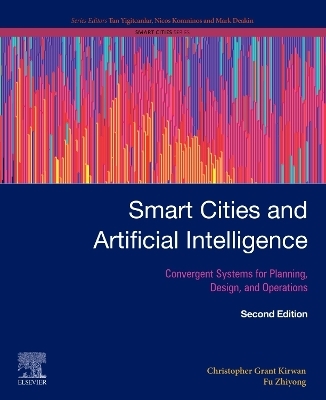
Smart Cities and Artificial Intelligence
Elsevier - Health Sciences Division (Verlag)
978-0-443-23621-1 (ISBN)
The second edition introduces a new section in each chapter framed as reflections and projections, offering insights across the ten-year window from 2020, when the first edition was published, through 2030. These additions align the book with recent developments in AI and urban technologies and include an expanded comparison of global smart cities in the City DNA section, examining how different cities evolve, adopt technology, and shape distinctive global identities and competitive positions. Additional updates include new material on Digital Twins and the Metaverse as emerging extensions of the smart city operating system, select new use cases, refreshed references, and an expanded glossary to improve clarity and accessibility. Together, these enhancements ensure that the book remains current and useful for practitioners, policymakers, researchers, and educators shaping the future of urban intelligence.
Christopher Grant Kirwan is a multidisciplinary professional and educator with more than three decades of global experience spanning urban planning, architecture, digital innovation, multimedia, and smart city development. Living and working across major international hubs—including Riyadh, London, New York, Milan, Beijing, Dubai, Seoul, and Rio de Janeiro—he has been involved in all phases of project implementation, from research and planning to design, technology integration, and implementation. He is currently CEO of AI Convergence Ltd., leading smart city and AI initiatives across public- and private-sector platforms. Concurrent with his professional work, he serves as a Visiting Professor and lecturer focusing on AI-enabled urban systems and the convergence of human, technological, and environmental intelligence. He has held academic appointments at Prince Sultan University in Riyadh, Parsons School of Design, Tsinghua University in Beijing, the University of Reading’s Henley Business School (Informatics Research Centre), the Harvard Graduate School of Design, and the Boston Architectural Center. He completed graduate studies at MIT’s Center for Advanced Visual Studies (CAVS), a pioneering program in the convergence of art, science, and technology, and holds a Bachelor of Architecture and Fine Arts from the Rhode Island School of Design (RISD). Fu Zhiyong is an Associate Professor at the Academy of Arts and Design, Tsinghua University, Beijing, China, and Co-Founder of the Global Design Futures Network. He has more than 20 years of teaching and research experience in the fields of information design, interaction design, service design, and social innovation related to human–computer interface and smart cities. Dedicated to educational program development and cross-institutional collaboration, he has established workshops, innovation labs, and special joint research projects around the world. He previously served as Associate Dean of the China-Italy Design Innovation Hub at Tsinghua University and Vice Director of the China Innovation and Entrepreneurship Education Research Center, and continues to hold leadership roles as Secretary-General for the China Information and Interaction Design Committee (IIDC) and Vice President of the International Chinese Association of Human–Computer Interaction (ICACHI).
1. Evolution of cities/technologies
2. City as living organism
3. Strategies, planning, and design
4. City Operating Systems
5. Connectivity
6. Interface
7. Smart City Scenarios
8. Smart city functions
9. Smart city business models
10. Conclusions
| Erscheinungsdatum | 02.12.2025 |
|---|---|
| Reihe/Serie | Smart Cities |
| Verlagsort | Philadelphia |
| Sprache | englisch |
| Maße | 191 x 235 mm |
| Gewicht | 450 g |
| Themenwelt | Informatik ► Theorie / Studium ► Künstliche Intelligenz / Robotik |
| Naturwissenschaften ► Geowissenschaften ► Geografie / Kartografie | |
| Technik | |
| ISBN-10 | 0-443-23621-6 / 0443236216 |
| ISBN-13 | 978-0-443-23621-1 / 9780443236211 |
| Zustand | Neuware |
| Informationen gemäß Produktsicherheitsverordnung (GPSR) | |
| Haben Sie eine Frage zum Produkt? |
aus dem Bereich