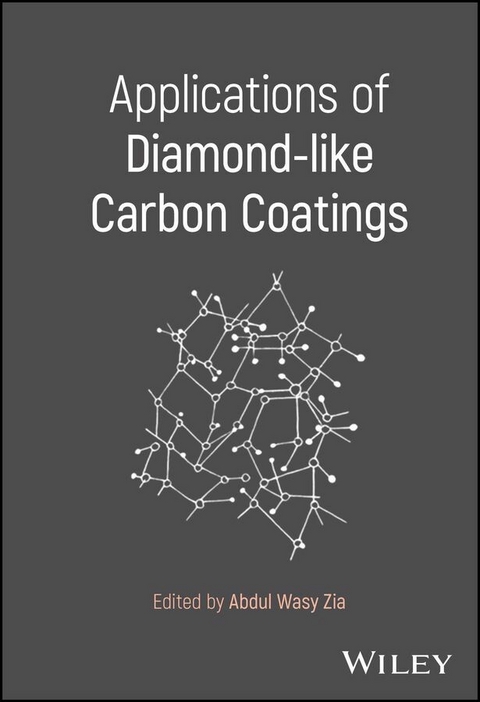
Applications of Diamond-like Carbon Coatings (eBook)
733 Seiten
Wiley (Verlag)
978-1-394-18913-7 (ISBN)
An incisive guide to diamond-like carbon (DLC) coatings and their contemporary applications
In Applications of Diamond-like Carbon Coatings, distinguished researcher Dr. Abdul Wasy Zia delivers an insightful and up-to-date discussion of the latest advancements in new and non-conventional applications of diamond-like carbon (DLC) coatings. The editor explains the transformation of typical topics into advanced applications of DLC, including tribology for future transportation solutions, green lubrication, invasive implants, MEMS, optical devices, and more.
The book also details advanced and contemporary trends in DLC coatings, like material informatics involving artificial intelligence and machine learning, and new, net-zero applications, including energy storage batteries. Readers will also find:
- A thorough introduction to applications of DLC coatings in mechanics, transportation, medicine, and electrical and optical device manufacture
- Comprehensive explorations of emerging trends in DLC coatings, including green energy, data-centric approaches, textile and plastics, and carbon circularity from DLC coated products
- Practical discussions of how small and medium industries can design and develop DLC coatings for broad engineering applications
- Complete treatments of the benefits and opportunities presented by DLC coating applications
Perfect for postgraduate students and researchers with an interest in DLC coatings, Applications of Diamond-like Carbon Coatings will also benefit scholars and instructors in academia, technical managers, scientists, engineers, and corporate research and development professionals with backgrounds in chemistry, materials science, polymer chemistry, and physical chemistry.
Abdul Wasy Zia, PhD, is an academic at the Institute of Mechanical Process and Energy Engineering, School of Engineering and Physical Sciences at Heriot-Watt University in Edinburgh, United Kingdom. He has over twelve years' experience working with diamond-like carbon coating solutions with technological, environmental, and socio-economic applications.
An incisive guide to diamond-like carbon (DLC) coatings and their contemporary applications In Applications of Diamond-like Carbon Coatings, distinguished researcher Dr. Abdul Wasy Zia delivers an insightful and up-to-date discussion of the latest advancements in new and non-conventional applications of diamond-like carbon (DLC) coatings. The editor explains the transformation of typical topics into advanced applications of DLC, including tribology for future transportation solutions, green lubrication, invasive implants, MEMS, optical devices, and more. The book also details advanced and contemporary trends in DLC coatings, like material informatics involving artificial intelligence and machine learning, and new, net-zero applications, including energy storage batteries. Readers will also find: A thorough introduction to applications of DLC coatings in mechanics, transportation, medicine, and electrical and optical device manufacture Comprehensive explorations of emerging trends in DLC coatings, including green energy, data-centric approaches, textile and plastics, and carbon circularity from DLC coated productsPractical discussions of how small and medium industries can design and develop DLC coatings for broad engineering applications Complete treatments of the benefits and opportunities presented by DLC coating applications Perfect for postgraduate students and researchers with an interest in DLC coatings, Applications of Diamond-like Carbon Coatings will also benefit scholars and instructors in academia, technical managers, scientists, engineers, and corporate research and development professionals with backgrounds in chemistry, materials science, polymer chemistry, and physical chemistry.
Chapter 1
Introduction of Diamond-like Carbon Coatings
Naveen Joshi1, Jagdish Narayan1, Roger J. Narayan1,2
1 Department of Materials Science and Engineering, Centennial Campus, North Carolina State University, Raleigh, NC, USA
2 Joint Department of Biomedical Engineering, Centennial Campus, North Carolina State University, Raleigh, NC, USA
Contents
- 1.1 Introduction
- 1.2 DLC Coatings for Mechanical and Transportation Applications
- 1.3 DLC Coatings for Medical Applications
- 1.4 DLC Coatings for Electrical and Optical Devices
- 1.5 DLC Coatings for Optical Applications
- 1.6 Emerging Applications of DLC Coatings
- 1.7 Limitations of DLC Coatings
- 1.8 Q-Carbon as a Superior Coating Material
- 1.9 Summary
1.1 Introduction
Carbon materials have attracted immense attention due to their exceptional mechanical strength and unique functionalities [1]. Among carbon materials, diamond-like carbon (DLC) has been extensively examined for its versatile structure and multifunctional capabilities [2]. The term DLC is generally utilized to define a type of carbon-based materials containing a mixture of (graphitic) sp2- and (diamond) sp3-hybridized phases. DLC can contain 0–50% hydrogen atoms depending on the deposition methods employed [3]. However, the DLC coatings can be formed without hydrogen incorporation. Narayan et al. showed the formation of hydrogen-free DLC films with high sp3 bonding and superior mechanical properties by pulsed laser deposition (PLD) [4]. The ternary phase diagram of DLC structures, as proposed by Robertson, is shown in Figure 1.1 [5]. Regions designated as a-C, ta-C, and a-C:H refer to pure carbon, tetrahedral amorphous carbon, and hydrogenated carbon with the corresponding extent of hydrogenation, respectively. Due to the variable fractions of sp2- and sp3-hybridized states, DLC structures show excellent mechanical strength, resistance to wear, resistance to corrosion, reduced friction coefficient, and unique functional properties [2, 4]. Thus, DLC materials have been a popular choice of coating materials for applications in mechanical and transportation industries, biomedical implants and devices, storage devices, and optical products. Some of the significant properties of different classes of carbon materials are summarized in Table 1.1 [6].
Figure 1.1 Ternary phase diagram that describes various parameters of DLC materials.
Source: Reproduced from [6] / with permission of ELSEVIER.
Table 1.1 Important physical characteristics of carbon materials currently in use.
Source: Reproduced from [6] / with permission of ELSEVIER.
| Mass density (g cm−3) | Hydrogen content (at. %) | Number density (1 cm−3) | Hard/soft |
|---|
| Diamond | 3.51 | 0 | 0.29 | Superhard |
| Graphite | 2.25 | 0 | 0.19 | Soft |
| ta-C | 3.2 | 1 | 0.27 | Superhard |
| a-C:H | 2.3 | 11 | 0.21 | Hard |
| Polystyrene | 1.05 | 50 | 0.16 | Soft |
Several approaches have been developed for processing DLC films, such as both chemical vapor deposition (CVD) and physical vapor deposition (PVD) techniques. Among PVD techniques, ion beam deposition, PLD, and magnetron sputtering are widely explored for the deposition of DLC films [7]. Ion beam deposition facilitates the deposition of high-quality coatings at near-room temperature. However, the deposition rate is too low; the substrates require complex manipulation methods for uniform deposition, limiting the practical application of this approach [8]. Sputtering is employed as another popular technique to deposit DLC films with variable sp2 content. Even so, the low ion energies associated with sputter deposition result in the poor mechanical strength of the coatings, making them unsuitable for high-strength applications [9]. On the other hand, PLD yields smooth DLC coatings with high sp3 content, but it has not yet been developed for the large-scale manufacturing of DLC, and it is often challenging to produce uniform coatings using this technique [10]. Among the CVD techniques, the plasma-enhanced chemical vapor deposition (PECVD) process has been commonly utilized for the growth of DLC films with high uniformity, conformal coverage, and reasonable deposition rates [11]. The PECVD also enables the growth of strain-free and adherent DLC coatings with high levels of mechanical strength and resistance to wear and corrosion [11–13]. Thus, it is highly preferred for the large-scale manufacturing of DLC coatings. A schematic showing the PECVD chamber used in the growth of DLC films is provided in Figure 1.2 [13].
Figure 1.2 Schematic showing the PECVD instrument utilized for the deposition of the DLC films [13] / John Wiley & Sons/CC BY 4.0.
DLC structures are doped with several elements and compounds to improve their functionality [14]. Metals and semiconductors such as Mo, Cu, Cr, Ag, Ti, Ni, Al, W, and Si and compounds such as ZnO and W2C have been reported to have doped to improve the performance of DLC coatings [13–17]. Among them, silicon (Si) is highly preferred as a dopant material, as it is known to reduce the internal stresses in the coating, enhance the adhesion of the coating to the underlying substrate, and improve the thermal stability of DLC structures [13, 18, 19]. Si-incorporated DLC (Si-DLC) is also shown to have a low friction coefficient, improved resistance to wear, and improved resistance to corrosion [18]. In addition, Yang et al. noted that Si-DLC coatings are biocompatible and inhibit microbial activity, expounding their applications to implantable medical devices [13]. This chapter gives an overview of several doped and undoped DLC coatings and their applications in mechanical and transportation, biomedical devices, electrical devices, and optical products. The limitations of DLC coatings are discussed briefly, and quenched carbon (Q-carbon) is introduced as an emerging, superior alternative for coating materials that are currently in use.
1.2 DLC Coatings for Mechanical and Transportation Applications
The unique combination of high hardness, reduced friction coefficient, resistance to wear, and resistance to corrosion in DLC materials have made them an unambiguous choice for protective coatings in the mechanical and transportation industry [2, 6]. Since their discovery in the 1950s, DLC coatings were first investigated for their unique scratch resistance properties [20]. In 1973, Aisenberg and Chabot reported that the cutting characteristics of paper cutting blades may be significantly improved by coating them with DLC films [21]. The wear tests revealed that the coefficient of friction is reduced on the coated blades. Since then, DLC coatings have been commonly used to enhance the performance of machines and mechanical tools. Moreover, due to their sophisticated structural properties, gears, bearings, and the inside of the automotive engines are coated with DLC to reduce wear, reduce friction, and the need for lubrication. Thus, it helps improve fuel efficiency and reduce the maintenance costs of the vehicle [22]. Some of these structural applications of DLC coatings are discussed in this section.
1.2.1 DLC Coatings for Lubricants
DLC is a popular choice of coating for mechanical and transportation applications, as it is a material that is able to provide high resistance to corrosion, low friction, and high hardness under dry sliding conditions with a coefficient friction as low as 0.01–0.5 based on the environmental conditions the DLC coating is subjected to [5, 23]. For instance, hydrogenated coatings perform better in an inert environment. In contrast, hydrogen-free DLC is preferred in humid environments where a friction coefficient as low as 0.1 can be achieved for an extended period [5, 24]. The variation of the coefficient of friction with relative humidity for hydrogenated and nonhydrogenated DLC coatings is shown in Figure 1.3 [25]. Another class of DLC coatings, which is referred to as near-frictionless carbon, is associated with the lowest possible friction coefficient of any known material (~0.005) due to the passivation of...
| Erscheint lt. Verlag | 18.3.2025 |
|---|---|
| Sprache | englisch |
| Themenwelt | Naturwissenschaften ► Chemie |
| Technik ► Maschinenbau | |
| Schlagworte | biomedical • carbon • circular economy • Diamond-like Carbon • diamond-like carbon coating applications • diamond-like carbon coating deposition • diamond-like carbon coating products • diamond-like carbon coatings in industry • diamond-like carbon coating trends • DLC coating • DLC coatings • Electronics • Energy Storage Batteries • Friction • Green Lubrication • Healthcare • implants • Interface • MEMS • NetZero • optical devices • Orthodontics • PECVD • plasma deposition • Plastics • PVD • sensors • surface coatings • Textiles • Thin Films • Tribology • Wear |
| ISBN-10 | 1-394-18913-3 / 1394189133 |
| ISBN-13 | 978-1-394-18913-7 / 9781394189137 |
| Informationen gemäß Produktsicherheitsverordnung (GPSR) | |
| Haben Sie eine Frage zum Produkt? |
 EPUB (Adobe DRM)
Kopierschutz: Adobe-DRM
Adobe-DRM ist ein Kopierschutz, der das eBook vor Mißbrauch schützen soll. Dabei wird das eBook bereits beim Download auf Ihre persönliche Adobe-ID autorisiert. Lesen können Sie das eBook dann nur auf den Geräten, welche ebenfalls auf Ihre Adobe-ID registriert sind.
Details zum Adobe-DRM
Dateiformat: EPUB (Electronic Publication)
EPUB ist ein offener Standard für eBooks und eignet sich besonders zur Darstellung von Belletristik und Sachbüchern. Der Fließtext wird dynamisch an die Display- und Schriftgröße angepasst. Auch für mobile Lesegeräte ist EPUB daher gut geeignet.
Systemvoraussetzungen:
PC/Mac: Mit einem PC oder Mac können Sie dieses eBook lesen. Sie benötigen eine
eReader: Dieses eBook kann mit (fast) allen eBook-Readern gelesen werden. Mit dem amazon-Kindle ist es aber nicht kompatibel.
Smartphone/Tablet: Egal ob Apple oder Android, dieses eBook können Sie lesen. Sie benötigen eine
Geräteliste und zusätzliche Hinweise
Buying eBooks from abroad
For tax law reasons we can sell eBooks just within Germany and Switzerland. Regrettably we cannot fulfill eBook-orders from other countries.
aus dem Bereich