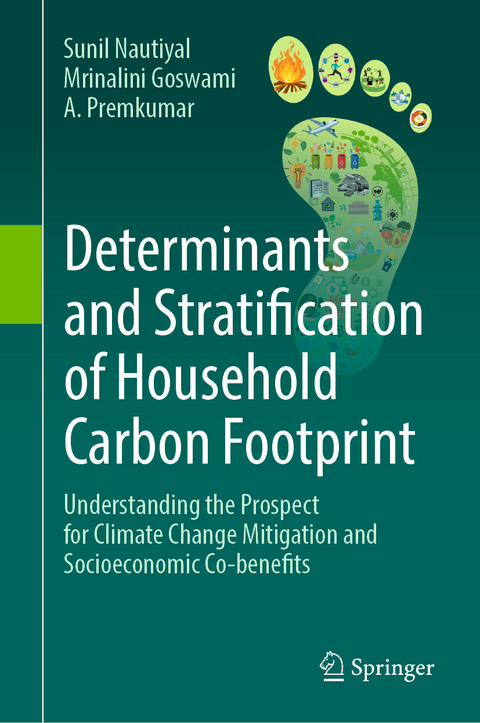
Determinants and Stratification of Household Carbon Footprint (eBook)
141 Seiten
Springer Nature Singapore (Verlag)
978-981-96-2739-4 (ISBN)
This book provides comprehensive insights into the socioeconomic systems, carbon accounting, and consumption-expenditure frameworks influencing household carbon footprints (HCF) in a developing economy. It offers a unique perspective on the link between socioeconomic classes, agro-ecological zones, and carbon emissions, specifically in the Indian context.
Household consumption patterns play a critical role in determining greenhouse gas emissions and are increasingly recognized as vital for shaping effective climate policies. Various socio-economic, demographic, and lifestyle factors—such as household size, income, food habits, mobility choices, waste management practices, home appliances, and education—significantly impact HCF. While the IPCC mitigation framework focuses extensively on direct emissions from energy and product production, this book emphasizes indirect emissions driven by lifestyle choices and end-use consumption. The book is based on a PAN-India study across 13 diverse locations within nine agro-ecological regions, examining the socioeconomic and geo-climatic determinants of household carbon emissions. It explores the income-consumption relationship, providing strategies to leverage these insights for targeted decarbonization and sustainable development. Additionally, the book addresses the behavioral aspects of carbon footprints and offers policy recommendations to promote a "carbon handprint"—advocating for carbon-friendly behaviors and solutions that are socially acceptable. By segregating emissions from production and consumption, it aims to guide the development of comprehensive emission reduction strategies for various consumables.
This volume is an essential resource for students, researchers, and policymakers interested in sustainable consumption, climate mitigation, and the socio-economic dimensions of carbon emissions in developing countries.
This book provides comprehensive insights into the socioeconomic systems, carbon accounting, and consumption-expenditure frameworks influencing household carbon footprints (HCF) in a developing economy. It offers a unique perspective on the link between socioeconomic classes, agro-ecological zones, and carbon emissions, specifically in the Indian context. Household consumption patterns play a critical role in determining greenhouse gas emissions and are increasingly recognized as vital for shaping effective climate policies. Various socio-economic, demographic, and lifestyle factors such as household size, income, food habits, mobility choices, waste management practices, home appliances, and education significantly impact HCF. While the IPCC mitigation framework focuses extensively on direct emissions from energy and product production, this book emphasizes indirect emissions driven by lifestyle choices and end-use consumption. The book is based on a PAN-India study across 13 diverse locations within nine agro-ecological regions, examining the socioeconomic and geo-climatic determinants of household carbon emissions. It explores the income-consumption relationship, providing strategies to leverage these insights for targeted decarbonization and sustainable development. Additionally, the book addresses the behavioral aspects of carbon footprints and offers policy recommendations to promote a "e;carbon handprint"e; advocating for carbon-friendly behaviors and solutions that are socially acceptable. By segregating emissions from production and consumption, it aims to guide the development of comprehensive emission reduction strategies for various consumables. This volume is an essential resource for students, researchers, and policymakers interested in sustainable consumption, climate mitigation, and the socio-economic dimensions of carbon emissions in developing countries.
| Erscheint lt. Verlag | 14.3.2025 |
|---|---|
| Zusatzinfo | XVIII, 141 p. 71 illus., 68 illus. in color. |
| Sprache | englisch |
| Themenwelt | Naturwissenschaften ► Biologie ► Ökologie / Naturschutz |
| Naturwissenschaften ► Geowissenschaften | |
| Technik ► Bauwesen | |
| Technik ► Elektrotechnik / Energietechnik | |
| Technik ► Umwelttechnik / Biotechnologie | |
| Wirtschaft ► Betriebswirtschaft / Management ► Unternehmensführung / Management | |
| Schlagworte | carbon accounting • Carbon Footprint Mitigation • climate change • developing economy • global warming • Greenhouse Gas Emission Behaviour • Household Carbon Footprint • Household consumption • Rural-Urban Divide |
| ISBN-10 | 981-96-2739-7 / 9819627397 |
| ISBN-13 | 978-981-96-2739-4 / 9789819627394 |
| Informationen gemäß Produktsicherheitsverordnung (GPSR) | |
| Haben Sie eine Frage zum Produkt? |
 PDF (Wasserzeichen)
DRM: Digitales Wasserzeichen
Dieses eBook enthält ein digitales Wasserzeichen und ist damit für Sie personalisiert. Bei einer missbräuchlichen Weitergabe des eBooks an Dritte ist eine Rückverfolgung an die Quelle möglich.
Dateiformat: PDF (Portable Document Format)
Mit einem festen Seitenlayout eignet sich die PDF besonders für Fachbücher mit Spalten, Tabellen und Abbildungen. Eine PDF kann auf fast allen Geräten angezeigt werden, ist aber für kleine Displays (Smartphone, eReader) nur eingeschränkt geeignet.
Systemvoraussetzungen:
PC/Mac: Mit einem PC oder Mac können Sie dieses eBook lesen. Sie benötigen dafür einen PDF-Viewer - z.B. den Adobe Reader oder Adobe Digital Editions.
eReader: Dieses eBook kann mit (fast) allen eBook-Readern gelesen werden. Mit dem amazon-Kindle ist es aber nicht kompatibel.
Smartphone/Tablet: Egal ob Apple oder Android, dieses eBook können Sie lesen. Sie benötigen dafür einen PDF-Viewer - z.B. die kostenlose Adobe Digital Editions-App.
Buying eBooks from abroad
For tax law reasons we can sell eBooks just within Germany and Switzerland. Regrettably we cannot fulfill eBook-orders from other countries.
aus dem Bereich