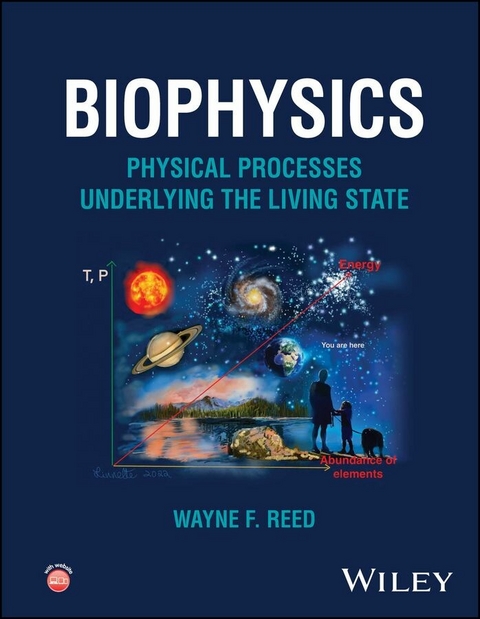
Biophysics (eBook)
1414 Seiten
Wiley (Verlag)
978-1-119-69642-1 (ISBN)
An introduction to the physics of living organisms
The field of biophysics employs the principles of physics to study biological systems, and introduces the concept of the living state. It is a multidisciplinary approach to the study of the living state combining physics, biochemistry, molecular and cell biology, medicine and engineering. The physics of macromolecules and macromolecular assemblies is a particularly important aspect of this broader field.
Biophysics: Physical Processes Underlying the living state offers an introduction to the general principles of the living state and their biological applications. Beginning with an historical overview of fundamental scientific theories and fields, the book then provides a brief introduction to cell biology and biochemistry, and then an overview of basic thermodynamics, kinetics, information theory, electrostatics in solution, fluid mechanics and macromolecular physics, and their relationship to the living state. After a presentation of physical methods, with an emphasis on light scattering, different biological macromolecules, selected aspects of their functions, and their physical properties and interactions are surveyed. A brief introduction to vision, biomotion, and theoretical biology is also provided. Exploration of some frontier issues in prebiotic origins of life, consciousness, and astrobiology round out the book. The result is a multifaceted window into the broad and evolving field of biophysics.
Biophysics readers will also find:
- Problems at the conclusion of each chapter to reinforce and focus student knowledge
- A gathering of topics in basic physics and physical chemistry which are seldom found in a single source
This textbook is suitable for physics and engineering students studying biophysics, macromolecular science, and biophysical chemistry, as well as for polymer scientists, chemists, biochemists, cell and molecular biologists, bioengineers, and others.
Wayne F. Reed is professor of physics with an interdisciplinary appointment in chemical and biomolecular engineering at Tulane University, New Orleans, USA. He has published extensively in the area of polymer reactions, biomacromolecules, new macromolecular characterization instrumentation, and related subjects, and has a long history of fruitful industrial collaboration.
An introduction to the physics of living organisms The field of biophysics employs the principles of physics to study biological systems, and introduces the concept of the living state. It is a multidisciplinary approach to the study of the living state combining physics, biochemistry, molecular and cell biology, medicine and engineering. The physics of macromolecules and macromolecular assemblies is a particularly important aspect of this broader field. Biophysics: Physical Processes Underlying the living state offers an introduction to the general principles of the living state and their biological applications. Beginning with an historical overview of fundamental scientific theories and fields, the book then provides a brief introduction to cell biology and biochemistry, and then an overview of basic thermodynamics, kinetics, information theory, electrostatics in solution, fluid mechanics and macromolecular physics, and their relationship to the living state. After a presentation of physical methods, with an emphasis on light scattering, different biological macromolecules, selected aspects of their functions, and their physical properties and interactions are surveyed. A brief introduction to vision, biomotion, and theoretical biology is also provided. Exploration of some frontier issues in prebiotic origins of life, consciousness, and astrobiology round out the book. The result is a multifaceted window into the broad and evolving field of biophysics. Biophysics readers will also find: Problems at the conclusion of each chapter to reinforce and focus student knowledgeA gathering of topics in basic physics and physical chemistry which are seldom found in a single source This textbook is suitable for physics and engineering students studying biophysics, macromolecular science, and biophysical chemistry, as well as for polymer scientists, chemists, biochemists, cell and molecular biologists, bioengineers, and others.
Preface
Biophysics is not a canonical or settled field, unlike traditional areas of physics, such as electromagnetic theory, thermodynamics, and classical and quantum mechanics, for which a unified body of knowledge exists and is treated in approximately the same form for each subject in many different texts. All would agree that biophysics involves both physics and biology, but then perspectives, fields, and texts quickly diverge after that.
It is appealing to attempt to establish the “living state” of matter as a subspace of the vast phase diagram for multicomponent systems, which can be unified by fundamental principles: living state physics. While the living state obeys all known physical laws, there is no universal agreement about whether the currently known laws are adequate for the description of the emergence and properties of the living state, or whether there are other operative principles yet to be discovered.
Beyond the search for fundamentals, biophysics has come to encompass an enormous space of research activity at all length scales, including exoplanets, local ecosystems, macroscopic biomechanics, neuroimaging of the brain, approaches to organ function, electrophysiology, information and systems integration, cellular and membrane level functions, and structure and dynamics of biomacromolecules. Some also consider biophysics to be the transfer to life sciences of existing physical theories, such as thermodynamics, statistical mechanics, fluid mechanics, and polymer physics, and methods, such as nuclear magnetic resonance, superconducting quantum interference devices (SQUIDs), scattering techniques, and a host of optical spectroscopies, to solve biologically and medically related problems. Yet another dimension deals with the interaction of ionizing radiation with living tissue, that is, radiation biophysics. With rapid advances in neuroscience, attempts at establishing the biophysics of consciousness are underway, intense, and controversial. While quantum phenomena underlie all atomic and molecular processes, the area of quantum biology is relatively untrammeled but is quickly pushing into areas of vision, photosynthesis, enzymatic action, theories of mutation, and others.
The preface to many biophysics texts often mentions “this book grew out of lecture notes prepared while I was teaching a course in biophysics at the University.” Many biophysics instructors cannot find the constellation of topics they want to present in any single text and so weave together their own narrative. It is fascinating to peruse the wide range of available biophysics texts and see how they range from dispassionate presentations of “established fact,” to highly intuitive, integrated approaches for student discovery of principles, to mathematically dense forays into very complex, specific biological systems or functions. There is virtually no unity among biophysics texts, unlike, say, texts on classical mechanics or electromagnetism.
This work tries to capture the broad outlines of the well-understood processes and principles in the living state, while taking a more detailed look into the area of macromolecular science. No single text can adequately embrace the vast scope of knowledge in all the dimensions of the living state and macromolecular science. Virtually every topic in this book roots back to scientific developments that took centuries to establish, and for which there are entire books and even dedicated journals. Most areas are still under active investigation. As a colleague once said, “if you woke up early and studied all day long, by the end of the day the amount of new knowledge produced in the world on that day will have dwarfed what you learned.”
Regarding macromolecular science, while it is also highly interdisciplinary, the situation is more focused than for biophysics. The historical foundations of polymer research are well documented, and a certain logical flow in terms of chemical structure, reactions, and resulting properties can be established. There are well-regarded foundational texts, such as “Principles of Polymer Chemistry” by Paul Flory and “Physical Chemistry of Macromolecules” by Charles Tanford which lay out large parts of the field and continue to be relevant. Further work by researchers such as John Kirkwood, Peter Debye, Bruno Zimm, Walter Stockmayer, Hiromi Yamakawa, and Pierre-Gilles de Gennes, among many others, built the foundation for much of modern polymer physics. Hence, many of the introductory polymer science texts will follow a similar pattern while emphasizing different aspects – chemistry, physics, engineering, applications, liquid state, solid state, rheology, materials properties – according to the author’s interests.
The organization of this book is as follows:
Part I. Scientific Overview, Biological and Biochemical Surveys
Chapter 1 starts with the evolution of scientific thought and considers theories that have been successful and others that have fallen on the trash heap of discarded ideas. A fair amount of historical background is provided to give an idea of the millennia of thought and myriad of investigators behind fields, such as atomic science, evolution, and biophysics itself. There is a brief survey of the ongoing attempts to define fundamentals in biophysics, including the notion of the living state as a far from equilibrium dissipative system, in which the phenomena of self-organization, auto-catalysis, cooperativity, and information storage and processing figure largely.
Chapters 2 and 3 provide very brief overviews of biology and biochemistry, respectively, and present some of the underlying basics behind biophysics, including a condensed summary of metabolism. These chapters are intended for the physical science majors who may have had little or no exposure to these life science fields.
Part II. Physical Processes underlying the Living State
Since the living state involves chemically driven thermodynamic structures and involves the creation of order and information, principles of thermodynamics are introduced first in Chapter 4. Elementary situations are worked through to get a feel for heat flow, entropy, free energy, and chemical potential. These lead naturally to entropy-based forces, chemical kinetics, and basic nonequilibrium thermodynamics. While probability distributions and averaging recur throughout the book, no attempt is made to use statistical thermodynamics beyond the introduction of some of the most important ideas, such as the partition function and statistical interpretation of entropy. A very lean background on information theory is given, used subsequently for a simple analysis of the genetic code.
Because the living state occurs largely in aqueous phase and involves electrically charged biological molecules, attention next turns to electrostatics in solution in Chapter 5, which begins by assessing the different types of electrostatic interactions in the liquid state, including how electric potentials and ions arrange themselves around charged objects. Introductory notions of ionic equilibria across membranes are also introduced. This is followed in Chapter 6 by fluid mechanics and transport properties in solution, manifestations of which abound from the intracellular level to the largest creatures. Throughout Part II, wherever possible, the physical principles are illustrated with examples from the living state.
Part III. Macromolecular Science
The many functions of the living state are enabled by macromolecules, so considerable attention is devoted to this field. Chapter 7 provides a brief overview of important organic functional groups, along with an overview of general polymer types and properties, the polymer manufacturing industry, and details on polymerization kinetics, and macromolecular characterization methods.
There is a fascinating elision of macromolecular science and molecular biology occurring throughout the twentieth century and continuing into the current one. Accordingly, the common ground between biological and synthetic macromolecules is laid out in Chapter 8, which treats the physics of macromolecules, with an emphasis on conformations, polymer chain statistics, interactions, molar mass distributions, transport properties, and electrically charged macromolecules. To accompany the focus on macromolecules, Chapter 9 is devoted to light scattering and other scattering and optical methods for their characterization. The portion on light scattering reflects one of the author’s abiding interests, and is elaborated in detail, and subsequently used to explore a variety of processes in some of the succeeding chapters.
While the complexity and capabilities of biomacromolecules vastly surpass those of any simple, human-created polymers, the latter have still taught us many things about the mechanisms by which they are produced. A profound difference exists between the behavior of synthetic polymers acting on their own or in combination with other components in a blend or nanostructure, and the complex processes which organize, fold, stretch, edit, chemically modify, activate, and deactivate biomacromolecules performing astoundingly specialized functions.
Part IV. Examples of Specific Living State Phenomena
While Part III explored the common ground between bio- and synthetic macromolecules, biomacromolecules got a head start on Earth approximately 4 billion years ahead of the latter, and have evolved a complexity of structure and function far beyond synthetic...
| Erscheint lt. Verlag | 27.2.2025 |
|---|---|
| Sprache | englisch |
| Themenwelt | Naturwissenschaften ► Physik / Astronomie |
| Technik ► Maschinenbau | |
| Schlagworte | biochemistry • biomacromolecules • Biophysics • history of molecular and evolutionary thought • living state physics • membrane and cellular level functions • Physics • Polymers • Supramolecular assemblies |
| ISBN-10 | 1-119-69642-9 / 1119696429 |
| ISBN-13 | 978-1-119-69642-1 / 9781119696421 |
| Informationen gemäß Produktsicherheitsverordnung (GPSR) | |
| Haben Sie eine Frage zum Produkt? |
 EPUB (Adobe DRM)
Kopierschutz: Adobe-DRM
Adobe-DRM ist ein Kopierschutz, der das eBook vor Mißbrauch schützen soll. Dabei wird das eBook bereits beim Download auf Ihre persönliche Adobe-ID autorisiert. Lesen können Sie das eBook dann nur auf den Geräten, welche ebenfalls auf Ihre Adobe-ID registriert sind.
Details zum Adobe-DRM
Dateiformat: EPUB (Electronic Publication)
EPUB ist ein offener Standard für eBooks und eignet sich besonders zur Darstellung von Belletristik und Sachbüchern. Der Fließtext wird dynamisch an die Display- und Schriftgröße angepasst. Auch für mobile Lesegeräte ist EPUB daher gut geeignet.
Systemvoraussetzungen:
PC/Mac: Mit einem PC oder Mac können Sie dieses eBook lesen. Sie benötigen eine
eReader: Dieses eBook kann mit (fast) allen eBook-Readern gelesen werden. Mit dem amazon-Kindle ist es aber nicht kompatibel.
Smartphone/Tablet: Egal ob Apple oder Android, dieses eBook können Sie lesen. Sie benötigen eine
Geräteliste und zusätzliche Hinweise
Buying eBooks from abroad
For tax law reasons we can sell eBooks just within Germany and Switzerland. Regrettably we cannot fulfill eBook-orders from other countries.
aus dem Bereich