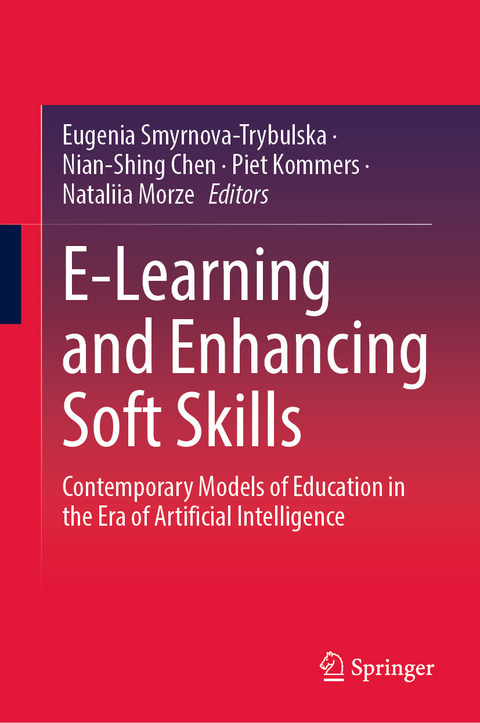
E-Learning and Enhancing Soft Skills (eBook)
358 Seiten
Springer Nature Switzerland (Verlag)
978-3-031-82243-8 (ISBN)
This volume E-Learning and Enhancing Soft Skills is a collection of articles by participants of the 16th annual scientific international conference “Theoretical and Practical Aspects of Distance Learning: E-Learning and Enhancing of Soft Skills. This conference, held on the 14th and 15th October 2024 in hybrid mode, is organized by the Faculty of Arts and Educational Sciences in Cieszyn, the Faculty of Social Sciences, the Institute of Pedagogy, the Faculty of Science and Technology, the Institute of Computer Science, University of Silesia in Katowice, Poland. Co-organizers and partners included: University of Ostrava (UO), Czech Republic, Silesian University in Opava (SU), Czech Republic, Constantine the Philosopher University in Nitra (UKF) Slovakia, University of Extremadura (UEx), Spain, University of Twente (UT), The Netherlands, Lisbon Lucíada University (LU), Portugal, Curtin University in Perth (CU), Australia, Borys Grinchenko Kyiv University (BGKU), Ukraine, Dniprovsk State Technical University (DSTU), Ukraine, IADIS - International Association for Development, of the Information Society, a non-profit association, Polish Pedagogical Society, Branch in Cieszyn, Polish Scientific Society for Internet Education, Association of Academic E-learning, Poland.
Experts on e-learning from different countries provide insights into their studies, present their recent research results and discuss their further scientific work. The authors include experts, well-known scholars, young researchers, highly trained academic lecturers with long experience in the field of e-learning, AI and robotics in education, MOOCs, teacher training an area digutak and soft skills, m-learning, smart technologies, VR/AR; PhD students, distance course developers, authors of multimedia teaching materials, designers of websites and digital educational resources. This monograph therefore describes the theoretical, methodological and practical issues in the field of e-learning and the developing of key competencies and soft skills, contemporary models of education in the era of artificial intelligence, proposing solutions to important problems and showing the road to further research in this field.
Built from the findings of an international retinue of scholars, this work will be of particular interest to academic researchers, educators, courseware designers, corporate trainers, and educational technology practitioners.
Contents 5
Chapter 1: Third Decade in the Twenty-First Century Skills and A.I. in Education 8
1.1 Precursors to Collaborative and Communicative Functioning for A.I. in Education 8
1.2 Preamble to this Book´s Main Messages 10
1.3 Meta Reflections 16
1.4 Conclusions 18
References 18
Chapter 2: Harnessing Large Language Models for Education: A Framework for Designing Effective Pedagogical AI Agents 20
2.1 Introduction 21
2.1.1 Five Approaches to Use LLMs 21
2.1.2 Myths About Using LLM-Based AI Chatbots 22
2.1.3 Prompt Engineering Is Not for Everyone 22
2.1.4 Overview of the Paper Structure 22
2.2 Designing and Enhancing AI Agents: Structures and Collaborative Strategies 23
2.2.1 Essential Concepts About AI Agents 23
2.2.2 Basic Structure for Designing AI Agents 24
2.2.3 Approaches for Making Your AI Agents Work Smarter 24
2.2.4 An Example of Two Cooperative Agents Are Better than One 25
2.3 Addressing Educational Challenges in the Era of AI: Designing Effective Pedagogical AI Agents 27
2.3.1 Existing Problems in the Era of LLMs and AI Chatbots: Teacher´s Perspectives 27
2.3.2 Existing Problems in the Era of LLMs and AI Chatbots: Students´ Perspectives 28
2.3.3 Key Concepts for Designing Pedagogical AI Agents 28
2.3.4 Requirements Analysis for a Pedagogical AI Agent 29
2.3.5 Functions Needed in a Pedagogical AI Agent 30
2.3.6 Structure Template for Designing a Pedagogical AI Agent 31
2.3.6.1 Objective and Role 31
2.3.6.2 Context and Contents 31
2.3.6.3 Rules 31
2.3.6.4 Workflow and Tasks 32
2.3.7 Essential Components Included in the Workflow and Tasks 32
2.3.7.1 Part 1: Introduction of Concepts 32
2.3.7.2 Part 2: Active Engagement and Practice with Examples 33
2.3.7.3 Part 3: Assessment of Understanding through Evaluation 33
2.3.7.4 Part 4: Guided Practice and Real-Time Feedback with AI as a Proxy for a Human Teacher 33
2.3.7.5 Part 5: Student-Driven Real-Life Applications of Learning 34
2.3.7.6 Part 6: Summary and Suggestions for Further Learning 34
2.4 Implementing a Pedagogical AI Agent 35
2.4.1 A Pedagogical AI Agent for Teaching Sequential Order Words 35
2.4.1.1 Agent Title: A Pedagogical AI Agent for Learning Order Words 36
2.4.2 Discussion 39
2.5 Conclusion 41
References 41
Chapter 3: The Concept of Teaching Secondary Students Programming Using Artificial Intelligence 43
3.1 Introduction 44
3.2 Literature Review 45
3.3 Research Design 47
3.4 The Results of the Study 49
3.5 Discussion 61
3.6 Conclusions 63
References 64
Chapter 4: Comparison of Methods for Identifying Rapid Guessing Behavior in Microlearning Courses 66
4.1 Introduction 66
4.2 Rapid Guessing Behavior 68
4.2.1 Rapid Guessing Behavior Identification 70
4.3 Research Design 72
4.3.1 Data Origin 73
4.3.2 Analyze 73
4.4 Discussion and Conclusion 76
4.4.1 Implementation of RGB Identification 78
4.4.2 Future Research 80
References 81
Chapter 5: Development of Youth Information Hygiene Skills: The Gap Between the Self-Assessment and Real State 85
5.1 Introduction 86
5.2 Research Design 87
5.2.1 Participants 87
5.2.2 Methods 87
5.3 The Results of the Study 92
5.3.1 Information Hygiene Skills 92
5.3.2 Self-Assessment 95
5.3.3 Methods of Measuring Self-Assessment of Information Hygiene Skills 96
5.3.4 Comparison of the Results of the Self-Assessment 1 Survey and Testing 97
5.3.5 Statistical Analysis of Surveys (Self-Assessment-1 and Self-Assessment-2) 99
5.4 Discussion 100
5.5 Conclusions 103
References 104
Chapter 6: The Use of Educational Applications in Primary and Lower Secondary School Teaching and Their Impact on the Developm... 109
6.1 Introduction 110
6.2 Learning Applications 111
6.3 Key Competences and Soft Skills 111
6.4 Methods 114
6.5 Results 115
6.5.1 Educational Applications and Their Categorization 118
6.6 Conclusions 120
References 121
Chapter 7: Programming in Technically Focused Education 123
7.1 Introduction 123
7.2 Programming Teaching 124
7.3 Programming Teaching at the Technical Faculty of the University of Defence in Brno 125
7.4 Programming Testing 128
7.5 Conclusion 133
References 134
Chapter 8: Examining M-Learning Trends Among University Students-Mobile Devices in Students´ Study and Life 135
8.1 Introduction 136
8.2 Literature Review 137
8.3 Research Design 141
8.4 The Results of the Study 142
8.4.1 Questionnaire 142
8.4.2 Frequency of the Use of Mobile Devices (Smartphones, Tablets, Notebooks) 142
8.4.3 Purposes for the Use of Mobile Devices 144
8.4.4 How the Pandemic Has Affected the Frequency of Use and which Mobile Devices 146
8.4.5 Features of Teaching M-Learning Are Most Important to Students 147
8.4.6 Negative Features of Teaching M-Learning Students Perceive 149
8.5 Discussion 151
8.5.1 Discussion of the Results 151
8.5.2 Frequency of Using Mobile Devices 151
8.5.3 Goals of Using Mobile Devices 153
8.5.4 Impact of the Pandemic on the Use of Mobile Devices 153
8.5.5 Positive and Negative Features of M-Learning 154
8.6 Conclusions 155
References 155
Chapter 9: E-learning in Developing Interaction with the Environment as Soft Skills in 6-Year-Old Children (on the Example of ... 160
9.1 Introduction 161
9.2 Research Design 162
9.2.1 The Essence of Using e-Learning in the Organization of the Educational Process with Preschool Children 162
9.2.2 Specifics of Developing Interactions with the Environment in Six-Year-Old Children as Soft Skills 163
9.2.3 Sample of Research 163
9.2.4 Research Questions 164
9.2.5 Hypothesis 164
9.2.6 Instrument and Procedures 165
9.2.7 Data Analysis 165
9.3 Results of Research 166
9.4 Discussion 176
9.5 Conclusions 176
Appendix 1 177
Survey for Preschool Teachers 177
References 178
Chapter 10: The Use of Artificial Intelligence in the Professional Activity of University Teachers in Ukraine 180
10.1 Introduction 180
10.2 Tools of AI in the Professional Activities of the Teacher 181
10.2.1 Analysis of Scientific Research 182
10.2.2 Routine Tasks of a University Teacher 183
10.3 The Results of the Study 186
10.3.1 Analysis of the Results of the Questionnaire of Ukrainian University Teachers 186
10.4 Conclusions 192
References 193
Chapter 11: New Approach to Learning Cyber-Security in Secondary School 195
11.1 Introduction 195
11.2 Introduction to the Problem 197
11.3 Workshop Methodology 198
11.4 Results 203
11.5 Summary 208
References 208
Chapter 12: Solution Time and Confidence in the Assessment of Algorithmic and Logical Thinking of First-Year Computer Science ... 210
12.1 Introduction 211
12.2 Methods 212
12.3 Results and Discussion 216
12.4 Conclusions 227
References 228
Chapter 13: An Approach to Automatic Test Generation from Ontologies in the Virtual Education Platform 230
13.1 Introduction 230
13.2 Motivation and Related Works 231
13.2.1 Semantic Modelling and Ontologies in Education 231
13.2.2 Virtual Education Space (VES) 233
13.3 An Approach to Automatic Generation of Test Questions from the Bulgarian Literature and History Ontology 235
13.3.1 An Approach to the Development of a Bulgarian Literature and History Ontology (BuLHO) 235
13.3.2 An Approach to the Automatic Generation of Test Questions from the Bulgarian Literature and History Ontology 237
13.3.3 Modelling of the Test Generation Process 240
13.3.4 Future Work Discussions 242
13.4 Conclusion 244
References 245
Chapter 14: CAN Bus Workplace with Remote Access Using LabVIEW Web Service 247
14.1 Introduction 247
14.2 Choosing LabVIEW for the Application 248
14.3 System Design 249
14.4 Target Module Structure 252
14.5 CAN Bus Workplace 253
14.6 Design of Target Module 254
14.7 Discussion 255
14.8 Conclusion 257
References 258
Chapter 15: Virtual Laboratory as a Tool to Empower IT Students 259
15.1 Introduction 260
15.2 Research Background 261
15.3 Virtual Laboratories as Part of Academic e-Learning 262
15.3.1 Virtual Laboratories for IT Learning 263
15.4 Virtual Laboratory for Algorithms and Data Structures Course: Aspects of Implementation 265
15.4.1 Requirements Analysis 265
15.4.2 Pedagogical Background of the Virtual Laboratory Implementation 266
15.4.3 Data Domain´s Actors and Use Cases 268
15.4.4 Data Storage 269
15.4.5 User Interface and Navigation 272
15.4.6 Features of Software Implementation 274
15.5 Conclusion 275
References 276
Chapter 16: Examination of Teachers´ Competencies for Online Teaching 278
16.1 Introduction 278
16.2 Research Design 281
16.3 The Results of the Study 281
16.3.1 Findings Related to Value of Online Education 281
16.3.2 Findings Related to the Perception Towards Providing Online Education 283
16.3.3 Findings Related to Being Competent on Online Education 284
16.3.4 Findings Related to the Advantages and Disadvantages of Online Education 286
16.4 Conclusions 288
References 290
Chapter 17: Digitalization of Social Services for Vulnerable Groups in Territorial Communities of Ukraine 292
17.1 Introduction 293
17.2 Literature Review 294
17.3 Analysis of the Selection Process for Participation in the Competition for Implementing Digitalization Projects in Ukrain... 295
17.4 Digitalization Programs for Social Services Implemented in Ukrainian Communities 298
17.5 Conclusion 303
References 304
Chapter 18: Tools for Teaching the R Programming Language to Bachelors of Computer Science in the Period of Distance Learning 307
18.1 Introduction 308
18.2 Literature Review 308
18.3 Research Methodology 310
18.4 Results 310
18.5 Discussion 326
18.6 Conclusions 327
References 327
Chapter 19: Developing Digital and Pedagogical Competences in Postgraduate Management Students 329
19.1 Introduction 329
19.2 Context of Research into the Postgraduate Students´ Teaching Practice 331
19.3 Learners´ Assessment of University Training 332
19.3.1 Postgraduate Students´ Assessment of University Training 332
19.3.2 Master Students´ Assessment of University Training 335
19.4 General Regulations Behind Postgraduate Management Students´ Teaching Practice 338
19.5 Some Practical Results About Developing Postgraduate Students´ Competences During Teaching Practice 341
19.6 Discussion 343
19.7 Conclusion 345
References 346
Correction to: Examining M-Learning Trends Among University Students-Mobile Devices in Students´ Study and Life 349
Correction to: Chapter 8 in: E. Smyrnova-Trybulska et al. (eds.), E-Learning and Enhancing Soft Skills, https://doi.org/10.100... 349
Appendix A: A Student´s Learning Log of Order Words with the Pedagogical AI Agent 350
Part 1: Explanation of the Concept of Order Words 350
Part 2: Providing Examples About Using Order Words 351
Part 3: Assessing Student´s Understanding About the Concept of Order Words 352
Part 3: Assessing Student´s Understanding About the Concept of Order Words (Continued) 353
Part 4: Practice by Giving Some Concrete Story Writing or Planning Tasks and Provide Evaluation and Real-Time Feedback 353
Part 5: Apply with Learners´ Own Chosen Topics and Provide Evaluation and Real-Time Feedback 355
Step 8: Self-Directed Learning 355
Part 6: Report Student´s Overall Performance and Suggest for Further Study 357
| Erscheint lt. Verlag | 10.3.2025 |
|---|---|
| Zusatzinfo | VII, 358 p. 127 illus., 106 illus. in color. |
| Sprache | englisch |
| Themenwelt | Sozialwissenschaften ► Pädagogik ► Schulpädagogik / Grundschule |
| Technik | |
| Schlagworte | Digital competences • Distance Learning • E-Learning • Information and Communication Technologies • innovative methods and tools in education • M-Learning • Moocs • Soft Skills • STEAM education |
| ISBN-10 | 3-031-82243-9 / 3031822439 |
| ISBN-13 | 978-3-031-82243-8 / 9783031822438 |
| Informationen gemäß Produktsicherheitsverordnung (GPSR) | |
| Haben Sie eine Frage zum Produkt? |
 PDF (Wasserzeichen)
DRM: Digitales Wasserzeichen
Dieses eBook enthält ein digitales Wasserzeichen und ist damit für Sie personalisiert. Bei einer missbräuchlichen Weitergabe des eBooks an Dritte ist eine Rückverfolgung an die Quelle möglich.
Dateiformat: PDF (Portable Document Format)
Mit einem festen Seitenlayout eignet sich die PDF besonders für Fachbücher mit Spalten, Tabellen und Abbildungen. Eine PDF kann auf fast allen Geräten angezeigt werden, ist aber für kleine Displays (Smartphone, eReader) nur eingeschränkt geeignet.
Systemvoraussetzungen:
PC/Mac: Mit einem PC oder Mac können Sie dieses eBook lesen. Sie benötigen dafür einen PDF-Viewer - z.B. den Adobe Reader oder Adobe Digital Editions.
eReader: Dieses eBook kann mit (fast) allen eBook-Readern gelesen werden. Mit dem amazon-Kindle ist es aber nicht kompatibel.
Smartphone/Tablet: Egal ob Apple oder Android, dieses eBook können Sie lesen. Sie benötigen dafür einen PDF-Viewer - z.B. die kostenlose Adobe Digital Editions-App.
Buying eBooks from abroad
For tax law reasons we can sell eBooks just within Germany and Switzerland. Regrettably we cannot fulfill eBook-orders from other countries.
aus dem Bereich