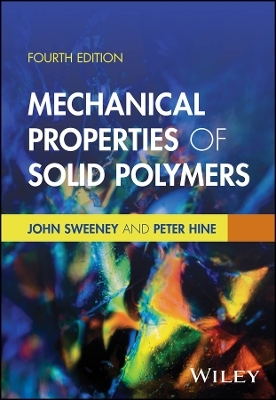
Mechanical Properties of Solid Polymers
John Wiley & Sons Inc (Verlag)
978-1-394-20206-5 (ISBN)
In the newly revised fourth edition of Mechanical Properties of Solid Polymers, a team of distinguished researchers delivers an up-to-date discussion of all aspects of the mechanical behavior of solid polymers. The book explores finite elastic behavior, linear viscoelasticity, mechanical relaxations, mechanical anisotropy, non-linear viscoelasticity, yield behavior, and fracture.
The authors emphasize biopolymers – as opposed to petrochemical-based polymers – and incorporate a great deal of computational, numerical, and simulation content. They offer extensive discussions of the effects of recycling, as well as nanocomposites – including carbon nanotubes, graphene, and other materials.
Readers will also find:
An updated comprehensive account of the properties of solid polymers
Discussions of the behaviors of polymers through the mathematical techniques of solid mechanics
Accounts of the influence of morphology on mechanics
Examples of the application of numerical methods
Perfect for academics, researchers and industrial scientists, Mechanical Properties of Solid Polymers will also benefit students of materials science, physics, and chemistry students.
John Sweeney, PhD, holds a Personal Chair in Polymer Mechanics at the University of Bradford. He is an expert in solid polymer behavior, including viscoelasticity, fracture mechanics, shear banding, large deformations, and nanocomposites. Peter Hine, PhD, is Associate Professor in the School of Physics and Astronomy at the University of Leeds, UK. His research is focused on understanding how the structure of polymers and polymer composites affect their mechanical properties.
Preface xiii
1 Structure of Polymers 1
1.1 Chemical Composition 1
1.2 Physical Structure 9
References 17
Further Reading 18
2 The Mechanical Properties of Polymers: General Considerations 19
2.1 Objectives 19
2.2 The Different Types of Mechanical Behaviour 19
2.3 The Elastic Solid and the Behaviour of Polymers 21
2.4 Stress and Strain 22
2.5 The Generalized Hooke’s Law 26
References 29
3 Finite Strain Elasticity 31
3.1 The Generalized Definition of Strain 31
3.2 The Stress Tensor 43
3.3 The Stress–Strain Relationships 44
3.4 The Use of a Strain-Energy Function 48
References 62
Further Reading 63
4 Rubber-Like Elasticity 65
4.1 General Features of Rubber-Like Behaviour 65
4.2 The Thermodynamics of Deformation 66
4.3 The Statistical Theory 69
4.4 Modifications of Simple Molecular Theory 76
4.5 The Internal Energy Contribution to Rubber Elasticity 85
4.6 Applications Using Finite Element Modelling 87
4.7 Conclusions 88
References 88
Further Reading 91
5 Linear Viscoelastic Behaviour 93
5.1 Viscoelasticity as a Phenomenon 93
5.2 Mathematical Representation of Linear Viscoelasticity 98
5.3 Dynamical Mechanical Measurements: The Complex Modulus and Complex Compliance 109
5.4 The Relationships Between the Complex Moduli and the Stress Relaxation Modulus 114
5.5 The Relaxation Strength 120
References 122
Further Reading 122
6 The Measurement of Viscoelastic Behaviour 125
6.1 Creep and Stress Relaxation 125
6.2 Dynamic Mechanical Thermal Analysis (DMTA) 128
6.3 Wave-Propagation Methods 128
References 132
7 Experimental Studies of Linear Viscoelastic Behaviour as a Function of Frequency and Temperature: Time–Temperature Equivalence 135
7.1 General Introduction 135
7.2 Time–Temperature Equivalence and Superposition 141
7.3 Transition-State Theories 143
7.4 The Time–Temperature Equivalence of the Glass Transition Viscoelastic Behaviour in Amorphous Polymers and the Williams, Landel and Ferry (WLF) Equation 147
7.5 Normal-Mode Theories Based on Motion of Isolated Flexible Chains 156
7.6 The Dynamics of Highly Entangled Polymers 160
References 163
8 Anisotropic Mechanical Behaviour 167
8.1 The Description of Anisotropic Mechanical Behaviour 167
8.2 Mechanical Anisotropy in Polymers 168
8.3 Measurement of Elastic Constants 171
8.4 Development of Mechanical Anisotropy in Oriented Polymers 181
8.5 Interpretation of Mechanical Anisotropy: General Considerations 188
8.6 Experimental Studies of Anisotropic Mechanical Behaviour and Their Interpretation 193
8.7 The Aggregate Model for Chain-Extended Polyethylene and Liquid Crystalline Polymers 208
8.8 Auxetic Materials: Negative Poisson’s Ratio 212
References 215
9 Morphology and Structural Effects 223
9.1 Evolution of Structures Under Tension: Cavitation 223
9.2 Effects of Stress Field 225
9.3 One-Dimensional Modelling 229
9.4 Three-Dimensional Models 235
References 241
10 Relaxation Transitions: Experimental Behaviour and Molecular Interpretation 245
10.1 Amorphous Polymers: An Introduction 245
10.2 Factors Affecting the Glass Transition in Amorphous and Low Crystallinity Polymers 247
10.3 Relaxation Transitions in Crystalline Polymers 252
10.4 Conclusions 265
References 265
11 Non-linear Viscoelastic Behaviour 269
11.1 The Engineering Approach 270
11.2 The Rheological Approach 273
References 294
Further Reading 297
12 Yielding and Instability in Polymers 299
12.1 Discussion of the Load–Elongation Curves in Tensile Testing 300
12.2 Ideal Plastic Behaviour 307
12.3 Historical Development of Understanding of the Yield Process 317
12.4 Experimental Evidence for Yield Criteria in Polymers 320
12.5 The Molecular Interpretations of Yield 325
12.6 Yield Considered to Relate to the Movement of Dislocations or Disclinations 338
12.7 The Billon Model 346
12.8 Multi-axial Deformation: Three-Dimensional Plasticity 347
12.9 Cold-Drawing, Strain Hardening and the True Stress–Strain Curve 350
12.10 Shear Bands 358
12.11 Physical Considerations Behind Viscoplastic Modelling 360
References 363
Further Reading 371
13 Fracture 373
13.1 Definition of Tough and Brittle Behaviour in Polymers 373
13.2 Principles of Brittle Fracture of Polymers 374
13.3 Finite Geometries 379
13.4 Elastic Anisotropy 381
13.5 Controlled Fracture in Brittle Polymers 382
13.6 Crazing in Glassy Polymers 384
13.7 Controlled Fracture in Tough Polymers 393
13.8 Factors Influencing Brittle–Ductile Behaviour: Brittle–Ductile Transitions 403
13.9 The Impact Strength of Polymers 410
13.10 The Tensile Strength and Tearing of Polymers in the Rubbery State 417
13.11 Time and Temperature Effects 420
13.12 Fatigue in Polymers 424
References 429
Further Reading 438
Index 439
| Erscheinungsdatum | 13.12.2025 |
|---|---|
| Verlagsort | New York |
| Sprache | englisch |
| Maße | 175 x 246 mm |
| Gewicht | 975 g |
| Themenwelt | Technik ► Maschinenbau |
| ISBN-10 | 1-394-20206-7 / 1394202067 |
| ISBN-13 | 978-1-394-20206-5 / 9781394202065 |
| Zustand | Neuware |
| Informationen gemäß Produktsicherheitsverordnung (GPSR) | |
| Haben Sie eine Frage zum Produkt? |
aus dem Bereich