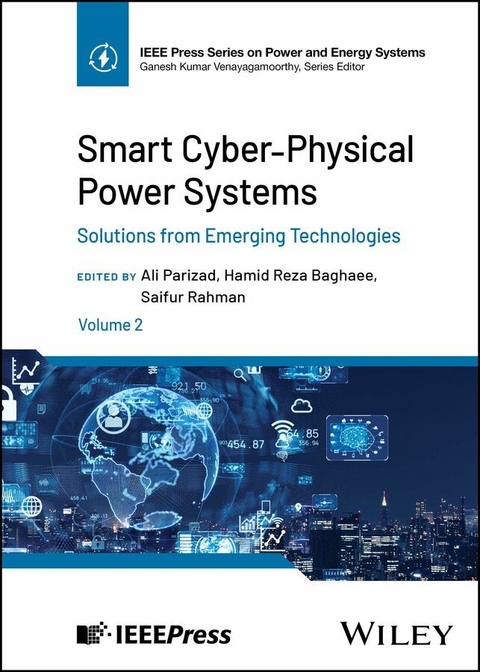
Smart Cyber-Physical Power Systems, Volume 2 (eBook)
1181 Seiten
Wiley-IEEE Press (Verlag)
978-1-394-33458-2 (ISBN)
A practical roadmap to the application of artificial intelligence and machine learning to power systems
In an era where digital technologies are revolutionizing every aspect of power systems, Smart Cyber-Physical Power Systems, Volume 2: Solutions from Emerging Technologies shifts focus to cutting-edge solutions for overcoming the challenges faced by cyber-physical power systems (CPSs). By leveraging emerging technologies, this volume explores how innovations like artificial intelligence, machine learning, blockchain, quantum computing, digital twins, and data analytics are reshaping the energy sector.
This volume delves into the application of AI and machine learning in power system optimization, protection, and forecasting. It also highlights the transformative role of blockchain in secure energy trading and digital twins in simulating real-time power system operations. Advanced big data techniques are presented for enhancing system planning, situational awareness, and stability, while quantum computing offers groundbreaking approaches to solving complex energy problems.
For professionals and researchers eager to harness cutting-edge technologies within smart power systems, Volume 2 proves indispensable. Filled with numerous illustrations, case studies, and technical insights, it offers forward-thinking solutions that foster a more efficient, secure, and resilient future for global energy systems, heralding a new era of innovation and transformation in cyber-physical power networks.
Welcome to the exploration of Smart Cyber-Physical Power Systems (CPPSs), where challenges are met with innovative solutions, and the future of energy is shaped by the paradigms of AI/ML, Big Data, Blockchain, IoT, Quantum Computing, Information Theory, Edge Computing, Metaverse, DevOps, and more.
Ali Parizad, PhD, is a Postdoctoral Associate at the Advanced Research Institute (ARI) of Virginia Polytechnic Institute and State University, VA, USA. Leveraging his extensive academic background, he served as a Senior Data Scientist in the IDA Data Science & Machine Learning (DSML) Department at Shell Energy. He holds the position of Staff Power Systems Machine Learning Engineer at Thinklabs AI, where he tackles critical challenges in power systems with cutting-edge AI applications.
Hamid Reza Baghaee, PhD, is an Associate Research Professor at Amirkabir University of Technology, Tehran, Iran.
Saifur Rahman, PhD, is the founding director of the Advanced Research Institute at Virginia Tech, where he is the Joseph R. Loring Professor of Electrical and Computer Engineering.
A practical roadmap to the application of artificial intelligence and machine learning to power systems In an era where digital technologies are revolutionizing every aspect of power systems, Smart Cyber-Physical Power Systems, Volume 2: Solutions from Emerging Technologies shifts focus to cutting-edge solutions for overcoming the challenges faced by cyber-physical power systems (CPSs). By leveraging emerging technologies, this volume explores how innovations like artificial intelligence, machine learning, blockchain, quantum computing, digital twins, and data analytics are reshaping the energy sector. This volume delves into the application of AI and machine learning in power system optimization, protection, and forecasting. It also highlights the transformative role of blockchain in secure energy trading and digital twins in simulating real-time power system operations. Advanced big data techniques are presented for enhancing system planning, situational awareness, and stability, while quantum computing offers groundbreaking approaches to solving complex energy problems. For professionals and researchers eager to harness cutting-edge technologies within smart power systems, Volume 2 proves indispensable. Filled with numerous illustrations, case studies, and technical insights, it offers forward-thinking solutions that foster a more efficient, secure, and resilient future for global energy systems, heralding a new era of innovation and transformation in cyber-physical power networks. Welcome to the exploration of Smart Cyber-Physical Power Systems (CPPSs), where challenges are met with innovative solutions, and the future of energy is shaped by the paradigms of AI/ML, Big Data, Blockchain, IoT, Quantum Computing, Information Theory, Edge Computing, Metaverse, DevOps, and more.
About the Editors
Ali Parizad, Postdoctoral Associate, Virginia Tech, Advanced Research Institute (ARI), Virginia, USA
Ali Parizad is a Postdoctoral Associate at Virginia Tech's Advanced Research Institute. His tenure at Virginia Tech involves leveraging machine learning (ML) to enhance energy efficiency within smart grids, under the mentorship of Professor Saifur Rahman, IEEE President 2023. Ali's academic foundation was laid at Southern Illinois University, where he obtained his PhD from the Electrical and Computer Engineering Department in 2021. His doctoral research, which was honored with the Dissertation Research Award for the 2020–2021 academic year, focused on pioneering solutions for modern power systems and smart grids. Specifically, he developed innovative software for Ameren Electric Company, aimed at optimizing distribution system planning with an emphasis on distributed energy resources (DERs) to boost the performance of electric distribution networks. His PhD dissertation emphasized the application of machine/deep learning algorithms for load forecasting, alongside exploring cyber-security and false data detection methods within power systems.
Before embarking on his PhD, Ali joined MAPNA Electric and Control Engineering and Manufacturing Company, Iran's premier power company, as a Power Systems Analysis Engineer in 2010. His roles expanded to include Energy Management System and Supervisory Control and Data Acquisition (SCADA) engineer, as well as Commissioning Supervisor in substation and power plant projects in collaboration with ABB and SIEMENS companies. His innovative work in the realm of real-time simulators culminated in the registration of a patent for a real-time islanded simulator for industrial power plants.
Ali's research interests are extensive, covering the application of artificial intelligence, deep learning, big data, information theory techniques in modern power systems and smart grids, distributed generation, renewable energies, and the operation and control of power systems. He has also explored the potential applications of real-time simulators in enhancing power system operations.
His contributions to the field are substantial, with three books, two book chapters, a patent, and numerous papers in reputable power systems journals to his name. Ali is a valued peer reviewer for several prestigious academic journals, including IEEE Transactions on Power Delivery, IEEE Transactions on Power Electronics, and IEEE Access, among others. His work not only contributes to the academic community but also to the advancement of practical solutions for power systems and smart grid challenges.
As a Senior Data Scientist in the Information and Data Analytics (IDA), Data Science & Machine Learning department at Shell Energy, Ali applied his profound expertise to develop and implement advanced data science solutions for energy demand forecasting and electric vehicle charging station analysis. This role underscored his commitment to leveraging data analytics and machine learning to solve complex challenges in the energy sector, marking his transition from academia to a leading role in industry innovation. Continuing on this path, he holds the position of Staff Power Systems Machine Learning Engineer at Thinklabs AI, where he is dedicated to furthering his impact by addressing critical power systems challenges through state-of-the-art AI technologies.
Hamid Reza Baghaee, Faculty of Electrical and Computer Engineering (ECE) at Tarbiat Modares University (TMU), Tehran, Iran
Hamid Reza Baghaee (SM' 2008, M' 2017) received his PhD in Electrical Engineering from Amirkabir University of Technology (AUT) (Center of Excellence in Power Engineering and the most prestigious university of Iran in electrical power engineering) in 2017. From 2007 to 2017, he was a teaching and research assistant in the Department of Electrical Engineering at AUT. He is the author of three books, three published book chapters, 85 ISI-ranked journal papers (mostly published in IEEE, IET, and Elsevier journals), 70 conference papers, and the owner of one registered patent. Additionally, he has presented 20 workshops and 15 invited talks at national and international conferences and scientific events. His book entitled Microgrids and Methods of Analysis was selected as the best book of the year in the power and energy industry of Iran by the technical committee of the Iran Ministry of Energy (MOE) in November 2021 and the winner of the Distinguished Author of the International Books Award in the AUT in December 2021. He has many HOT and HIGHLY-CITED papers in his journal and conference papers, based on SciVal and Web of Science (WoS) statistics. His special fields of interest are micro- and smart grids, cyber-physical power systems, power system cyber security and cyber-resiliency, application of artificial intelligence (AI) and machine learning (ML) and big data analytics in power systems, real-time simulation of power systems, distributed generation, and renewable energy resources, FACTS, HVDC and custom power devices, power electronics applications in power systems, Power Electronics-Dominated Grids (PEDGs), power quality, real-time simulation of power systems, and power system operation, control, monitoring, and protection.
Dr. Baghaee is also the winner of four national and international prizes, as the best dissertation award, from the Iran Scientific Organization of Smart Grids (ISOSG) in December 2017, the Iranian Energy Association (IEA) in February 2018, Amirkabir University of Technology in December 2018, and the IEEE Iran Section in May 2019 for his PhD dissertation. After pursuing his post-doctoral fellowship in AUT (October 2017–August 2019), in August 2019, he joined AUT as an Associate Research Professor in the Department of Electrical Engineering. He is the Project Coordinator of the AUT pilot microgrid project, one of the sub-projects of the Iran grand (National) Smart Grid Project. He has been a co-supervisor and consulting professor of more than 15 PhD and 20 MSc students since 2017. In 2022, he joined the Faculty of Electrical and Computer Engineering (ECE) at Tarbiat Modares University (TMU), Tehran, Iran, where he is now an Assistant Professor. In December 2023, has was selected as a distinguished researcher at TMU for the reputation and citations of his research among papers and patents. He also was a short-term scientist with CERN and ABB Switzerland. Besides, Dr. Baghaee is a member and Vice-Chairperson of the IEEE Iran Section Power Chapter (since 2022), a member and secretary-chair of the IEEE Iran Section Communication Committee (from 2020 to 2023), and a member of the IEEE, IEEE Smart Grid Community, IEEE Internet of Things Technical Community, IEEE Big Data Community, IEEE Smart Cities Community, and IEEE Sensors Council. Since August 2021, he has been elected as a member of the board and chairperson of the committee on publication and conferences at the ISOSG, the Vice-Chairperson and international representative of CIGRE Iran C6 working group on “Active distribution systems and distributed energy resources,” a member of the IEE Transmission and Distribution (TD) Committee, IEEE PES Transmission Sub-Committee and its working groups of Reliability impacts of Inverter-based Resources, Generation and Energy Storage Integration, Voltage Optimization, and Transmission Power System Switching, and also IEEE PES Subcommittee on Big Data Analytics for Power Systems, and IEEE PES Task Force on Application of Big Data Analytic on Transmission System Dynamic Security Assessment, IEEE PES Task Force on Resilient and Secure Large-Scale Energy Internet Systems (RSEI), and IEEE Task Force on Microgrid Design. He is also the reviewer of several IEEE, IET, and Elsevier journals, and Guest Editor of several special issues in IEEE, IET, and Elsevier, MDPI, and a scientific program committee member of several IEEE conferences. Since December 2020, he served as an Associate Editor and Energy Section Editor of the IET Journal of Engineering. He has also been selected as the best and outstanding reviewer of several journals, such as IEEE Transactions on Power Systems (Top 0.66 of reviewers, among more than 8000 reviewers in 2020), Elsevier Control Engineering Practice (in 2018, 2019, and 2020), Wiley International Transaction on Electrical Energy Systems in 2020, and the Pablon best and listed among top 1 of the reviewers in Engineering (in 2018) and both Engineering and Cross-Field (in 2019). He was selected as the Star Reviewer of the IEEE JESTPE and IEEE Power Electronics Society (PELS) in 2020, commemorated and presented during the IEEE ECCE 2021 conference in Vancouver, Canada. He has also been listed in 2020, 2021, and 2022 editions of the top 2% of scientists in the field of Energy, Electrical Engineering, and Enabling and Strategic Technologies according to the Science-Wide Citation Indicators (reported by Stanford University, USA), and mentioned among World's top 1% of Elite Scientists according to Web of Science (WoS) and Essential Science Indicators (ESI) ranking since 2020.
Prof. Saifur Rahman, Director, Virginia Tech Advanced Research Institute, Virginia, USA 2023 IEEE President and CEO
Professor Saifur Rahman is the founding director of the Advanced Research Institute at Virginia Tech, USA, where he is the Joseph R. Loring professor of electrical and computer engineering. He also directs the Center for Energy and the Global Environment at the University. He is a Life Fellow of the IEEE and an IEEE Millennium Medal winner. He was the 2023 IEEE President and CEO. He was the IEEE Power and Energy Society (PES) President in 2018 and 2019. He is the founding...
| Erscheint lt. Verlag | 7.3.2025 |
|---|---|
| Reihe/Serie | IEEE Press Series on Power and Energy Systems |
| Sprache | englisch |
| Themenwelt | Technik ► Elektrotechnik / Energietechnik |
| Schlagworte | </p> <p class=MsoNormal>Power system cybersecurity • microgrid ai • microgrid ml • power system artificial intelligence • power system machine learning • power systems ai • power systems ml • smart grid ai • smart grid machine learning <p class=MsoNormal> • smart grid ml • smart power cybersecurity |
| ISBN-10 | 1-394-33458-3 / 1394334583 |
| ISBN-13 | 978-1-394-33458-2 / 9781394334582 |
| Informationen gemäß Produktsicherheitsverordnung (GPSR) | |
| Haben Sie eine Frage zum Produkt? |
 EPUB (Adobe DRM)
Kopierschutz: Adobe-DRM
Adobe-DRM ist ein Kopierschutz, der das eBook vor Mißbrauch schützen soll. Dabei wird das eBook bereits beim Download auf Ihre persönliche Adobe-ID autorisiert. Lesen können Sie das eBook dann nur auf den Geräten, welche ebenfalls auf Ihre Adobe-ID registriert sind.
Details zum Adobe-DRM
Dateiformat: EPUB (Electronic Publication)
EPUB ist ein offener Standard für eBooks und eignet sich besonders zur Darstellung von Belletristik und Sachbüchern. Der Fließtext wird dynamisch an die Display- und Schriftgröße angepasst. Auch für mobile Lesegeräte ist EPUB daher gut geeignet.
Systemvoraussetzungen:
PC/Mac: Mit einem PC oder Mac können Sie dieses eBook lesen. Sie benötigen eine
eReader: Dieses eBook kann mit (fast) allen eBook-Readern gelesen werden. Mit dem amazon-Kindle ist es aber nicht kompatibel.
Smartphone/Tablet: Egal ob Apple oder Android, dieses eBook können Sie lesen. Sie benötigen eine
Geräteliste und zusätzliche Hinweise
Buying eBooks from abroad
For tax law reasons we can sell eBooks just within Germany and Switzerland. Regrettably we cannot fulfill eBook-orders from other countries.
aus dem Bereich