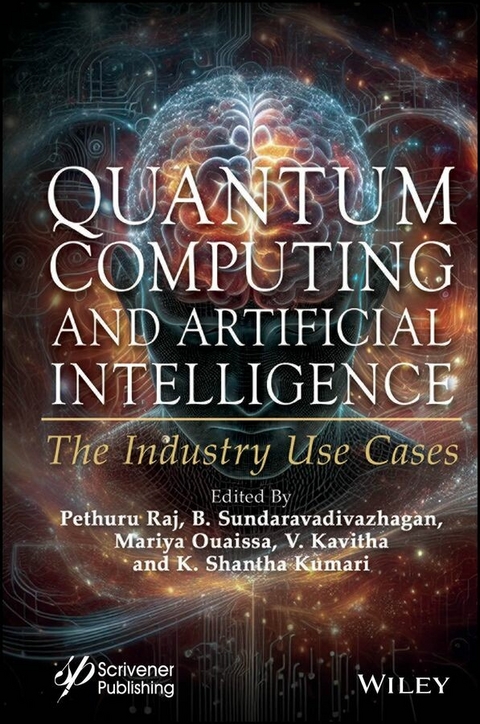
Quantum Computing and Artificial Intelligence (eBook)
769 Seiten
Wiley-Scrivener (Verlag)
978-1-394-24237-5 (ISBN)
This book explores the essential role of quantum computing and artificial intelligence in advancing healthcare. This comprehensive guide explores the practical applications and real-world use cases, exploring their transformative potential across various sectors. It covers nanodiagnostic tools known for accuracy, along with advanced imaging techniques. Through real-world examples, it offers valuable insights on nanomaterials to improve medical solutions.
This book is divided into three sections. The first section examines the fundamentals of quantum computing and its practical applications. The second section explores how quantum computing offers a myriad of opportunities to various industries, transitions between classical and quantum networks, and post-quantum cryptography. The third section further explores the exciting potential of quantum machine learning for Industry 4.0, as well as the applications of quantum computing and AI applications in the emerging Industry 5.0 landscape.
Pethura Raj, Ph.D., is the chief architect at Reliance Jio Platforms Ltd., Bangalore, India. His research focuses on the Internet of Things (IoT), artificial intelligence (AI), model optimization techniques, etc.
B. Sundaravadivazhagan, Ph.D., is a faculty member in the Department of Information Technology, University of Technology and Applied Science-AL Mussanah, Muladdah, Oman. His research interests include the Internet of Things, artificial intelligence and machine learning, deep learning, cloud computing, and cyber security.
Mariya Quaissa, Ph.D., is a professor of cybersecurity and networks at Cadi Ayyad University in Marrakech, Morocco. Her main research focuses on IoT, M2M, D2D, WSN, cellular networks, and vehicular networks.
V. Kavitha, Ph.D., is an assistant professor in the Department of Computer Science with Cognitive Systems, Sri Ramakrishna College of Arts & Science, Coimbatore, Tamil Nadu, India. Her research interests include cyber security, IoT security, artificial intelligence, machine learning, and deep learning.
K. Shantha Kumari, Ph.D., works in the Department of Data Science and Business Systems, SRM Institute of Science and Technology, Chengalpattu, Tamil Nadu, India. Her research interests include data science, big data analytics, AI for good, blockchain, and cryptography
This book explores the essential role of quantum computing and artificial intelligence in advancing healthcare. This comprehensive guide explores the practical applications and real-world use cases, exploring their transformative potential across various sectors. It covers nanodiagnostic tools known for accuracy, along with advanced imaging techniques. Through real-world examples, it offers valuable insights on nanomaterials to improve medical solutions. This book is divided into three sections. The first section examines the fundamentals of quantum computing and its practical applications. The second section explores how quantum computing offers a myriad of opportunities to various industries, transitions between classical and quantum networks, and post-quantum cryptography. The third section further explores the exciting potential of quantum machine learning for Industry 4.0, as well as the applications of quantum computing and AI applications in the emerging Industry 5.0 landscape.
Introduction to Quantum Computing
Vinoj J.1*, Swathika R.2, Gavaskar S.3 and K. B. Manikandan1
1Department of CSE, Vignan’s Foundation for Science, Technology and Research (Deemed to be University), Guntur, Andra Pradesh, India
2Department of Computer Science, Bharathiar University, Coimbatore, Tamil Nadu, India
3Department of Computer Applications, Bharathiar University, Coimbatore, Tamil Nadu, India
Abstract
Quantum computing is poised to revolutionize the world as the next big technological advancement. Combining principles from quantum physics, computer science, and information theory, it overcomes the complexities that classical computers struggle with and transcends their limitations. Unlike classical computers, which follow classical physics, quantum computers are based on the principles of quantum mechanics, enabling them to exploit quantum phenomena. Quantum entanglement and quantum superposition are key quantum mechanical principles used in this technology. Quantum computers utilize these principles to perform complex tasks that classical computers cannot handle. The hardware components of quantum computers consist of the quantum data plane, control and measurement plane, control processor plane, and host processor. The quantum data plane houses physical qubits and related systems, along with support circuits for measuring the qubit’s state and executing gate operations on them for gate-based systems. The control and measurement plane converts digital signals from the control processor into analog control signals required to operate the qubits in the quantum data plane. The control processor plane, on the other hand, translates compiled code into commands for the control and measurement layer. One of the groundbreaking features of quantum computers is their ability to operate on qubits, allowing information to be processed simultaneously as both 1s and 0s, represented by [00, 01, 11, 10]. This is achieved through the implementation of quantum mechanical principles, namely, superposition and entanglement. The quantum superposition principle enables a qubit to exist in multiple states simultaneously, setting it apart from classical bits. Moreover, the quantum entanglement property causes the state of one entangled qubit to instantly influence the state of its paired qubit, significantly accelerating the processing speed of quantum computers.
Keywords: Quantum computing, quantum tools, quantum methodology, real-time systems, program processors
1 History of Computing
The progress of science and technology in any given field has consistently been a driving force behind the emergence of new discoveries, reshaping the way we live and interact with the world around us. A remarkable example of this transformative power lies in the advancements made in functional computing technologies over a relatively short period, spanning less than a century. These developments have sparked a revolution with far-reaching implications across diverse realms, including science, technology, and nations, fundamentally altering the course of human history. In the early 20th century, the practical implementation of computers was in its infancy, and these early machines had limited capacity to perform mathematical computations independently. Their functionality hinged upon the painstaking realization of theoretical concepts into tangible physical devices. These early computers were colossal, power-hungry machines, with a level of computational prowess that pales in comparison to the devices we use today. However, even in their nascent form, they laid the groundwork for the extraordinary potential of computing that was yet to be fully realized. Fast forward to the present day, and we find ourselves in an era where computers have evolved into marvels of efficiency and capability. With astonishing speed and accuracy, modern computers can solve complex problems, provided they are given relevant input and precise instructions. From data processing to simulations, from artificial intelligence to virtual reality, the breadth of their applications knows no bounds.
The roots of this remarkable transformation can be traced back to the crucible of World War II, where the brilliant mind of Alan Turing gave birth to the “Universal Turing Machine.” This groundbreaking concept ushered in the era of genuine general-purpose computers that could be programmed to perform various tasks, making them remarkably adaptable and versatile. Subsequently, this seminal idea was further developed and refined by the renowned mathematician and physicist John von Neumann, leading to the widely adopted Von Neumann architecture that underpins nearly every computer in existence today. Over time, computers and their physical components have undergone a perpetual process of improvement, in terms of both performance and capabilities. This continuous evolution has been fueled by the relentless pursuit of innovation, with each advancement opening new frontiers of possibility. Beyond their origins in military applications, computers transcended their initial purpose to become a dominant force in shaping modern society. From businesses to education, healthcare to entertainment, they have permeated every aspect of our lives, becoming an integral part of our daily existence. The remarkable progress achieved in understanding and controlling the natural world, as well as physical systems, has been pivotal in propelling the development of sophisticated electronic devices that now serve as indispensable tools for humanity. Our reliance on computers, in turn, has ignited a virtuous cycle of technological advancement, where each stride forward inspires the next. In conclusion, the extraordinary journey of computing technologies exemplifies how the progress of science and technology, when harnessed with ingenuity and vision, can drive a transformative wave of discoveries and innovations. From their humble beginnings as limited computational machines to their current status as ubiquitous and indispensable devices, computers stand as a testament to the indomitable human spirit in unraveling the mysteries of the universe and reshaping the world in ways once deemed unimaginable [1]. LaRose (2019) provides a comprehensive overview and comparison of gate-level quantum software platforms, critically analyzing their design, functionality, and practical applications. The study highlights the core features of various platforms, emphasizing their role in enabling quantum algorithm development and simulation at the gate level. By assessing the strengths and limitations of these tools, LaRose identifies key factors influencing their adoption, such as ease of use, hardware compatibility, and scalability. This work serves as a valuable resource for researchers and practitioners aiming to select or develop quantum software frameworks, fostering advancements in quantum computing methodologies [2]. Hu et al. (2019) explore the integration of quantum computing and machine learning through the application of D-Wave quantum computers. Their study investigates how quantum annealing, a key capability of D-Wave systems, can be leveraged for solving optimization problems inherent in machine learning tasks. By focusing on practical implementations, the authors demonstrate the potential of quantum-enhanced methods to outperform classical approaches in specific scenarios, particularly in areas like clustering and classification. The paper provides insights into the challenges and opportunities in quantum machine learning, emphasizing the transformative impact of quantum annealers on computational efficiency and solution quality [3].
Quantum computing is a revolutionary field that leverages the principles of quantum mechanics to perform computations that are beyond the reach of classical computers. Unlike classical computers, which use bits as the basic unit of information, quantum computers use quantum bits, or qubits. Qubits can exist in multiple states simultaneously thanks to the phenomena of superposition and entanglement, enabling quantum computers to process a vast amount of information in parallel. This gives quantum computers the potential to solve complex problems much faster than classical computers.
Real-Time Applications of Quantum Computing:
- Cryptography: Quantum computing has significant implications for cryptography. Classical cryptographic methods, like RSA encryption, rely on the difficulty of factoring large numbers—a task that classical computers struggle with. Quantum computers, however, can use algorithms like Shor's algorithm to factor these numbers efficiently, potentially breaking widely used cryptographic protocols. This has led to the development of quantum-resistant encryption methods.
- Optimization Problems: Quantum computers excel at solving optimization problems, which are prevalent in various industries. For example, in logistics and supply chain management, quantum algorithms can optimize delivery routes, reducing costs and improving efficiency. Companies like Volkswagen have already experimented with quantum computing to optimize traffic flow in real time.
- Drug Discovery and Materials Science: Quantum computing can simulate molecular structures at an atomic level, something that classical computers struggle to do efficiently. This capability can accelerate drug discovery by enabling researchers to simulate and analyze complex biological systems quickly. It also holds promise in materials science, where quantum simulations can lead to the discovery of new materials with desired properties.
- Financial Modeling:...
| Erscheint lt. Verlag | 5.3.2025 |
|---|---|
| Sprache | englisch |
| Themenwelt | Technik ► Elektrotechnik / Energietechnik |
| Schlagworte | AI Data Analysis Quantum Computing • AI Healthcare Quantum Computing • AI Industry Innovations • AI Optimization Quantum Computing • AI Quantum Technology Integration • AI Telecommunications Quantum Computing • Computing Cybersecurity Solutions • Industry Use Cases Quantum AI • quantum • Quantum Computing AI Applications • Quantum Computing Business Solutions • Quantum Computing Finance Applications • Quantum Computing Manufacturing Efficiency • Quantum Computing Practical Examples • Quantum Computing Research Developments • Quantum machine learning |
| ISBN-10 | 1-394-24237-9 / 1394242379 |
| ISBN-13 | 978-1-394-24237-5 / 9781394242375 |
| Informationen gemäß Produktsicherheitsverordnung (GPSR) | |
| Haben Sie eine Frage zum Produkt? |
 EPUB (Adobe DRM)
Kopierschutz: Adobe-DRM
Adobe-DRM ist ein Kopierschutz, der das eBook vor Mißbrauch schützen soll. Dabei wird das eBook bereits beim Download auf Ihre persönliche Adobe-ID autorisiert. Lesen können Sie das eBook dann nur auf den Geräten, welche ebenfalls auf Ihre Adobe-ID registriert sind.
Details zum Adobe-DRM
Dateiformat: EPUB (Electronic Publication)
EPUB ist ein offener Standard für eBooks und eignet sich besonders zur Darstellung von Belletristik und Sachbüchern. Der Fließtext wird dynamisch an die Display- und Schriftgröße angepasst. Auch für mobile Lesegeräte ist EPUB daher gut geeignet.
Systemvoraussetzungen:
PC/Mac: Mit einem PC oder Mac können Sie dieses eBook lesen. Sie benötigen eine
eReader: Dieses eBook kann mit (fast) allen eBook-Readern gelesen werden. Mit dem amazon-Kindle ist es aber nicht kompatibel.
Smartphone/Tablet: Egal ob Apple oder Android, dieses eBook können Sie lesen. Sie benötigen eine
Geräteliste und zusätzliche Hinweise
Buying eBooks from abroad
For tax law reasons we can sell eBooks just within Germany and Switzerland. Regrettably we cannot fulfill eBook-orders from other countries.
aus dem Bereich