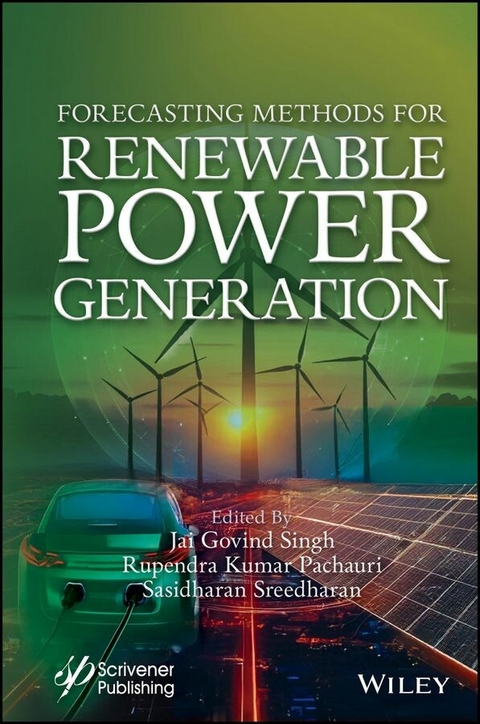
Forecasting Methods for Renewable Power Generation (eBook)
416 Seiten
Wiley-Scrivener (Verlag)
978-1-394-24945-9 (ISBN)
Forecasting Methods for Renewable Power Generation is an essential resource for both professionals and students, providing in-depth insights into vital forecasting techniques that enhance grid stability, optimize resource management, and enable effective electricity pricing strategies. It is a must-have reference for anyone involved in the clean energy sector.
Forecasting techniques in renewable power generation, demand response, and electricity pricing are vital for grid stability, optimal resource allocation, efficient energy management, and cost-effective electricity supply. They enable grid operators and market participants to make informed decisions, mitigate risks, and enhance the overall reliability and sustainability of the electrical grid. Electricity prices can vary significantly based on supply and demand dynamics. By forecasting expected demand and the availability of generation resources, market operators can optimize electricity pricing strategies. This alignment of prices with anticipated supply-demand balance incentivizes the efficient use of electricity and promotes market efficiency. Accurate forecasting helps prevent price spikes, reduces market uncertainties, and supports the development of effective energy trading strategies.
This book presents these topics and trends in an encyclopedic format, serving as a go-to reference for engineers, scientists, or students interested in the subject. The book is divided into three easy-to-navigate sections that thoroughly examine the AI and machine learning-based algorithms and pseudocode considered in this study. This is the most comprehensive and up-to-date encyclopedia of forecasting in renewable power generation, demand response, and electricity pricing ever written, and is a must-have for any library.
Jai Govind Singh, PhD, is an associate professor in the Department of Energy, Environment, and Climate Change at the School of Environment, Resources, and Development, Asian Institute of Technology, Bangkok, Thailand. He has completed 19 sponsored research projects with various international organizations and has published over 110 research papers in reputed journals and conferences. His wide net of research areas includes e-vehicle technologies, smart grid and micro-grid design and operation, power system operation and control, electricity market restructuring and power trading, and energy storage technologies.
Rupendra Kumar Pachauri, PhD, is an assistant professor in the Electrical and Electronics Engineering Department at the University of Petroleum and Energy Studies, Dehradun, India. He has published over 130 research papers in internationally reputed journals and conferences, as well as several patents. His primary areas of research include solar energy, fuel cell technology, and smart grid operations.
Sasidharan Sreedharan, PhD, is an assistant professor at the College of Applied Sciences, Ministry of Higher Education, Sultanate of Oman. He has completed more than 15 sponsored research projects for various international organizations and published over 80 research papers in reputed journals and conferences. His primary areas of research include high-performance computing, AI and machine learning, optimization and cybersecurity, smart grid operations, electrical supply restructuring, and energy storage.
Forecasting Methods for Renewable Power Generation is an essential resource for both professionals and students, providing in-depth insights into vital forecasting techniques that enhance grid stability, optimize resource management, and enable effective electricity pricing strategies. It is a must-have reference for anyone involved in the clean energy sector. Forecasting techniques in renewable power generation, demand response, and electricity pricing are vital for grid stability, optimal resource allocation, efficient energy management, and cost-effective electricity supply. They enable grid operators and market participants to make informed decisions, mitigate risks, and enhance the overall reliability and sustainability of the electrical grid. Electricity prices can vary significantly based on supply and demand dynamics. By forecasting expected demand and the availability of generation resources, market operators can optimize electricity pricing strategies. This alignment of prices with anticipated supply-demand balance incentivizes the efficient use of electricity and promotes market efficiency. Accurate forecasting helps prevent price spikes, reduces market uncertainties, and supports the development of effective energy trading strategies. This book presents these topics and trends in an encyclopedic format, serving as a go-to reference for engineers, scientists, or students interested in the subject. The book is divided into three easy-to-navigate sections that thoroughly examine the AI and machine learning-based algorithms and pseudocode considered in this study. This is the most comprehensive and up-to-date encyclopedia of forecasting in renewable power generation, demand response, and electricity pricing ever written, and is a must-have for any library.
| Erscheint lt. Verlag | 4.3.2025 |
|---|---|
| Sprache | englisch |
| Themenwelt | Technik ► Elektrotechnik / Energietechnik |
| Schlagworte | biofuel • biomass • DC Micro-Grid Renewable Energy Forecasting • Electric Vehicle • historical data analysis • Machine Learning Forecasting • Power Generation Forecasting • renewable energy • Solar Battery Charger • Solar irradiation • solar power forecasting • Stand-Alone • Statistical forecasting • Weather Data Integration • wind power forecasting |
| ISBN-10 | 1-394-24945-4 / 1394249454 |
| ISBN-13 | 978-1-394-24945-9 / 9781394249459 |
| Informationen gemäß Produktsicherheitsverordnung (GPSR) | |
| Haben Sie eine Frage zum Produkt? |
 PDF (Adobe DRM)
Kopierschutz: Adobe-DRM
Adobe-DRM ist ein Kopierschutz, der das eBook vor Mißbrauch schützen soll. Dabei wird das eBook bereits beim Download auf Ihre persönliche Adobe-ID autorisiert. Lesen können Sie das eBook dann nur auf den Geräten, welche ebenfalls auf Ihre Adobe-ID registriert sind.
Details zum Adobe-DRM
Dateiformat: PDF (Portable Document Format)
Mit einem festen Seitenlayout eignet sich die PDF besonders für Fachbücher mit Spalten, Tabellen und Abbildungen. Eine PDF kann auf fast allen Geräten angezeigt werden, ist aber für kleine Displays (Smartphone, eReader) nur eingeschränkt geeignet.
Systemvoraussetzungen:
PC/Mac: Mit einem PC oder Mac können Sie dieses eBook lesen. Sie benötigen eine
eReader: Dieses eBook kann mit (fast) allen eBook-Readern gelesen werden. Mit dem amazon-Kindle ist es aber nicht kompatibel.
Smartphone/Tablet: Egal ob Apple oder Android, dieses eBook können Sie lesen. Sie benötigen eine
Geräteliste und zusätzliche Hinweise
Buying eBooks from abroad
For tax law reasons we can sell eBooks just within Germany and Switzerland. Regrettably we cannot fulfill eBook-orders from other countries.
aus dem Bereich