


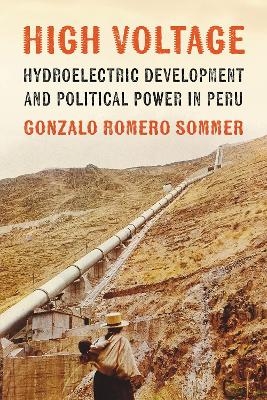
High Voltage
Hydroelectric Development and Political Power in Peru
Seiten
2025
University of Nebraska Press (Verlag)
978-1-4962-3512-1 (ISBN)
University of Nebraska Press (Verlag)
978-1-4962-3512-1 (ISBN)
Beginning in the early nineteenth century, Peru sought to advance its national progress through the development of infrastructure, especially through the economic and social potential of hydroelectricity. However, decades of modernization efforts by the Peruvian state failed to deliver national social integration or political stability.
In High Voltage Gonzalo Romero Sommer examines Peru’s political history through its efforts at hydroelectrification as part of state formation in the central Andes, from the beginning of the twentieth century through the Cold War. Intellectuals, scientists, and statesmen advocated electricity-led development as a possibility for dismantling traditional social and geographic hierarchies, but they also wielded hydroelectric development as an opportunity for strengthening what may be fairly called “colonial” economic and political structures. By the end of the twentieth century, the electrical grid physically unified parts of the country and simultaneously highlighted critical divisions in Peru’s fragmented society and political class. In this first comprehensive study of modern Peru’s electrification process, Romero Sommer provides a new perspective on Peruvian state formation by examining how the central state engaged with rural communities through electrification, contributing to a larger global debate about electricity, power, and the political uses of infrastructure.
In High Voltage Gonzalo Romero Sommer examines Peru’s political history through its efforts at hydroelectrification as part of state formation in the central Andes, from the beginning of the twentieth century through the Cold War. Intellectuals, scientists, and statesmen advocated electricity-led development as a possibility for dismantling traditional social and geographic hierarchies, but they also wielded hydroelectric development as an opportunity for strengthening what may be fairly called “colonial” economic and political structures. By the end of the twentieth century, the electrical grid physically unified parts of the country and simultaneously highlighted critical divisions in Peru’s fragmented society and political class. In this first comprehensive study of modern Peru’s electrification process, Romero Sommer provides a new perspective on Peruvian state formation by examining how the central state engaged with rural communities through electrification, contributing to a larger global debate about electricity, power, and the political uses of infrastructure.
List of Illustrations
List of Tables
Acknowledgements
Abbreviations in Text
Introduction: An Electric Century
1. Fragmented Power
2. Vertical Limits
3. Electrification from Above
4. Electrification from Below
5. Electric Revolutions
Epilogue: From Light to Darkness
Notes
Bibliography
Index
| Erscheinungsdatum | 17.10.2025 |
|---|---|
| Zusatzinfo | 11 photographs, 5 illustrations, 4 maps, 2 tables, index |
| Verlagsort | Lincoln |
| Sprache | englisch |
| Maße | 152 x 229 mm |
| Themenwelt | Geschichte ► Allgemeine Geschichte ► Neuzeit (bis 1918) |
| Geisteswissenschaften ► Geschichte ► Regional- / Ländergeschichte | |
| Technik ► Elektrotechnik / Energietechnik | |
| ISBN-10 | 1-4962-3512-6 / 1496235126 |
| ISBN-13 | 978-1-4962-3512-1 / 9781496235121 |
| Zustand | Neuware |
| Informationen gemäß Produktsicherheitsverordnung (GPSR) | |
| Haben Sie eine Frage zum Produkt? |
Mehr entdecken
aus dem Bereich

aus dem Bereich
Geschichte einer wilden Handlung
Buch | Hardcover (2024)
C.H.Beck (Verlag)
CHF 47,60


