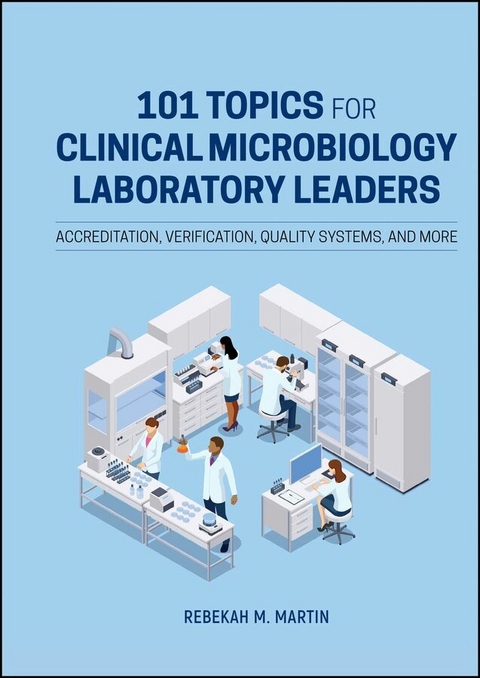
101 Topics for Clinical Microbiology Laboratory Leaders (eBook)
499 Seiten
ASM Press (Verlag)
978-1-68367-447-4 (ISBN)
Successfully manage your laboratory accreditation and compliance audits with this easily accessible how-to resource for clinical laboratories
101 Topics for Clinical Microbiology Laboratory Leaders: Accreditation, Verification, Quality Systems, and More by Rebekah M. Martin is your roadmap to achieving and maintaining excellence in clinical microbiology laboratory administration. This quick reference guide is designed to help laboratory professionals efficiently navigate the key aspects of accreditation, regulatory compliance, and quality management. This practical resource is perfect for both new and experienced laboratory leaders who need accessible, actionable information.
Inside, you'll find:
- Regulatory Overview: Information on the Clinical Laboratory Improvement Amendments, test complexity categories, and the roles of key agencies like the Centers for Medicare & Medicaid Services, the Centers for Disease Control and Prevention, and the Food & Drug Administration in overseeing clinical laboratories.
- Accreditation Basics: Guidance on how to obtain and maintain laboratory accreditation, including what to expect during inspections and how to respond to deficiencies.
- Test Verification & Validation: Essential tips on conducting verification and validation studies to ensure your laboratory's test systems are accurate, reliable, and compliant with regulatory standards.
- Quality Management Essentials: Practical strategies for implementing and maintaining a quality management system, including process control, document management, and continuous improvement techniques that keep your lab running smoothly.
Presented in a user-friendly question-and-answer format, 101 Topics for Clinical Microbiology Laboratory Leaders is your go-to resource for quick, reliable guidance on leading a compliant and high-performing clinical microbiology laboratory.
Rebekah M. Martin is currently a Medical Affairs Manager for Molecular Solutions at Becton, Dickinson and Company (BD). She completed a CPEP-accredited medical microbiology fellowship, is a Diplomate of the American Board of Medical Microbiology (ABMM), a former Associate Technical Director of Microbiology for a national reference laboratory and has been working in clinical microbiology for more than a decade.
Successfully manage your laboratory accreditation and compliance audits with this easily accessible how-to resource for clinical laboratories 101 Topics for Clinical Microbiology Laboratory Leaders: Accreditation, Verification, Quality Systems, and More by Rebekah M. Martin is your roadmap to achieving and maintaining excellence in clinical microbiology laboratory administration. This quick reference guide is designed to help laboratory professionals efficiently navigate the key aspects of accreditation, regulatory compliance, and quality management. This practical resource is perfect for both new and experienced laboratory leaders who need accessible, actionable information. Inside, you ll find: Regulatory Overview: Information on the Clinical Laboratory Improvement Amendments, test complexity categories, and the roles of key agencies like the Centers for Medicare & Medicaid Services, the Centers for Disease Control and Prevention, and the Food & Drug Administration in overseeing clinical laboratories.Accreditation Basics: Guidance on how to obtain and maintain laboratory accreditation, including what to expect during inspections and how to respond to deficiencies.Test Verification & Validation: Essential tips on conducting verification and validation studies to ensure your laboratory s test systems are accurate, reliable, and compliant with regulatory standards.Quality Management Essentials: Practical strategies for implementing and maintaining a quality management system, including process control, document management, and continuous improvement techniques that keep your lab running smoothly. Presented in a user-friendly question-and-answer format, 101 Topics for Clinical Microbiology Laboratory Leaders is your go-to resource for quick, reliable guidance on leading a compliant and high-performing clinical microbiology laboratory.
1
Clinical Laboratory Improvement Amendments (CLIA) and Regulatory Oversight
How is “clinical laboratory” defined?
The Code of Federal Regulations in the United States defines a laboratory as follows:
“…a facility for the biological, microbiological, serological, chemical, immunohematological, hematological, biophysical, cytological, pathological, or other examination of materials derived from the human body for the purpose of providing information for the diagnosis, prevention, or treatment of any disease or impairment of, or the assessment of the health of, human beings. These examinations also include procedures to determine, measure, or otherwise describe the presence or absence of various substances or organisms in the body. Facilities only collecting or preparing specimens (or both) or only serving as a mailing service and not performing testing are not considered laboratories.” (42 CFR §493.2) (1)
Laboratories that operate as defined above are subject to regulation by the Clinical Laboratory Improvement Amendments (CLIA) and are often referred to as clinical laboratories. The term clinical laboratories will be used throughout this book to refer to laboratories regulated by CLIA.
There are some key aspects that help identify a clinical laboratory based on the definition above:
What is occurring in the laboratory? Laboratories must be involved in testing. If a location is handling specimens for other purposes but is not performing any testing, they are not considered a clinical laboratory.
What is being tested? The laboratory must examine human specimens, which refers to any materials that are obtained from humans. These include but are not limited to blood, body fluids and secretions, tissues, urine, stool, hair and nails, and swabs from various body sites. Human samples collected postmortem during an autopsy may also be tested in clinical laboratories (2).
What is the purpose of testing? The purpose of testing in the laboratory must be for patient management. This can include testing to assist in diagnosis, monitor disease progress, track treatment impact, engage in preventative care, or assess potential organ donors (3).
Other laboratories may perform testing on human samples, but not for the purposes of health assessment and patient management. These are not considered clinical laboratories and they are not subject to CLIA requirements. Examples of such laboratories include research laboratories, forensic laboratories, and laboratories certified by the Substance Abuse and Mental Health Services Administration (SAMSHA) that perform only drug testing (other testing performed in SAMSHA certified laboratories may require a CLIA certificate) (4).
What is CLIA?
CLIA stands for Clinical Laboratory Improvement Amendments. When someone mentions “CLIA” they may be talking about either CLIA law or CLIA regulations. CLIA law refers to the Clinical Laboratory Improvement Amendments of 1988 (CLIA’88) (Public Law 100‐578), which were amendments to the Clinical Laboratories Improvement Act of 1967 (CLIA’67) and were signed into law in 1988. CLIA regulations, on the other hand, are requirements codified in the Code of Federal Regulations (42 CFR §493 Laboratory Requirements). CLIA regulations were issued by the Centers for Medicare and Medicaid Services (CMS) in 1992 in order to enact CLIA’88. From 1992 to 1994, CLIA regulations were phased in. Amendments to these regulations have occurred periodically since then. For further information on CLIA regulations see section What is the Code of Federal Regulations (CFR)? The section here will discuss CLIA law.
The Clinical Laboratories Improvement Act of 1967 (Public Law 90‐174)
In 1967, a new section (Sec. 353) was added to the Public Health Service Act (5). Titled Licensing—Biological Products and Clinical Laboratories, the purpose of this addition was briefly noted as “to improve the performance of clinical laboratories.” Also known as The Clinical Laboratories Improvement Act of 1967 (CLIA’67), this brief section represented the establishment of quality standards for clinical laboratories in the United States.
CLIA’67 required interstate laboratories performing testing on human samples for the purposes of diagnosis, prevention, treatment, or assessment of a disease or condition to obtain a license to operate. In order to obtain and maintain a license, laboratories needed to demonstrate adherence to certain standards meant to improve clinical laboratory quality and ultimately ensure patient safety. Specifically, the standards were meant to ensure: 1) maintenance of a quality control program, 2) maintenance of records, equipment, and facilities, 3) qualifications of the laboratory’s director(s) and other personnel, and 4) participation in a proficiency testing program.
CLIA’67 had a relatively limited reach, however. It only applied to laboratories that took part in “interstate commerce” i.e., only laboratories that did business across state lines. Laboratories accredited by any accrediting agency with requirements equal to or more stringent than those found in CLIA’67 were exempt from the licensing requirement, as were smaller laboratories and labs whose activities remained within one state. CLIA’88 would widen that reach.
The Clinical Laboratory Improvement Amendments of 1988 (Public Law 100‐578)
In late 1987, two articles were published in The Wall Street Journal by journalist Walt Bogdanich detailing false negative Papanicolaou (Pap) smear results that led to missed diagnoses in cervical cancer screening (6, 7). Bogdanich’s articles suggested that the inaccurate Pap smear results were due to overwork, lack of quality control, and lack of appropriate education for testing personnel (). In response to the resulting public upset and in order to strengthen and improve existing laws governing clinical laboratories, Congress passed the Clinical Laboratory Improvement Amendments of 1988 (CLIA’88) (8).
CLIA’88 outlined several amendments to Public Health Service Act section 353. Important among these changes was the establishment of minimum standards for all clinical laboratories in the U.S., not just those involved in interstate commerce (9). Also included in CLIA’88 was the requirement for development of standards for: laboratory personnel qualifications, quality control (QC) and quality assurance (QA) procedures, and proficiency testing requirements. CLIA’88 also introduced waived and nonwaived test categorization.
Two amendments to CLIA’88 were later implemented, one in 1997 to update the criteria for waived testing and one in 2012 related to proficiency testing referral (10, 11). Despite these recent amendments, CLIA law is still referred to as CLIA’88.
What is the Code of Federal Regulations (CFR)?
The Code of Federal Regulations (CFR) is the codification of regulations set forth by federal departments and agencies in the United States. The official CFR is reviewed and published annually by the Office of the Federal Register. An unofficial “point in time” version can be found online and is known as the Electronic Code of Federal Regulations (e‐CFR) (https://www.ecfr.gov/).
The CFR provides regulations for a wide range of industries and sectors, including clinical laboratories. Specifically, Title 42 Part 493 (42 CFR §493), titled “Laboratory Requirements,” details the regulations all clinical laboratories must follow in order to acquire and maintain certification to perform human specimen testing under CLIA ’88 (1). In other words, the CFR contains the federal requirements a clinical laboratory must comply with in order to legally test human samples for health care purposes. 42 CFR §493 provides regulations for all clinical laboratories, including those performing microbiology and serology testing on human specimens. As with CLIA law, the purpose of 42 CFR §493 is to provide quality standards that clinical laboratories must meet, with a mind toward ensuring quality testing and patient safety.
42 CFR §493 provides regulations on several topics ranging from how clinical laboratories acquire and maintain certification, to personnel qualifications, to details on how to maintain a quality system for every type of system. Several topics within 42 CFR §493 will be covered in this book, however readers are advised to read through 42 CFR §493 for official information (https://www.ecfr.gov/current/title‐42/chapter‐IV/subchapter‐G/part‐493). Though the CFR is an excellent resource for clinical laboratory administrators, it can sometimes be unclear. To aid laboratories in interpreting how to fulfill various requirements, the Centers for Medicare and Medicaid Services (CMS) publishes interpretive guidelines that accompany 42 CFR §493 (12).
What roles do the Centers for Medicare and Medicaid Services (CMS), the Centers for Disease Control and Prevention (CDC), and the U.S. Food and Drug Administration (FDA) play in regulating clinical laboratories?
Three federal agencies are responsible for administering CLIA in the United States: the Centers for Medicare and Medicaid Services (CMS), the Centers for Disease Control and Prevention (CDC), and the U.S. Food and Drug...
| Erscheint lt. Verlag | 28.2.2025 |
|---|---|
| Reihe/Serie | ASM Books |
| Sprache | englisch |
| Themenwelt | Medizin / Pharmazie ► Medizinische Fachgebiete |
| Technik | |
| Schlagworte | accreditation regulation • CLIA oversight waived testing • clinical microbiology laboratory • lab-developed test • Laboratory Accreditation • laboratory test validation • Process Improvement • Quality assurance • Quality management system • Regulatory oversight |
| ISBN-10 | 1-68367-447-2 / 1683674472 |
| ISBN-13 | 978-1-68367-447-4 / 9781683674474 |
| Informationen gemäß Produktsicherheitsverordnung (GPSR) | |
| Haben Sie eine Frage zum Produkt? |
 EPUB (Adobe DRM)
Kopierschutz: Adobe-DRM
Adobe-DRM ist ein Kopierschutz, der das eBook vor Mißbrauch schützen soll. Dabei wird das eBook bereits beim Download auf Ihre persönliche Adobe-ID autorisiert. Lesen können Sie das eBook dann nur auf den Geräten, welche ebenfalls auf Ihre Adobe-ID registriert sind.
Details zum Adobe-DRM
Dateiformat: EPUB (Electronic Publication)
EPUB ist ein offener Standard für eBooks und eignet sich besonders zur Darstellung von Belletristik und Sachbüchern. Der Fließtext wird dynamisch an die Display- und Schriftgröße angepasst. Auch für mobile Lesegeräte ist EPUB daher gut geeignet.
Systemvoraussetzungen:
PC/Mac: Mit einem PC oder Mac können Sie dieses eBook lesen. Sie benötigen eine
eReader: Dieses eBook kann mit (fast) allen eBook-Readern gelesen werden. Mit dem amazon-Kindle ist es aber nicht kompatibel.
Smartphone/Tablet: Egal ob Apple oder Android, dieses eBook können Sie lesen. Sie benötigen eine
Geräteliste und zusätzliche Hinweise
Buying eBooks from abroad
For tax law reasons we can sell eBooks just within Germany and Switzerland. Regrettably we cannot fulfill eBook-orders from other countries.
aus dem Bereich