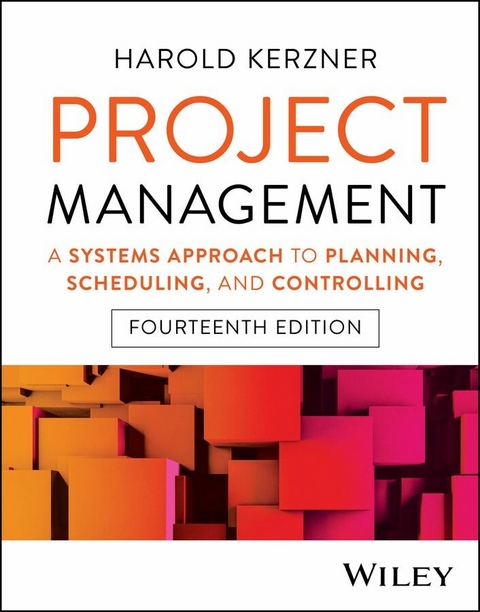
Project Management (eBook)
1758 Seiten
Wiley (Verlag)
978-1-394-29004-8 (ISBN)

The gold standard for project management students and professionals-enhanced with AI, agile, and data-driven strategies in this landmark 14th edition.
For over four decades, Project Management: A Systems Approach to Planning, Scheduling, and Controlling has been the go-to resource for project managers, students, and professionals worldwide. In this newly revised 14th edition, renowned project management expert Harold Kerzner integrates the latest advancements, from artificial intelligence (AI) and data-driven decision-making to agile and hybrid methodologies, ensuring today's project leaders are equipped to navigate an evolving landscape.
Aligned with the Project Management Body of Knowledge (PMBOK® Guide), this bestselling guide prepares readers for the PMP® exam's principles-first approach. Whether you're leading complex global projects, managing sustainability initiatives, or leveraging AI for project insights, this book provides the tools to drive success. In this new 14th edition, you'll find:
- Cutting-edge insights on AI in project management, data-driven strategies, and emerging methodologies.
- Practical frameworks for settting clear objectives, defining project success, and managing risks.
- Comprehensive guidance on agile, hybrid, and traditional project management approaches.
- In-depth coverage of sustainability and corporate social responsibility in project execution.
- Real-world strategies for managing complex, large-scale, and global projects.
Harold Kerzner, is Senior Executive Director for Project Management at the International Institute for Learning, Inc. (IIL), a global learning solutions company offering professional training and consulting services worldwide. Dr. Kerzner's profound effect on the project management industry inspired IIL to establish, in coordination with PMI, the Kerzner International Project Manager of the Year Award, which is presented to a distinguished PMP® or global equivalent each year.
The gold standard for project management students and professionals enhanced with AI, agile, and data-driven strategies in this landmark 14th edition. For over four decades, Project Management: A Systems Approach to Planning, Scheduling, and Controlling has been the go-to resource for project managers, students, and professionals worldwide. In this newly revised 14th edition, renowned project management expert Harold Kerzner integrates the latest advancements, from artificial intelligence (AI) and data-driven decision-making to agile and hybrid methodologies, ensuring today's project leaders are equipped to navigate an evolving landscape. Aligned with the Project Management Body of Knowledge (PMBOK Guide), this bestselling guide prepares readers for the PMP exam's principles-first approach. Whether you're leading complex global projects, managing sustainability initiatives, or leveraging AI for project insights, this book provides the tools to drive success. In this new 14th edition, you'll find: Cutting-edge insights on AI in project management, data-driven strategies, and emerging methodologies. Practical frameworks for settting clear objectives, defining project success, and managing risks. Comprehensive guidance on agile, hybrid, and traditional project management approaches. In-depth coverage of sustainability and corporate social responsibility in project execution. Real-world strategies for managing complex, large-scale, and global projects. Ideal for students, PMP candidates, and practicing professionals, Project Management, 14th Edition remains the gold standard for mastering project management.
1
Overview
1.0 INTRODUCTION
In the United States, the roots of project management date back to the Department of Defense (DOD) and heavy construction companies during the 1960s. Early use of project management focused on the completion of unique, or sometimes repetitive, projects with a heavy focus on compliance with budgets and schedules. To maintain standardization and control in the way that projects were managed, DOD established policies and procedures for gate reviews and the way that status should be reported.
In the early years, project management was seen as a part‐time job rather than as a career path position. In many companies, project management existed in only a small portion of the business, which made it difficult for some projects to get total company support.
Executives began realizing the complexities of resource control and effective project staffing. In addition, the rapid rate of change in both technology and the marketplace created enormous strains on existing organizational forms. The traditional structure, which was highly bureaucratic, showed that it could not respond rapidly enough to a changing environment. Thus, the traditional structure was replaced by project management, or other temporary management structures, that were highly organic and could respond very rapidly as situations developed inside and outside the company. The organic nature of project management practices today allows project managers to customize the project management tools and processes to adapt to a variety of different environments.
The acceptance of project management was not easy. Many executives were not willing to accept change and were inflexible when it came to adapting to a different environment and flexible organizational structures. The project management approach required a departure from the traditional business organizational form, which was basically vertical, and which emphasized a strong superior–subordinate relationship. Many executives had very strong beliefs as to how a company should be run and refused to recognize or admit that project management could benefit their company.
Unfavorable economic conditions forced executives to reconsider the value that project management could bring to a firm. Some of the unfavorable conditions included the recessions of the late 1970s and early 1990s, the housing crisis that began in 2008, the European economy downturn in 2013 and 2014, the world economic slowdown in 2015, and the COVID‐19 pandemic. These unfavorable conditions emphasized the need for better control of existing resources, the creation of a portfolio of projects that would maximize the value brought to the firm, and a higher percentage of project successes. It soon became apparent that project management could satisfy all of these needs, and that project management is a necessity in both bad and good economic conditions. Today, the concept behind project management is being applied in such diverse industries and organizations as defense, construction, pharmaceuticals, chemicals, banking, hospitals, accounting, advertising, law, state and local governments, and the United Nations.
Almost all of today's executives are convinced that project management can and does work well. Project management is now being applied to all facets of a business rather than just parts of the business. Projects are now being aligned with corporate or strategic objectives. Simply stated, “Why work on a project that is not aligned to strategic objectives with the goal of creating business value?” In some companies – such as IBM, Microsoft, and Hewlett‐Packard – project management is recognized as a strategic competency necessary for the survival of the firm. This recognition of the importance of project management today permeates almost all industries and companies of all sizes.
1.1 UNDERSTANDING PROJECT MANAGEMENT
In order to understand project management, one must begin with the definition of a project. A project can be any series of activities and tasks that:
- Have a specific objective, with a focus on the creation of business value, to be completed within certain specifications
- Have defined start and end dates
- Have funding limits (if applicable)
- Consume human and nonhuman resources (i.e., money, people, equipment)
- Are multifunctional (i.e., cut across several functional lines)
The result or outcome of the project can be unique or repetitive and must be achieved within a finite period. Because companies have very limited resources, care must be taken that the right mix of projects is approved. As such, another outcome of a project is that it provides business value to the company as opposed to being a “pet” project for the personal whims of one person.
Project management is the application of knowledge, skills, and tools necessary to achieve the project's requirements. The knowledge, skills, and tools are usually grouped into activities or processes. PMI®'s PMBOK® Guide, 6th edition, identified five process groups. Some of the activities within these groups included:
- Project initiation
- Selection of the best project given resource limits
- Recognizing the benefits of the project
- Preparation of the documents to sanction the project
- Assigning of the project manager
- Project planning
- Definition of the work requirements
- Definition of the quality and quantity of work
- Definition of the resources needed
- Scheduling the activities
- Evaluation of the various risks
- Project execution
- Negotiating for the project team members
- Directing and managing the work
- Working with the team members to help them improve
- Project monitoring and control
- Tracking progress
- Comparing actual outcome to predicted outcome
- Analyzing variances and impacts
- Making adjustments when necessary
- Project closure
- Verifying that all of the work has been accomplished
- Contractual closure of the contract
- Financial closure of the charge numbers
- Administrative closure of the paperwork
Many companies viewed the five process groups as life‐cycle phases and created a singular methodology that all projects were required to follow. Each process group had documentation requirements and performance measurements, and reporting was aligned to the process groups. This one‐size‐fits‐all approach limited the flexibility that project teams needed to customize project management to the requirements of each project. In the 7th edition of the PMBOK® Guide, it was recommended that project teams be given the freedom to select their own approach for each project as well as the models, methods, and artifacts best suited for this project.
The 6th edition of the PMBOK® Guide focused on process groups and areas of knowledge, with an emphasis on the inputs, tools and outputs needed. In the 7th edition, the emphasis was on eight performance domain areas that are deemed critical for repetitive project success:
- Stakeholders
- Team
- Development Approach and Life Cycle
- Planning
- Project Work
- Delivery
- Measurement
- Uncertainty
Although each of the eight domains appears as independent, the domains overlap and interact with each other. The information within the domains can be customized for each project. The processes, tools, and techniques discussed in the 6th edition of the PMBOK® Guide direct the behavior that project managers should consider for the performance domains to be successfully implemented.
Successful project management, as seen from a corporate perspective, can be defined as achieving a continuous stream of project objectives within time, within cost, at the desired performance/technology level, while utilizing the assigned resources effectively and efficiently, and by providing customers and/or stakeholders with the benefits and value they expected. Because each project is inherently different and each customer can have different requirements, the activities included within the performance domains may change from project to project. The PMBOK® Guide identifies industry‐accepted activities regarded as best practices for each performance domain and these best practices can be structured to create several project management delivery systems that can be applied and customized to a variety of projects.
The potential benefits from effective project management are:
- Clear identification of functional responsibilities to ensure that all activities are accounted for, regardless of personnel turnover
- Minimizing the need for continuous reporting
- Identification of time limits for scheduling
- Identification of a methodology for trade‐off analysis
- Measurement of accomplishment against plans
- Early identification of problems so that corrective action may follow
- Improved estimating capability for future planning
- Knowing when objectives cannot be met or will be exceeded
Unfortunately, the benefits cannot be achieved without overcoming obstacles such as project complexity, customer's special requirements and scope changes, organizational restructuring, project risks, changes in technology, and forward planning and pricing.
Project management is designed to make better use of...
| Erscheint lt. Verlag | 25.2.2025 |
|---|---|
| Sprache | englisch |
| Themenwelt | Technik ► Maschinenbau |
| Wirtschaft ► Betriebswirtschaft / Management ► Projektmanagement | |
| Schlagworte | Advanced Project Management • agile project management • AI-driven project strategies • AI in Project Management • best project management book • CAPM exam prep • Complex project management • Construction Project Management • corporate social responsibility projects • data-driven project management • Digital project management • Effective project management • engineering project management • Enterprise Project Management • Harold Kerzner • Hybrid Project Management • IT Project Management • leadership in project management • managing diverse teams • PMBOK guide • PMO strategies • PMP certification • pmp exam prep • pmp study guide • professional project management • program management • Project Controlling • Project execution • Project Governance • Project Leadership • Project Management • project management best practices • project management book • project management certification • Project management guide • project management methodologies • project management professional • project management success • Project Management Techniques • Project Management textbook • Project Management Tools • project management training • project manager handbook • Project Planning • Project Portfolio Management • Project Scheduling • Risk Management • Software Project Management • Stakeholder Management • Strategic Project Management • sustainability in project management |
| ISBN-10 | 1-394-29004-7 / 1394290047 |
| ISBN-13 | 978-1-394-29004-8 / 9781394290048 |
| Informationen gemäß Produktsicherheitsverordnung (GPSR) | |
| Haben Sie eine Frage zum Produkt? |
 EPUB (Adobe DRM)
Kopierschutz: Adobe-DRM
Adobe-DRM ist ein Kopierschutz, der das eBook vor Mißbrauch schützen soll. Dabei wird das eBook bereits beim Download auf Ihre persönliche Adobe-ID autorisiert. Lesen können Sie das eBook dann nur auf den Geräten, welche ebenfalls auf Ihre Adobe-ID registriert sind.
Details zum Adobe-DRM
Dateiformat: EPUB (Electronic Publication)
EPUB ist ein offener Standard für eBooks und eignet sich besonders zur Darstellung von Belletristik und Sachbüchern. Der Fließtext wird dynamisch an die Display- und Schriftgröße angepasst. Auch für mobile Lesegeräte ist EPUB daher gut geeignet.
Systemvoraussetzungen:
PC/Mac: Mit einem PC oder Mac können Sie dieses eBook lesen. Sie benötigen eine
eReader: Dieses eBook kann mit (fast) allen eBook-Readern gelesen werden. Mit dem amazon-Kindle ist es aber nicht kompatibel.
Smartphone/Tablet: Egal ob Apple oder Android, dieses eBook können Sie lesen. Sie benötigen eine
Geräteliste und zusätzliche Hinweise
Buying eBooks from abroad
For tax law reasons we can sell eBooks just within Germany and Switzerland. Regrettably we cannot fulfill eBook-orders from other countries.
aus dem Bereich