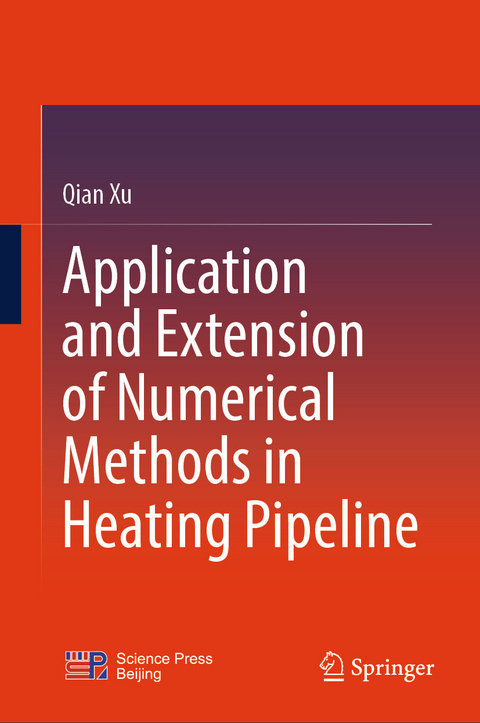
Application and Extension of Numerical Methods in Heating Pipeline (eBook)
XIV, 313 Seiten
Springer Nature Singapore (Verlag)
9789819611201 (ISBN)
This book is a summary of the author's pioneering work on the theory of heating pipelines and its application expansion over the years, trying to establish a complete logical system from the basic theory of pipelines to the application of heating pipelines to the innovation and expansion of large-diameter energy transmission pipelines. These esoteric fundamental theories are linked to practical applications, and numerical simulations are used to help readers understand the problems faced by pipelines in engineering practice.
The book consists of four chapters, the first chapter describes the basic concepts of district heating system, related standards, development history, facing problems and future prospects, while for the basic characteristics of district heating pipe network installation and laying methods made an introduction; followed by the second chapter summarizes and organizes the pipeline safety research of fluid-solid heat, elastic-plasticity and other basic theories, as well as heating pipeline thermal insulation system heat loss and the economic evaluation of theory and so on. Based on the basic theory of pipeline, the third and fourth chapters introduce several typical pipeline application cases in detail, and each case includes modelling, solving, and result analysis, which can provide readers with technical references and idea guidelines in the field of pipeline research. The third chapter of the different structures of the heating pipeline from the safety and economic aspects of a detailed numerical study; the fourth chapter in the heating pipeline on the basis of energy transportation pipeline, transportation medium from the original hot water, hot steam to the oil and gas, specifically introduced various types of large-diameter energy transportation pipeline under the action of different loads of the dynamic response characteristics.
It has important theoretical significance for enriching and developing the basic theory of pipeline and the expansion of all kinds of pipeline applications, and at the same time, it provides technical guidance for the safe, stable, economic and efficient operation of all kinds of long-distance pipelines, such as heating pipelines and energy transmission and transportation pipelines. It helps readers to systematically and comprehensively understand the basic theories of elasticity and plasticity, fluid-solid-thermal coupling, and economic evaluation of pipelines, and at the same time provides readers with new research ideas and technical means from the perspective of scientific research.
This book is a summary of the author's pioneering work on the theory of heating pipelines and its application expansion over the years, trying to establish a complete logical system from the basic theory of pipelines to the application of heating pipelines to the innovation and expansion of large-diameter energy transmission pipelines. These esoteric fundamental theories are linked to practical applications, and numerical simulations are used to help readers understand the problems faced by pipelines in engineering practice. The book consists of four chapters, the first chapter describes the basic concepts of district heating system, related standards, development history, facing problems and future prospects, while for the basic characteristics of district heating pipe network installation and laying methods made an introduction; followed by the second chapter summarizes and organizes the pipeline safety research of fluid-solid heat, elastic-plasticity and other basic theories, as well as heating pipeline thermal insulation system heat loss and the economic evaluation of theory and so on. Based on the basic theory of pipeline, the third and fourth chapters introduce several typical pipeline application cases in detail, and each case includes modelling, solving, and result analysis, which can provide readers with technical references and idea guidelines in the field of pipeline research. The third chapter of the different structures of the heating pipeline from the safety and economic aspects of a detailed numerical study; the fourth chapter in the heating pipeline on the basis of energy transportation pipeline, transportation medium from the original hot water, hot steam to the oil and gas, specifically introduced various types of large-diameter energy transportation pipeline under the action of different loads of the dynamic response characteristics. It has important theoretical significance for enriching and developing the basic theory of pipeline and the expansion of all kinds of pipeline applications, and at the same time, it provides technical guidance for the safe, stable, economic and efficient operation of all kinds of long-distance pipelines, such as heating pipelines and energy transmission and transportation pipelines. It helps readers to systematically and comprehensively understand the basic theories of elasticity and plasticity, fluid-solid-thermal coupling, and economic evaluation of pipelines, and at the same time provides readers with new research ideas and technical means from the perspective of scientific research.
| Erscheint lt. Verlag | 19.2.2025 |
|---|---|
| Zusatzinfo | XIV, 313 p. 166 illus., 130 illus. in color. |
| Sprache | englisch |
| Themenwelt | Mathematik / Informatik ► Mathematik ► Angewandte Mathematik |
| Naturwissenschaften ► Physik / Astronomie ► Mechanik | |
| Technik ► Bauwesen | |
| Technik ► Maschinenbau | |
| Schlagworte | Blood vessel • Elastoplastic • Equivalent stress • Fluid-solid thermal coupling • Heating pipeline • Structural Deformation |
| ISBN-13 | 9789819611201 / 9789819611201 |
| Informationen gemäß Produktsicherheitsverordnung (GPSR) | |
| Haben Sie eine Frage zum Produkt? |
 PDF (Wasserzeichen)
DRM: Digitales Wasserzeichen
Dieses eBook enthält ein digitales Wasserzeichen und ist damit für Sie personalisiert. Bei einer missbräuchlichen Weitergabe des eBooks an Dritte ist eine Rückverfolgung an die Quelle möglich.
Dateiformat: PDF (Portable Document Format)
Mit einem festen Seitenlayout eignet sich die PDF besonders für Fachbücher mit Spalten, Tabellen und Abbildungen. Eine PDF kann auf fast allen Geräten angezeigt werden, ist aber für kleine Displays (Smartphone, eReader) nur eingeschränkt geeignet.
Systemvoraussetzungen:
PC/Mac: Mit einem PC oder Mac können Sie dieses eBook lesen. Sie benötigen dafür einen PDF-Viewer - z.B. den Adobe Reader oder Adobe Digital Editions.
eReader: Dieses eBook kann mit (fast) allen eBook-Readern gelesen werden. Mit dem amazon-Kindle ist es aber nicht kompatibel.
Smartphone/Tablet: Egal ob Apple oder Android, dieses eBook können Sie lesen. Sie benötigen dafür einen PDF-Viewer - z.B. die kostenlose Adobe Digital Editions-App.
Buying eBooks from abroad
For tax law reasons we can sell eBooks just within Germany and Switzerland. Regrettably we cannot fulfill eBook-orders from other countries.
aus dem Bereich