


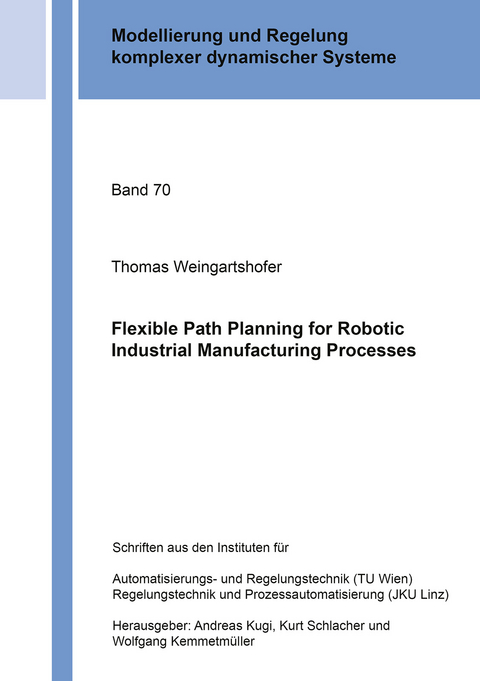
Flexible Path Planning for Robotic Industrial Manufacturing Processes
Seiten
The current challenge in flexible production with highly automated production lines is the ongoing trend toward customization of products up to full individualization. Consequently, path-planning algorithms for industrial robots have to keep pace with this trend. This work presents flexible planning algorithms to support the automatic generation of robot programs in flexible automation to solve complex path-planning problems in industrial processes on freeform 3D surfaces.
In industry, offline robot programming approaches using computer-aided workflows, where manufacturing paths are generated manually or semi-automatically, are state-of-the-art. This work investigates a fully automatic generation of robot programs for 3D workpieces based on user-generated 2D input patterns. In addition, a robotic work cell must be able to execute an industrial process on a wide range of products. If specific manufacturing paths are not executable, laborious adaptions of the robot placement or manufacturing path are necessary. In some instances, adapting the tool mounting on the end-effector can also lead to executable robot trajectories, which is shown in this work. To further increase the flexibility of given work cells, the distinct properties of the manufacturing process, i.e., redundant degrees of freedom and allowed deviations from the manufacturing path can significantly enlarge the path planning search space. Hence, an optimization-based joint-space path planner is developed, which systematically includes these process properties.
The developed algorithms are demonstrated experimentally for a drawing task and in simulation for a trimming and spray-painting task, which are manufacturing processes representative of industrial processes on freeform 3D surfaces.
In industry, offline robot programming approaches using computer-aided workflows, where manufacturing paths are generated manually or semi-automatically, are state-of-the-art. This work investigates a fully automatic generation of robot programs for 3D workpieces based on user-generated 2D input patterns. In addition, a robotic work cell must be able to execute an industrial process on a wide range of products. If specific manufacturing paths are not executable, laborious adaptions of the robot placement or manufacturing path are necessary. In some instances, adapting the tool mounting on the end-effector can also lead to executable robot trajectories, which is shown in this work. To further increase the flexibility of given work cells, the distinct properties of the manufacturing process, i.e., redundant degrees of freedom and allowed deviations from the manufacturing path can significantly enlarge the path planning search space. Hence, an optimization-based joint-space path planner is developed, which systematically includes these process properties.
The developed algorithms are demonstrated experimentally for a drawing task and in simulation for a trimming and spray-painting task, which are manufacturing processes representative of industrial processes on freeform 3D surfaces.
| Erscheinungsdatum | 13.05.2025 |
|---|---|
| Reihe/Serie | Modellierung und Regelung komplexer dynamischer Systeme ; 70 |
| Verlagsort | Düren |
| Sprache | englisch |
| Maße | 170 x 240 mm |
| Gewicht | 302 g |
| Themenwelt | Technik ► Elektrotechnik / Energietechnik |
| Schlagworte | Flexible Manufacturing • industrial robots • Path Planning |
| ISBN-10 | 3-8440-9938-7 / 3844099387 |
| ISBN-13 | 978-3-8440-9938-6 / 9783844099386 |
| Zustand | Neuware |
| Informationen gemäß Produktsicherheitsverordnung (GPSR) | |
| Haben Sie eine Frage zum Produkt? |
Mehr entdecken
aus dem Bereich

aus dem Bereich
Grundlagen, Systemtechnik und Analysen ausgeführter Beispiele …
Buch | Softcover (2025)
Springer Vieweg (Verlag)
CHF 55,95
Wegweiser für Elektrofachkräfte
Buch | Hardcover (2024)
VDE VERLAG
CHF 67,20
Planungsfehler vermeiden – Probleme analysieren – Arbeitszahlen …
Buch | Softcover (2024)
VDE VERLAG
CHF 61,60


