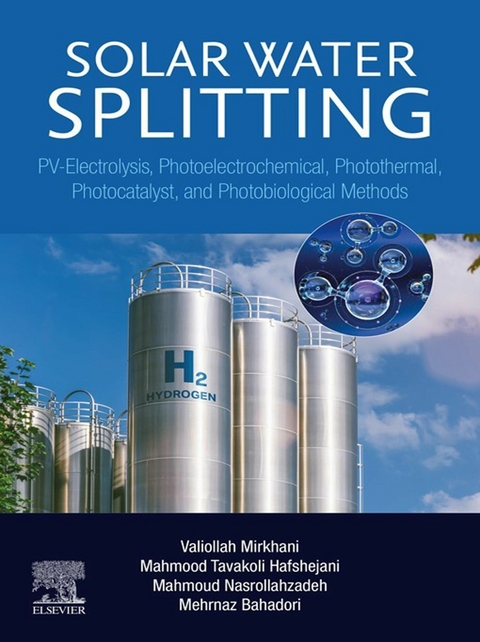
Solar Water Splitting (eBook)
300 Seiten
Elsevier Science (Verlag)
978-0-443-13958-1 (ISBN)
Dr. Valiollah Mirkhani received his B.Sc. (1993) in Applied Chemistry, M.Sc. (1995) in Inorganic Chemistry, and Ph.D. degree in Inorganic Chemistry from Isfahan University, Iran, in 1999. After completing his Ph.D. degree, he continued his activities as an Assistant Professor at the University of Isfahan. Dr. Mirkhani is a member of the editorial board of Inorganic Chemistry Research and Nanochemistry Research and has published more than 400 scientific papers with over 11000 citations.
Solar Water Splitting: PV-Electrolysis, Photoelectrochemical, Photothermal, Photocatalyst, and Photobiological Methods is a fundamental resource offering detailed information on PV-electrolysis, photoelectrochemical, photothermal, photocatalyst, photobiological, and other innovative methods for the production of hydrogen gas, as well as presenting the theory, design, and materials involved. This is supported by application examples and recent developments in areas such as tandem cells, dye-sensitized photoelectrochemical cells, and perovskite cells for solar water splitting.This book will be of interest to researchers, scientists, and advanced students across solar energy, renewable energy, chemistry, chemical engineering, nanotechnology, and materials science, as well as engineers and industrial personnel with an interest in water splitting, solar cells, and hydrogen production. - Introduces the theory, design, and materials of solar water splitting- Provides in-depth coverage of a range of processes and applications- Reviews current progress and considers future opportunities
| Erscheint lt. Verlag | 15.2.2025 |
|---|---|
| Sprache | englisch |
| Themenwelt | Technik ► Elektrotechnik / Energietechnik |
| ISBN-10 | 0-443-13958-X / 044313958X |
| ISBN-13 | 978-0-443-13958-1 / 9780443139581 |
| Informationen gemäß Produktsicherheitsverordnung (GPSR) | |
| Haben Sie eine Frage zum Produkt? |
 EPUB (Adobe DRM)
Kopierschutz: Adobe-DRM
Adobe-DRM ist ein Kopierschutz, der das eBook vor Mißbrauch schützen soll. Dabei wird das eBook bereits beim Download auf Ihre persönliche Adobe-ID autorisiert. Lesen können Sie das eBook dann nur auf den Geräten, welche ebenfalls auf Ihre Adobe-ID registriert sind.
Details zum Adobe-DRM
Dateiformat: EPUB (Electronic Publication)
EPUB ist ein offener Standard für eBooks und eignet sich besonders zur Darstellung von Belletristik und Sachbüchern. Der Fließtext wird dynamisch an die Display- und Schriftgröße angepasst. Auch für mobile Lesegeräte ist EPUB daher gut geeignet.
Systemvoraussetzungen:
PC/Mac: Mit einem PC oder Mac können Sie dieses eBook lesen. Sie benötigen eine
eReader: Dieses eBook kann mit (fast) allen eBook-Readern gelesen werden. Mit dem amazon-Kindle ist es aber nicht kompatibel.
Smartphone/Tablet: Egal ob Apple oder Android, dieses eBook können Sie lesen. Sie benötigen eine
Geräteliste und zusätzliche Hinweise
Buying eBooks from abroad
For tax law reasons we can sell eBooks just within Germany and Switzerland. Regrettably we cannot fulfill eBook-orders from other countries.
aus dem Bereich