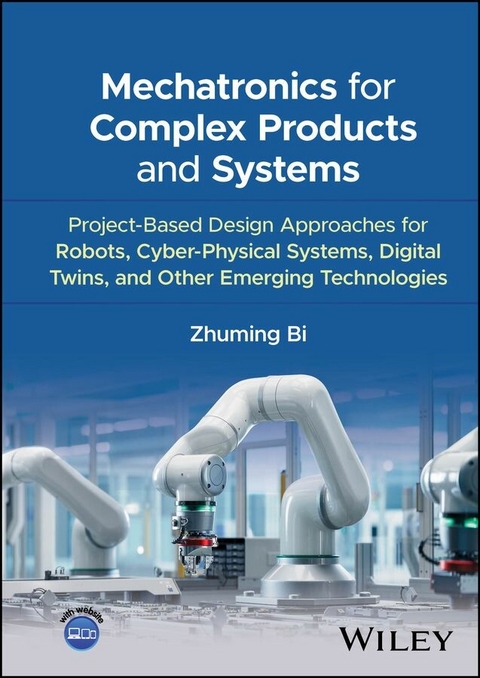
Mechatronics for Complex Products and Systems (eBook)
1371 Seiten
Wiley (Verlag)
978-1-394-20960-6 (ISBN)

A project-based approach to designing mechatronic systems with new and emerging technologies
In Mechatronics for Complex Products and Systems: Project-Based Designs for Cyber-Physical Systems, Digital Twins, and Other Emerging Technologies, distinguished researcher Dr. Zhuming Bi delivers an expert discussion of real-world mechatronics skills that students will need in their engineering careers.
The book explains the characteristics and innovation principles underlying mechatronic systems, including modularization, adaptability, predictability, sustainability, and concurrent engineering. A mechatronic system is decomposed into a set of mechatronic functional modules such as power systems, actuating systems, sensing systems, systems of signal conditioning and processing, and control systems.
The author also offers:
- A thorough introduction from classic integration of mechanical, electronic and electrical systems to more complex products and systems, including cyber-physical systems, robotics, human-robot interactions, digital twins, and Internet of Things applications
- Insightful project assignments that help reinforce a practical understanding of a learning subject
- Practical discussions of real-world engineering problems
- Comprehensive guidance on how to select the right type of sensors, motors, and controllers for a variety of mechatronic functional modules
Perfect for advanced undergraduate and graduate students of mechatronics, Mechatronics for Complex Products and Systems will also benefit professional engineers working on interdisciplinary projects enabled by digital technologies, Internet of Things (IoT), and Artificial Intelligence (AI).
Zhuming Bi, PhD, is a Professor of Mechanical Engineering in the Department of Civil and Mechanical Engineering and Harris Chair in Wireless Communication and Applied Research at Purdue University Fort Wayne. He was a 2023-2024 Fulbright-Nokia Distinguished Chair in Information Communications Technologies (ICT). He has previously held positions at the Nanjing University of Science and Technology (China), Northern Ireland Technology Center (UK), the National Research Council of Canada (Canada), National Institute of Standards and Technology (USA), and Lappeenranta University of Technology (Finland).
1
Introduction
1.1 Introduction
Mechatronics is an engineering discipline that brings multiple conventional disciplines including mechanical, electrical, electronic, and information engineering together to optimize the solutions to various engineering problems. Originally, the concept of Mechatronics was coined by a Japanese Engineer Tetsuro Mori from the words of mechanical engineering and electronics in 1969. Nowadays, the coverage of modern mechatronics has gone far beyond from the integration of conventional engineering disciplines to the extension to many new disciplines such as artificial intelligence (AI), telecommunications, and cybersecurity as long as emerging disciplines can be integrated to enhance the capabilities of mechatronic systems.
In comparison with conventional systems, a mechatronic system consists of a set of multiple mechatronic components that exhibit multidisciplinary behaviors. Therefore, the design of a mechatronic system must be performed concurrently, so that design constraints in multiple disciplines can be modeled, analyzed, and satisfied simultaneously. From this perspective, mechatronics is also viewed as a philosophy where a system design associated with multiple disciplines is performed concurrently to seek integrated solutions to complex engineering problems. Mechatronics becomes a growing discipline that has been, and it will be evolve continuously with emerging technological advancements in Materials, Science, Processes, Engineering, Integration technologies, and Information Technologies (ITs). Most of the classic books on mechatronics have lagged to reflect recent advancements, especially in ITs. In the following sections, the trends of the developments in engineering designs, integration technologies, and ITs are discussed with a focus on their impact on Mechatronics.
1.2 Growing Complexity of Engineering Designs
Engineering design is to formulate customer's requirements (CRs) into a design problem with specified constraints and objectives and develop a design solution (DS) that can satisfy CRs optimally. A complete engineering design usually includes design for manufacturing (DfM) and design for assembly (DfA) where the constraints of manufacturing or assembling processes are taken into considerations at the phases of manufacturing and assembling, respectively. By DfM and DfA, a virtual model can be used to analyze system behaviors, predict system outcomes, and verify if all design constraints can be satisfied. These reduce the needs of iterations when design defects are identified and fixed at late phases of system development.
Since the information and knowledge about a product or system are accumulated gradually when its design process proceeds, the constraints involved in later design stages cannot be verified until relevant information becomes available. This becomes an obvious reason why an engineering design process is naturally iterative. In other words, the constraints that are ignored in early design phases must be verified later. In such a way, a design space with tentative solutions should be continuously refined to satisfy more and more constraints until all of them are fully satisfied.
It is desirable that less number of iterations is needed to transform a virtual model into a physical model. This implies that design iterations all occur in the virtual world with no additional cost on physical prototyping. The finalized virtual model is converted into its physical model correctly at the first time. It is referred as First‐Time Right (FTR) practice (Bi and Wang 2020). The methodologies for engineering designs are being advanced continuously to cope with the growing complexity of products or systems in their lifecycles from design to manufacturing, assembly, application, and to disposal. Figure 1.1 shows the trend of increasing complexity of engineering designs from the perspective of manufacturing (Alkan et al. 2018). The growth of the complexity of a manufacturing system can be observed in the aspects of products, enabling technologies, and business environments.
Figure 1.2 shows the dimensions of complexity in engineering designs that are dependent on those of products, technologies, and degrees of dynamics and uncertainties. The complexity of each aspect could be further decomposed when the solutions to corresponding functional requirements are not available. Accordingly, the complexity of products depends on many factors including the number of parts and assemblies, the degrees of connectivity, nonlinearity, and dynamics, the number of accessible technologies, and the levels of technological difficulties and assistive technologies.
Figure 1.1 Dimensions of growing complexity of engineering designs
Figure 1.2 The dimensions of complexity in engineering design: products, technologies, and degrees of dynamics and uncertainties
1.2.1 Products
The complexity of a product has been measured by numerous factors such as types and numbers of constitutive parts and components, types and numbers of the processes to manufacture parts and assemble parts into components, variants and volumes of products, and system performance criteria such as quality, lead‐time, cost, lifespan, and after‐sales services of products (Orfi et al. 2011). Researchers agree that the scale and the complexity of modern products have been increasing greatly. Figure 1.3 shows some examples of main variables that affect the complexity of products (i.e., lawn mowers, grand pianos, cars, and airplanes); some factors such as numbers, types, and complexity of constitutive components contribute to the complexity of products directly. It seems clear that a product with a high‐level complexity involves a high number and types of simple or complex parts and components.
The growing complexity of modern products can be evidenced by the evolution of various product families. Adamsson (2005, 2007) used the examples of wiring harnesses to show an increase in the complexity of automotive products. An automobile in 1949 had ~60 contact points with ~40 wires. An automobile in 1990 had around 3800 contact points and used approximately 1900 wires with a total length of ~3 km. An automobile in 1999 used 110 electric motors and 60 electronic control units (ECUs). Three data bus systems were used to support information integration and data exchanges. BeyondPLM (2018) discussed the trend of the ever‐increasing complexity of modern products; it was associated with the number of configuration items (NICs). A typical mechanical system, mechatronic system, and large‐scale integrated system have typically less than 103, 103–105, and over 108 NICs, respectively.
Product complexity is related to numerous factors in manufacturing and production such as design, development, manufacturing, assembly, and supply chain management. As shown in Figure 1.4a, product complexity was modeled in the dimensions of designs, manufacturing processes, functionalities, and varieties. A manufacturer can be profitable only when the complexity of products and associated processes can be managed by mechatronic design at the design phase and by mass customization at the manufacturing phase appropriately. As shown in Figure 1.4b), the more products a company makes, the higher revenue the company can gain. On the other hand, making more product variants implies the increase in the complexity of the corresponding production system, thus affecting the productivity, lead time, and cost reduction. Production cost increases monolithically with the number of products and variants. Knowing customers' needs becomes a strategic resource to enterprises now. However, there is a limited business window for enterprises to make products to meet customers’ needs in a profitable way. To expand a profitable business window, efforts can be made to increase the production revenue by making more products through mass customization and reduce the development cost by increasing system efficiency such as through mechatronic design.
Figure 1.3 Examples of product complexity versus numbers of parts
With the need for more versatile and advanced products, the number and types of parts and the complexity levels of parts are expected to be increased continuously. The complexity of products due to other factors, such as volume and variety in enterprise and personalization, has been thoroughly discussed by other scholars (Bi et al. 2021a). The survey of over 246 engineers by Rowe (2019) concluded that the complexity of products was continuously increasing, and design methodologies need to evolve to manage the complexity effectively. Ninety‐two percent of the engineers reported that in the last five years, the products had increased the complexity in various aspects such as intricate mechanical designs, embedded electronics, and newly introduced materials and processes. It was found that the main causes of increased products’ complexities were attributed by intricate mechanical design (57%), more electronics (47%), adoption of different materials (43%), reduced reductions (40%), system integration (30%), compacted...
| Erscheint lt. Verlag | 12.2.2025 |
|---|---|
| Sprache | englisch |
| Themenwelt | Technik ► Maschinenbau |
| Schlagworte | Artificial Intelligence • Cyber-Physical Systems • digital triads • Digital Twins • Human-Cyber-Physical Systems • innovation technologies • internet of things • Mechatronics • Metaverse. • model-based designs • project-based designs • Robotics • Sustainable Systems |
| ISBN-10 | 1-394-20960-6 / 1394209606 |
| ISBN-13 | 978-1-394-20960-6 / 9781394209606 |
| Informationen gemäß Produktsicherheitsverordnung (GPSR) | |
| Haben Sie eine Frage zum Produkt? |
 EPUB (Adobe DRM)
Kopierschutz: Adobe-DRM
Adobe-DRM ist ein Kopierschutz, der das eBook vor Mißbrauch schützen soll. Dabei wird das eBook bereits beim Download auf Ihre persönliche Adobe-ID autorisiert. Lesen können Sie das eBook dann nur auf den Geräten, welche ebenfalls auf Ihre Adobe-ID registriert sind.
Details zum Adobe-DRM
Dateiformat: EPUB (Electronic Publication)
EPUB ist ein offener Standard für eBooks und eignet sich besonders zur Darstellung von Belletristik und Sachbüchern. Der Fließtext wird dynamisch an die Display- und Schriftgröße angepasst. Auch für mobile Lesegeräte ist EPUB daher gut geeignet.
Systemvoraussetzungen:
PC/Mac: Mit einem PC oder Mac können Sie dieses eBook lesen. Sie benötigen eine
eReader: Dieses eBook kann mit (fast) allen eBook-Readern gelesen werden. Mit dem amazon-Kindle ist es aber nicht kompatibel.
Smartphone/Tablet: Egal ob Apple oder Android, dieses eBook können Sie lesen. Sie benötigen eine
Geräteliste und zusätzliche Hinweise
Buying eBooks from abroad
For tax law reasons we can sell eBooks just within Germany and Switzerland. Regrettably we cannot fulfill eBook-orders from other countries.
aus dem Bereich