
Smart Cyber-Physical Power Systems, Volume 1 (eBook)
803 Seiten
Wiley (Verlag)
978-1-394-19150-5 (ISBN)
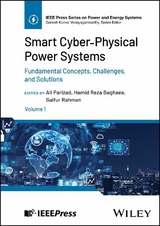
Authoritative, highly comprehensive guide on how emerging technologies can address various challenges in different sectors of smart cyber-physical power systems
As the world shifts towards smarter and more resilient energy systems, cyber-physical power systems (CPSs) represent a critical step in modernizing the power infrastructure. Smart Cyber-Physical Power Systems, Volume 1: Fundamental Concepts, Challenges, and Solutions, offers an in-depth exploration of the fundamental concepts, structures, and major challenges that underlie these complex systems. It covers the essential theories and frameworks that drive the integration of digital technologies with physical power systems, including smart grids, microgrids, and the Internet of Energy.
This volume addresses a range of crucial topics, from global demand response strategies and microgrid architectures to smart energy management in cities and advanced distributed control strategies. Additionally, it highlights key challenges such as ensuring resiliency, protecting against cyberattacks, and maintaining reliability in the face of rapid technological advancements.
Experts from around the world contribute to this volume, sharing vital insights into the transformation of traditional power systems into adaptive, cyber-physical networks. Their focus on the growing importance of privacy, security, and data analytics makes this book a critical resource for anyone involved in power system research, offering essential tools to navigate and shape the future landscapes of energy systems.
Whether you're a researcher, engineer, or industry professional, this volume provides the foundational knowledge needed to understand the evolving landscape of smart cyber-physical power systems and the significant challenges they face.
Join us on a journey through the landscape of Smart Cyber-Physical Power Systems (CPPSs), where cutting-edge solutions meet the challenges of today and forge the energy paradigms of tomorrow, driven by AI/ML, Big Data, Blockchain, IoT, Quantum Computing, Information Theory, Edge Computing, Metaverse, DevOps, and more.
Ali Parizad, PhD, is a Postdoctoral Associate at the Advanced Research Institute (ARI) of Virginia Polytechnic Institute and State University, VA, USA. Leveraging his extensive academic background, he served as a Senior Data Scientist in the IDA Data Science & Machine Learning (DSML) Department at Shell Energy. He holds the position of Staff Power Systems Machine Learning Engineer at Thinklabs AI, where he tackles critical challenges in power systems with cutting-edge AI applications.
Hamid Reza Baghaee, PhD, is an Associate Research Professor at Amirkabir University of Technology, Tehran, Iran.
Saifur Rahman, PhD, is the founding director of the Advanced Research Institute at Virginia Tech, where he is the Joseph R. Loring Professor of Electrical and Computer Engineering.
Authoritative, highly comprehensive guide on how emerging technologies can address various challenges in different sectors of smart cyber-physical power systems As the world shifts towards smarter and more resilient energy systems, cyber-physical power systems (CPSs) represent a critical step in modernizing the power infrastructure. Smart Cyber-Physical Power Systems, Volume 1: Fundamental Concepts, Challenges, and Solutions, offers an in-depth exploration of the fundamental concepts, structures, and major challenges that underlie these complex systems. It covers the essential theories and frameworks that drive the integration of digital technologies with physical power systems, including smart grids, microgrids, and the Internet of Energy. This volume addresses a range of crucial topics, from global demand response strategies and microgrid architectures to smart energy management in cities and advanced distributed control strategies. Additionally, it highlights key challenges such as ensuring resiliency, protecting against cyberattacks, and maintaining reliability in the face of rapid technological advancements. Experts from around the world contribute to this volume, sharing vital insights into the transformation of traditional power systems into adaptive, cyber-physical networks. Their focus on the growing importance of privacy, security, and data analytics makes this book a critical resource for anyone involved in power system research, offering essential tools to navigate and shape the future landscapes of energy systems. Whether you re a researcher, engineer, or industry professional, this volume provides the foundational knowledge needed to understand the evolving landscape of smart cyber-physical power systems and the significant challenges they face. Join us on a journey through the landscape of Smart Cyber-Physical Power Systems (CPPSs), where cutting-edge solutions meet the challenges of today and forge the energy paradigms of tomorrow, driven by AI/ML, Big Data, Blockchain, IoT, Quantum Computing, Information Theory, Edge Computing, Metaverse, DevOps, and more.
| Erscheint lt. Verlag | 11.2.2025 |
|---|---|
| Reihe/Serie | IEEE Press Series on Power and Energy Systems |
| Sprache | englisch |
| Themenwelt | Technik ► Elektrotechnik / Energietechnik |
| Schlagworte | Artificial Intelligence • Big Data • Blockchain • cyber-physical power systems • cyber-physical-social power systems • Data Science • deep neural networks • Digital Twins • Information Theory • IOT • machine learning • Microgrids • Power Systems • Quantum Computing • Smart Grids |
| ISBN-10 | 1-394-19150-2 / 1394191502 |
| ISBN-13 | 978-1-394-19150-5 / 9781394191505 |
| Informationen gemäß Produktsicherheitsverordnung (GPSR) | |
| Haben Sie eine Frage zum Produkt? |
 PDF (Adobe DRM)
Kopierschutz: Adobe-DRM
Adobe-DRM ist ein Kopierschutz, der das eBook vor Mißbrauch schützen soll. Dabei wird das eBook bereits beim Download auf Ihre persönliche Adobe-ID autorisiert. Lesen können Sie das eBook dann nur auf den Geräten, welche ebenfalls auf Ihre Adobe-ID registriert sind.
Details zum Adobe-DRM
Dateiformat: PDF (Portable Document Format)
Mit einem festen Seitenlayout eignet sich die PDF besonders für Fachbücher mit Spalten, Tabellen und Abbildungen. Eine PDF kann auf fast allen Geräten angezeigt werden, ist aber für kleine Displays (Smartphone, eReader) nur eingeschränkt geeignet.
Systemvoraussetzungen:
PC/Mac: Mit einem PC oder Mac können Sie dieses eBook lesen. Sie benötigen eine
eReader: Dieses eBook kann mit (fast) allen eBook-Readern gelesen werden. Mit dem amazon-Kindle ist es aber nicht kompatibel.
Smartphone/Tablet: Egal ob Apple oder Android, dieses eBook können Sie lesen. Sie benötigen eine
Geräteliste und zusätzliche Hinweise
Buying eBooks from abroad
For tax law reasons we can sell eBooks just within Germany and Switzerland. Regrettably we cannot fulfill eBook-orders from other countries.
aus dem Bereich