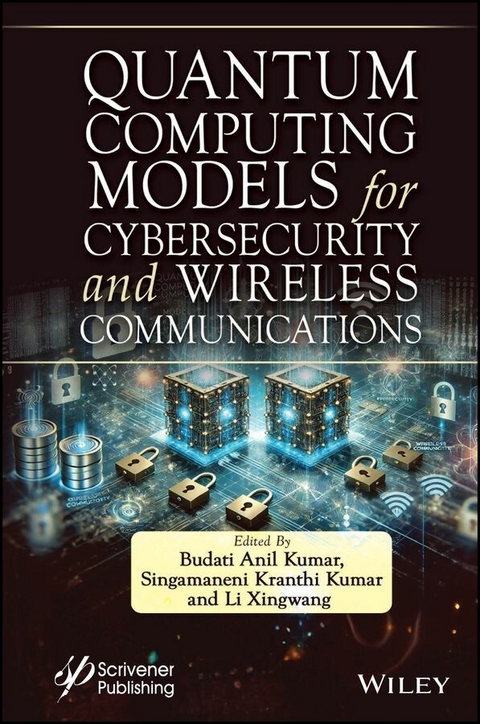
Quantum Computing Models for Cybersecurity and Wireless Communications (eBook)
543 Seiten
Wiley-Scrivener (Verlag)
978-1-394-27140-5 (ISBN)

The book explores the latest quantum computing research focusing on problems and challenges in the areas of data transmission technology, computer algorithms, artificial intelligence-based devices, computer technology, and their solutions.
Future quantum machines will exponentially boost computing power, creating new opportunities for improving cybersecurity. Both classical and quantum-based cyberattacks can be proactively identified and stopped by quantum-based cybersecurity before they harm. Complex math-based problems that support several encryption standards could be quickly solved by using quantum machine learning.
This comprehensive book examines how quantum machine learning and quantum computing are reshaping cybersecurity, addressing emerging challenges. It includes in-depth illustrations of real-world scenarios and actionable strategies for integrating quantum-based solutions into existing cybersecurity frameworks. A range of topics are examined, including quantum-secure encryption techniques, quantum key distribution, and the impact of quantum computing algorithms. Additionally, it talks about machine learning models and how to use machine learning to solve problems. Through its in-depth analysis and innovative ideas, each chapter provides a compilation of research on cutting-edge quantum computer techniques, like blockchain, quantum machine learning, and cybersecurity.
Audience
This book serves as a ready reference for researchers and professionals working in the area of quantum computing models in communications, machine learning techniques, IoT-enabled technologies, and various application industries such as finance, healthcare, transportation and utilities.
Budati Anil Kumar, PhD, is an associate professor at the Faculty of Electronics & Communication Engineering, Koneru Lakshmaiah Education Foundation (Deemed University), Aziz Nagar Campus, Hyderabad, Telangana, India. His research interests include cognitive radio networks, software-defined radio networks, artificial intelligence, etc. He has published 53 research articles in highly reputed publishing journals and conferences.
Singamaneni Kranthi Kumar, PhD, Faculty of Computer Engineering and Technology, Chaitanya Bharathi Institute of Technology, Gandipet, Hyderabad, Telangana, India. He has authored at least 30 SCI journal articles and received the prestigious 'Global Teachers Award' in 2020.
Li Xingwang, PhD, is an associate professor at the School of Physics and Electronic Information Engineering, Henan Polytechnic University, Jiaozuo, China. He is on the editorial board of many IEEE journals and his research interests include wireless communication, intelligent transport systems, artificial intelligence, and the Internet of Things.
The book explores the latest quantum computing research focusing on problems and challenges in the areas of data transmission technology, computer algorithms, artificial intelligence-based devices, computer technology, and their solutions. Future quantum machines will exponentially boost computing power, creating new opportunities for improving cybersecurity. Both classical and quantum-based cyberattacks can be proactively identified and stopped by quantum-based cybersecurity before they harm. Complex math-based problems that support several encryption standards could be quickly solved by using quantum machine learning. This comprehensive book examines how quantum machine learning and quantum computing are reshaping cybersecurity, addressing emerging challenges. It includes in-depth illustrations of real-world scenarios and actionable strategies for integrating quantum-based solutions into existing cybersecurity frameworks. A range of topics are examined, including quantum-secure encryption techniques, quantum key distribution, and the impact of quantum computing algorithms. Additionally, it talks about machine learning models and how to use machine learning to solve problems. Through its in-depth analysis and innovative ideas, each chapter provides a compilation of research on cutting-edge quantum computer techniques, like blockchain, quantum machine learning, and cybersecurity. Audience This book serves as a ready reference for researchers and professionals working in the area of quantum computing models in communications, machine learning techniques, IoT-enabled technologies, and various application industries such as finance, healthcare, transportation and utilities.
1
Performance Evaluation of Avionics System Under Hardware-In-Loop Simulation Framework with Implementation of an AS9100 Quality Management System
Rajesh Shankar Karvande1* and Tatineni Madhavi2
1’F’ RCI, DRDO, Hyderabad, TS, India
2EECE, GITAM, Hyderabad, TS, India
Abstract
Performance evaluation of avionics subsystem is mandatory before the deployment of the system. In the aerospace and defense industry it is critical to validate the embedded system software along with the flight subsystem in real time before real launch. The launch of the flight vehicle is single shot operation and involves so many factors. To avoid the catastrophic failures due to errors in algorithms, subsystems integrated working under real time, it is essential and mandatory to validate the software using Hardware-In-Loop Simulation (HILS) platform. This is unique platform that evaluate the performance of mission software i.e. control and guidance software using different criteria and conditions. This is cost effective tool to evaluate the performance for the expensive flight trial and using its rapid prototyping technique designer can validate their software in early stage of development. Development of AS9100 Quality Management System (QMS) in the HILS process is essential and inevitable part of avionics design to improve the process. This paper focus on the embedded system testing, validation, and certification area. The HILS test-bed designed as part of performance evaluation, different configuration of the HILS for centralized and distributed architecture, test plan for all software test cases with different perturbation cases. The lifecycle of the HILS process is explained in details with respect to AS9100 QMS requirements and implementation. Development of HILS test-bed for centralized and distributed architecture configuration is explained in details. The results are discussed and the conclusion and suggestions for future improvement are discussed in last section.
Keywords: 6Dof plant model, hardware-in-loop simulation, inertial navigation system, on board computer, OBC-in-loop, quality management system
1.1 Introduction
Performance Evaluation of avionics system specially used in aerospace vehicle is essential and critical task that ensure the success rate of developmental flight trial. The evaluation of the On-Board Computer (OBC) mission software along with the integrated flight hardware is carried out using the unique Hardware In Loop Simulation Test-bed [1, 2]. There are number of steps involved in testing phase of HILS. Design of the test-bed, development of the simulation software, testing of the OBC software. All the errors or deficiency related with mission software has been validated in HILS with number of test cases. Unit level testing carried out by the developer is not sufficient to test system completely. This unit testing only verifies the system independently working as per design. The integrated level testing and user acceptance testing is performed at HILS as shown in Figure 1.1. This testing highlights the design issues like lags, communication delay, bandwidth etc. for the individual system when it is integrated with other sub-systems.
In the total product life cycle of software development HILS is important phase for the validation and testing of avionics system is shown in Figure 1.1. HILS consists of both Hardware and Software parts: Simulation computer based on the configuration of the avionics system that is helpful to select the I/O cards of the system like MIL-STD 1553 cards, ADC cards, DAC cards and RS-422 cards [7]. The second part is the 6Dof software development part based on the Real Time Operating Systems. The problem is that the HILS process has many branches and there is no process control. It has been experienced the delay and ineffectiveness in the early stages of the HILS. It was highly essential to establish a stepwise process with the effectiveness and timely delivery of the product from HILS. So more focus and effort has been given to develop unified HILS process that will be stepwise process with the effectiveness of the Quality Management System for ensuring the timely completion of the process. The process of HILS is covered under the Aerospace Standard AS9100. The problem is to develop the methodology that defines the scope of the HILS process that is critical part of the project cycle to evaluate the performance of the software and flight hardware in integrated mode. This paper has given the detail explanation about the development of HILS process and the development of AS9100 QMS standard that is adopted for this process that has been bonded together first time to achieve the quality objective for the HILS as well as at the laboratory level to be recognized as global level. First the concept of the performance evaluation is explained with HILS Configuration, then the development of control i.e. Test plan, Test cases, Test results followed by induction of AS9100 quality absorption to HILS activities. The Key Performance Indicator (KPI) that shows the effectiveness of the concept of development of QMS at process level and the performance of the HILS according to that is discussed at the end with conclusion and suggestion at the end.
Figure 1.1 Testing phases of software and the avionics product lifecycle.
There are White Box Testing and Black Box Testing. White Box testing only verify the algorithm by visual inspection or flow chats. Performance evaluation is also called as the Black Box testing methodology that execute the algorithm and evaluate that the development is meeting the goals of design. This uses the input design specifications and parameters and measure output generated after execution of the software in real time. Hardware-In-Loop Simulation Framework is unique setup that is used for the performance evaluation of the Avionics system for both centralized architecture as well as distributed architecture.
Centralized Architecture
In this scheme all the algorithms are built using single processor with On Board Computer is shown in Figure 1.2. All the required interfaces are controlled by the processor. The sub systems are mainly electro mechanical that do not have any processing or computing unit inside the subsystem.
Figure 1.2 Centralized and distributed architecture of the avionics system.
Distributed Architecture
There is processor available in each subsystem and the data processed inside the subsystem itself is shown in Figure 1.2, e.g. in the case of Inertial Navigation System, the raw data gyros and accelerometers samples are processed inside the INS unit and the processed data i.e. positions, velocities, rates, accelerations, quaternions are posted to the OBC at regular interval. Similarly actuator setup has their own processor to process the deflection commands and send back the feedback information about the actuator at regular interval.
The challenge is to establish testing methodology for both architecture and the develop the uniform methodology in this area. The recent research paper has been studied for the development of the process effectiveness. Paper title “Development of Hardware-In-Loop Simulation Test-bed for testing of Navigation System-INS” by Rajesh K & B Ramesh Kumar explain the testing methodology for INS. It is limited for INS system only. Another paper titled “On joint hardware-in-the-loop simulation of aircraft control system and propulsion system” by Yao Zhao explains about the HILS system of the aircraft system. The development of the process for timely completion of the HILS activities and control for the effectiveness monitoring of the process paper is essential to help the researcher and engineers to have a layout of methodology for future experiments in this area.
1.2 HILS Process and Quality Management System
There are many AS9100 is Quality Management system for Aviation, Space and Defence industry released by International Aerospace Quality Group (IAQG). AS9100 Quality Management System goes hand to hand with each process of the Aerospace Research and Development Laboratory. After the Design and Development phase is finalized then the simulation and testing of the subsystem in integrated mode has been initiated. HILS process is the part of testing of the product and covered under QMS. Four Major processes has been defined and covered under QMS.
- HILS Planning and Configuration Management.
- Development of the HILS Setup
- OBC Software Validation
- Hardware In Loop Simulation.
A. HILS Planning and Configuration Management
Planning is crucial as all the schedule of the further testing and real launch depends on the HILS planning as shown in Figure 1.3. In parallel with the development cycle, development of HILS testbed, planning of test cases and HILS testing is established. Test-bed development focuses on the configuration, Timeline required and the HILS test cases for the mission software validation. Development of HILS testbed and development of simulation software mainly depend on the avionics configuration, Interface Control Document (ICD) of each sub-system and interface communication protocol of different sub-systems. This all together is covered under the HILS configuration and planning.
Figure 1.3 Planning of HILS activities of the project.
B. Development of HILS Test-Bed
Generally, the design and...
| Erscheint lt. Verlag | 7.2.2025 |
|---|---|
| Reihe/Serie | Sustainable Computing and Optimization |
| Sprache | englisch |
| Themenwelt | Technik ► Elektrotechnik / Energietechnik |
| ISBN-10 | 1-394-27140-9 / 1394271409 |
| ISBN-13 | 978-1-394-27140-5 / 9781394271405 |
| Informationen gemäß Produktsicherheitsverordnung (GPSR) | |
| Haben Sie eine Frage zum Produkt? |
 EPUB (Adobe DRM)
Kopierschutz: Adobe-DRM
Adobe-DRM ist ein Kopierschutz, der das eBook vor Mißbrauch schützen soll. Dabei wird das eBook bereits beim Download auf Ihre persönliche Adobe-ID autorisiert. Lesen können Sie das eBook dann nur auf den Geräten, welche ebenfalls auf Ihre Adobe-ID registriert sind.
Details zum Adobe-DRM
Dateiformat: EPUB (Electronic Publication)
EPUB ist ein offener Standard für eBooks und eignet sich besonders zur Darstellung von Belletristik und Sachbüchern. Der Fließtext wird dynamisch an die Display- und Schriftgröße angepasst. Auch für mobile Lesegeräte ist EPUB daher gut geeignet.
Systemvoraussetzungen:
PC/Mac: Mit einem PC oder Mac können Sie dieses eBook lesen. Sie benötigen eine
eReader: Dieses eBook kann mit (fast) allen eBook-Readern gelesen werden. Mit dem amazon-Kindle ist es aber nicht kompatibel.
Smartphone/Tablet: Egal ob Apple oder Android, dieses eBook können Sie lesen. Sie benötigen eine
Geräteliste und zusätzliche Hinweise
Buying eBooks from abroad
For tax law reasons we can sell eBooks just within Germany and Switzerland. Regrettably we cannot fulfill eBook-orders from other countries.
aus dem Bereich