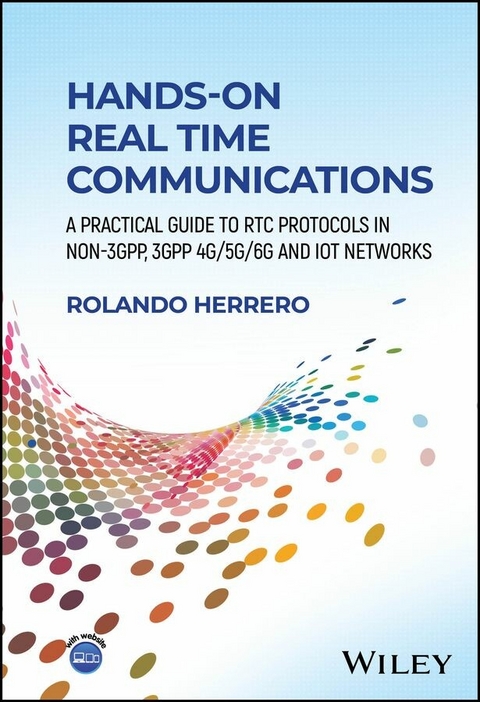
Hands-On Real Time Communications (eBook)
Understand and deploy RTC protocols for any kind of communication system
Since the emergence of Voice over IP (VoIP) communications in the late 1990s, a set of real time communication (RTC) protocols has evolved that together now support an immense range of technologies and systems architectures. Whether it's 5G networks (and beyond) or Internet of Things architectures, RTC protocols are indispensable to modern telecommunications. An understanding of these protocols and their design and deployment is critical for engineers, academics, and industry professionals in virtually every connected field.
Hands-On Real Time Communications offers a thorough yet accessible introduction to this subject, incorporating both the theory and practical applications of RTC protocols. It offers detailed instructions for deploying RTC protocols on various types of network stacks, as well as the use of a huge range of speech, audio, and video codecs. Practice-oriented and designed for students as well as established professionals, it's a must-own for anyone looking to deploy and maintain essential communications architectures.
Readers will also find:
- A matching hands-on section for each theoretical aspect, incorporating license-free protocol analyzers and emulation tools
- Detailed discussion of topics including signaling, media packetization, real hardware-based network interfaces, and many more
- End-of-chapter questions and lab exercises to facilitate learning
Hands-On Real Time Communications is ideal for advanced undergraduate or graduate students in RTC communication and networking classes, as well as for engineers, technologists, and architects looking to learn and understand the principles of RTC networking.
Rolando Herrero, PhD, holds faculty appointments at Northeastern University, University of Massachusetts at Lowell, and Southern New Hampshire University, USA, and is Founder of Link 7 Technology Research (L7TR), a research and development company with a focus on real time communications and Internet of Things technologies.
Understand and deploy RTC protocols for any kind of communication system Since the emergence of Voice over IP (VoIP) communications in the late 1990s, a set of real time communication (RTC) protocols has evolved that together now support an immense range of technologies and systems architectures. Whether it s 5G networks (and beyond) or Internet of Things architectures, RTC protocols are indispensable to modern telecommunications. An understanding of these protocols and their design and deployment is critical for engineers, academics, and industry professionals in virtually every connected field. Hands-On Real Time Communications offers a thorough yet accessible introduction to this subject, incorporating both the theory and practical applications of RTC protocols. It offers detailed instructions for deploying RTC protocols on various types of network stacks, as well as the use of a huge range of speech, audio, and video codecs. Practice-oriented and designed for students as well as established professionals, it s a must-own for anyone looking to deploy and maintain essential communications architectures. Readers will also find: A matching hands-on section for each theoretical aspect, incorporating license-free protocol analyzers and emulation toolsDetailed discussion of topics including signaling, media packetization, real hardware-based network interfaces, and many moreEnd-of-chapter questions and lab exercises to facilitate learning Hands-On Real Time Communications is ideal for advanced undergraduate or graduate students in RTC communication and networking classes, as well as for engineers, technologists, and architects looking to learn and understand the principles of RTC networking.
Acronyms
| 3G | 3rd Generation |
| 3GPP | 3G Partnership Project |
| 4G | 4th Generation |
| 5G | 5th Generation |
| 6G | 6th Generation |
| 6Lo | IPv6 over Networks of Resource-constrained Nodes |
| 6LoBTLE | IPv6 over Low-power Bluetooth Low Energy |
| 6LoWPAN | IPv6 over Low-power Wireless Personal Area Networks |
| AAC | Advanced Audio Coding |
| AAL2 | ATM Adaptation Layer 2 |
| AC | Alternating Current |
| ACELP | Algebraic CELP |
| ACR | Absolute Category Rating |
| AES | Advanced Encryption Standard |
| AM | Amplitude Modulation |
| AMR | Adaptive Multi-Rate |
| AP | Access Point |
| APCM | Adaptive PCM |
| API | Application Program Interfaces |
| AR | Autoregressive |
| ARP | Address Resolution Protocol |
| ARQ | Automatic Request |
| ASCII | American Standard Code for Information Interchange |
| ASR | Automatic Speech Recognition |
| AVC | Advanced Video Coding |
| AWS | Amazon Web Services |
| BLE | Bluetooth Low Energy |
| BOOTP | Bootstrap Protocol |
| bps | bits per second |
| BPSK | Binary PSK |
| BSS | Basic Service Set |
| BSSID | BSS Identifier |
| CA | Certification Authority |
| CBC | Cipher Block Chaining |
| CBR | Constant Bit Rate |
| CCR | Comparison Category Rating |
| CELP | Code-excited LP |
| CIDR | Classless Interdomain Routing |
| CIF | Common Intermediate Format |
| CM | Counter Mode |
| CSCF | Call Session Control Function |
| CMR | Codec Mode Request |
| CNAME | Canonical Name |
| CNG | Comfort Noise Generation |
| CoAP | Constrained Application Protocol |
| codec | Coder/Decoder |
| CSFB | Circuit-switched Fallback |
| CSMA/CA | Carrier Sense Multiple Access with Collision Avoidance |
| CSMA/CD | Carrier Sense Multiple Access with Collision Detection |
| CSRC | Contributing Source |
| CSS | Chirp Spread Spectrum |
| CRC | Cyclical Redundancy Checking |
| DAC | Digital-to-Analog Converter |
| DAM | Destination Address Mode |
| DBPSK | Differential BPSK |
| DC | Direct Current |
| DCF | Distributed Coordination Function |
| DCR | Degradation Category Rating |
| DCT | Discrete Cosine Transform |
| DES | Data Encryption Standard |
| DHCP | Dynamic Host Configuration Protocol |
| DIFS | Distributed Inter Frame Spacing |
| DMOS | Degradation MOS |
| DNS | Domain Name System |
| DoS | Denial of Service |
| DPCM | Differential PCM |
| DPSK | Differential PSK |
| DRS | Dynamic Rate Shifting |
| DSA | Digital Signature Algorithm |
| DSCP | Differentiated Services Code Point |
| DSSS | Direct Sequence SS |
| DTMF | Dual-Tone Multi-Frequency |
| DTLS | Datagram Transport Layer Security |
| DTX | Discontinuous Transmissions |
| EBIT | End Bit Position |
| ECC | Elliptic Curve Cryptography |
| ECN | Explicit Congestion Notification |
| EDCF | Enhanced DCF |
| EID | Extension Identifier |
| EIRP | Equivalent Isotropic Radiated Power |
| eMBB | Enhanced Mobile Broadband |
| EPC | Enhanced Packet Core |
| ESS | Extended Service Set |
| ETSI | European Telecommunications Standards Institute |
| EU-TRAN | Evolved UMTS Terrestrial Radio Access Network |
| EUI | Extended Unique Identifier |
| EVRC | Enhanced Variable Rate Codec |
| EVS | Enhanced Voice Services |
| FB | Full Band |
| FCF | Frame Control Field |
| FCS | Frame Checksum |
| FDD | Frequency Division Duplex |
| FDMA | Frequency Division Multiple Access |
| FEC | Forward Error Correction |
| FHSS | Frequency Hopping SS |
| FIPS | Federal Information Processing Standard |
| FM | Frequency Modulation |
| fmtp | format specific parameter |
| FQ | Frame Quality |
| FSF | Frame Control Field |
| FSK | Frequency Shift Keying |
| FT | Field Type |
| Gbps | Gigabits per second |
| gNB | Next Generation node B |
| GOB | Group of Blocks |
| GOP | Group of Pictures |
| GSM | Global System for Mobile Communications |
| HAN | Home Area Network |
| HBR | High Bit Rate |
| HC1 | Header Compression 1 |
| HC2 | Header Compression 2 |
| HD | High Definition |
| HD TV | HD Television |
| HEVC | High Efficiency Video Coding |
| HSS | Home Subscriber Server |
| HMAC | HASH-based Message Authentication Codec |
| HTML | Hypertext Markup Language |
| HTTP | HyperText Transfer Protocol |
| IBSS | Independent BSS |
| ICMP | Internet Control Message Protocol |
| IDE | Integrated Development Environment |
| IETF | Internet Engineering Task Force |
| IID | Interface Identifier |
| IMS | IP Multimedia Subsystem |
| iLBC | Internet Low Bitrate Codec |
| IoT | Internet of Things |
| IP | Internet Protocol |
| IP TTL | IP Time-to-Live |
| IPHC | IP Header Compression |
| iSAC | internet Speech Audio Codec |
| ISM | Instrumental Scientific and Medical |
| ITU | International Telecommunications Union |
| IPv4 | Internet Protocol version 4 |
| IPv6 | Internet... |
| Erscheint lt. Verlag | 28.1.2025 |
|---|---|
| Sprache | englisch |
| Themenwelt | Technik ► Elektrotechnik / Energietechnik |
| Schlagworte | audio codecs • building topologies • internet of things • media generation • media packetization • media session control • PESQ • POLQA • Session Description Protocol • session initialization protocol • speech codecs • video codecs • Volte • VoNR |
| ISBN-13 | 9781394239634 / 9781394239634 |
| Informationen gemäß Produktsicherheitsverordnung (GPSR) | |
| Haben Sie eine Frage zum Produkt? |
 EPUB (Adobe DRM)
Kopierschutz: Adobe-DRM
Adobe-DRM ist ein Kopierschutz, der das eBook vor Mißbrauch schützen soll. Dabei wird das eBook bereits beim Download auf Ihre persönliche Adobe-ID autorisiert. Lesen können Sie das eBook dann nur auf den Geräten, welche ebenfalls auf Ihre Adobe-ID registriert sind.
Details zum Adobe-DRM
Dateiformat: EPUB (Electronic Publication)
EPUB ist ein offener Standard für eBooks und eignet sich besonders zur Darstellung von Belletristik und Sachbüchern. Der Fließtext wird dynamisch an die Display- und Schriftgröße angepasst. Auch für mobile Lesegeräte ist EPUB daher gut geeignet.
Systemvoraussetzungen:
PC/Mac: Mit einem PC oder Mac können Sie dieses eBook lesen. Sie benötigen eine
eReader: Dieses eBook kann mit (fast) allen eBook-Readern gelesen werden. Mit dem amazon-Kindle ist es aber nicht kompatibel.
Smartphone/Tablet: Egal ob Apple oder Android, dieses eBook können Sie lesen. Sie benötigen eine
Geräteliste und zusätzliche Hinweise
Buying eBooks from abroad
For tax law reasons we can sell eBooks just within Germany and Switzerland. Regrettably we cannot fulfill eBook-orders from other countries.
aus dem Bereich