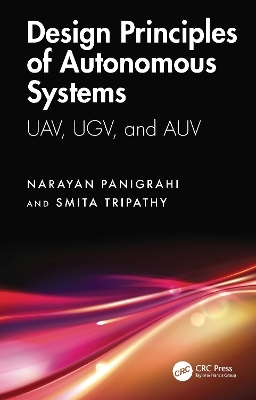
Design Principles of Autonomous Systems
CRC Press (Verlag)
978-1-032-45267-8 (ISBN)
This book explains unmanned systems including Unmanned Aerial Vehicles (UAVs), Autonomous Underwater Vehicles (AUVs) and Unmanned Ground Vehicles (UGVs). It also details system and subsystem compositions and their basic design. The components/subcomponents, employed payloads and sensors, and communication systems used to compose the autonomous system are discussed. It examines generic applications of these unmanned systems including specific missions for which they are employed. Other topics like swarm of drone, anti-drone system, and some algorithms used in navigation and communication of the drone are also discussed.
Some key features:
Helps readers understand nuances of autonomous systems on land, in air, and in sea.
Explains pertinent design principles, sensors, and communication system.
Lays the foundation for crafting, designing, and deploying autonomous systems for different applications.
Reviews algorithms, computing, control and technology stacks required for design of UAS.
Discusses software and navigation aspects of autonomous systems with the concepts of SLAM.
This book is aimed at graduate students and researchers in mechatronics engineering, systems and sensors, systems and control, and aerospace engineering.
Dr Narayan Panigrahi heads a team of scientists at the Center for Artificial Intelligence and Robotics, a premier laboratory of the Defence Research and Development Organization, India. He is engaged in building capacity and capability in the research and development of Geographic Information System (GIS) and its applications in different domains and is also pursuing his research for the design and development of indigenous geospatial and spatio-temporal algorithms. He has been instrumental in designing and developing Indigenous GIS for military applications and GIS for cross-domain applications in terrain-bathymetry and space. He is the recipient of many awards, including the Best Graduate & Governor's Gold Medal of Berhampur University (1987), Best Research Award by INRIA France (2012), and the Agni Award for Self-Reliance (2019). He is a recipient of the National Geospatial Award for excellence (2019) and National Geomatics Award for excellence (2023). Smita Tripathy joined as a scientist in the Light Combat Aircraft (LCA) programme of the Aeronautical Development Agency, Ministry of Defence, India, in 1998. Since then, she has been engaged in the research and development of avionic systems of LCA. She has contributed to the design and development of avionics system, and her primary interest lies in the design and development of avionic systems and subsystems of LCA.
Chapter 1: Introduction to Unmanned Autonomous Systems (UAS)
Chapter 2: Crafting an Unmanned Aerial Vehicle (UAV)
Chapter 3: Designing the fuselage, wing, propulsion, and empennage of a fixed-wing UAV
Chapter 4: Application-specific UAVs and their requirements
Chapter 5: Classifications of different UAVs
Chapter 6: Counter-UAS systems
Chapter 7: Design criteria of a UAV for photogrammetry and ISTAR applications
Chapter 8: Autonomous Underwater Vehicles (AUVs)
Chapter 9: Essential design concepts of AUVs
Chapter 10: Unmanned Ground Vehicles (UGVs)
Chapter 11: Crafting a UGV
Chapter 12: Algorithms, control, and software used for UAS missions
| Erscheinungsdatum | 09.09.2025 |
|---|---|
| Zusatzinfo | 20 Tables, black and white; 44 Line drawings, black and white; 48 Halftones, black and white; 92 Illustrations, black and white |
| Verlagsort | London |
| Sprache | englisch |
| Maße | 152 x 229 mm |
| Gewicht | 700 g |
| Themenwelt | Technik ► Elektrotechnik / Energietechnik |
| Technik ► Fahrzeugbau / Schiffbau | |
| Technik ► Luft- / Raumfahrttechnik | |
| Technik ► Umwelttechnik / Biotechnologie | |
| ISBN-10 | 1-032-45267-6 / 1032452676 |
| ISBN-13 | 978-1-032-45267-8 / 9781032452678 |
| Zustand | Neuware |
| Informationen gemäß Produktsicherheitsverordnung (GPSR) | |
| Haben Sie eine Frage zum Produkt? |
aus dem Bereich