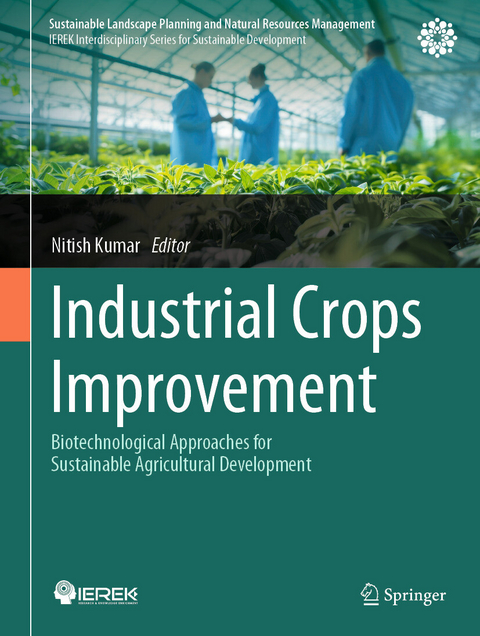
Industrial Crops Improvement (eBook)
X, 257 Seiten
Springer Nature Switzerland (Verlag)
978-3-031-75937-6 (ISBN)
This book explores the different conventional and biotechnological techniques for enhancing the productivity of industrial crops. The growth of the industrial crop sector has become a widespread global phenomenon that helps rural livelihoods and propels economic development. Contrary to staple crops, industrial crops are cultivated with the intention of being sold for a high profit. Industrial crops are a crucial component of plans to increase food security because they offer the required stability during periods of economic or climatic crises. In order to maintain their livelihood and food security, many farm households balance the advantages and disadvantages of producing food crops and industrial crops. Avoiding land-use rivalry with crops grown for food and feed production is crucial when considering growing industrial crops on agricultural soils.
The past several years have seen a rise in the awareness of scholars and decision-makers regarding the immediate and long-term effects of climatic variables on economic, food security, social, and political results. In order to sustain food production with more climate-resilient crops for future generations, genetic variety, both natural and artificial, is crucial. Therefore, addressing the problem of finding a compromise between increasing crop production under a specific set of conditions and reducing the chance of crop failure when conditions change is important and difficult. An assortment of meteorological conditions is used to grow industrial crops. Many are subsistence farmers who run extremely tiny farms with very little agricultural input to produce products that can be sold. It is a significant problem to preserve the variety of these crops and handle all crop culture-related difficulties. By offering the knowledge required to minimize the dangers of industrial crop breeding through managing genetic diversity, the author believe that this book will primarily address a need that has not yet been met in this and other grower groups.
| Erscheint lt. Verlag | 24.1.2025 |
|---|---|
| Reihe/Serie | Sustainable Landscape Planning and Natural Resources Management |
| Zusatzinfo | X, 257 p. 35 illus., 32 illus. in color. |
| Sprache | englisch |
| Themenwelt | Naturwissenschaften ► Geowissenschaften |
| Technik | |
| Schlagworte | Biotechnology • Genetic Engineering • Genetic improvement • Genome editing • Industrial Crops • Molecular Breeding • Mutagenesis |
| ISBN-10 | 3-031-75937-0 / 3031759370 |
| ISBN-13 | 978-3-031-75937-6 / 9783031759376 |
| Informationen gemäß Produktsicherheitsverordnung (GPSR) | |
| Haben Sie eine Frage zum Produkt? |
 PDF (Wasserzeichen)
DRM: Digitales Wasserzeichen
Dieses eBook enthält ein digitales Wasserzeichen und ist damit für Sie personalisiert. Bei einer missbräuchlichen Weitergabe des eBooks an Dritte ist eine Rückverfolgung an die Quelle möglich.
Dateiformat: PDF (Portable Document Format)
Mit einem festen Seitenlayout eignet sich die PDF besonders für Fachbücher mit Spalten, Tabellen und Abbildungen. Eine PDF kann auf fast allen Geräten angezeigt werden, ist aber für kleine Displays (Smartphone, eReader) nur eingeschränkt geeignet.
Systemvoraussetzungen:
PC/Mac: Mit einem PC oder Mac können Sie dieses eBook lesen. Sie benötigen dafür einen PDF-Viewer - z.B. den Adobe Reader oder Adobe Digital Editions.
eReader: Dieses eBook kann mit (fast) allen eBook-Readern gelesen werden. Mit dem amazon-Kindle ist es aber nicht kompatibel.
Smartphone/Tablet: Egal ob Apple oder Android, dieses eBook können Sie lesen. Sie benötigen dafür einen PDF-Viewer - z.B. die kostenlose Adobe Digital Editions-App.
Buying eBooks from abroad
For tax law reasons we can sell eBooks just within Germany and Switzerland. Regrettably we cannot fulfill eBook-orders from other countries.
aus dem Bereich