Wastewater Reuse, Volume 1 (eBook)
482 Seiten
Wiley-Iste (Verlag)
978-1-394-35177-0 (ISBN)
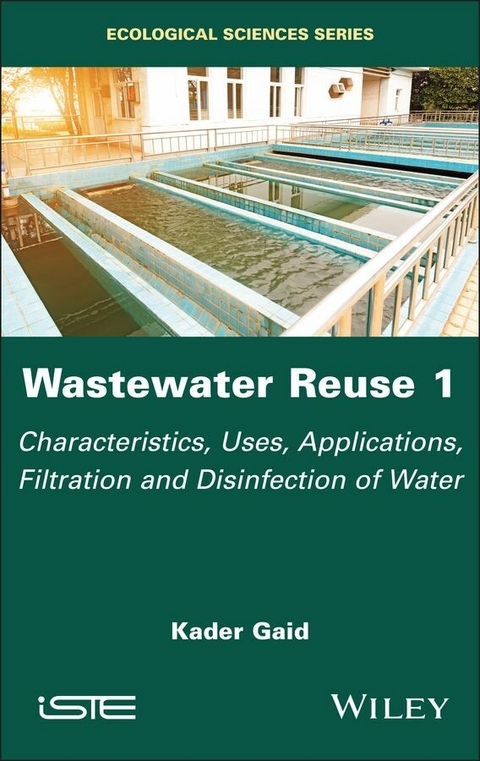
The reuse of wastewater is a socioeconomic challenge for the development of drinking water and wastewater services. It has the following advantages: it increases usable water resources, preserves natural resources and alleviates water shortages caused by climate change.
Wastewater Reuse 1 provides a comprehensive and educational overview of the many ways wastewater can be reused, the variety of treatments, their performance, their conditions of use and how to combine them to give wastewater a new lease on life. Droughts are already a concern in many parts of the world; however, we now have new technologies to rely on.
Kader Gaid is a professor at the University of Science and Technology Houari Boumediene, Algeria. He specializes in Environmental Process Engineering and was an expert at the utilities company Veolia in France for over 25 years.
Water issues are inextricably linked to sustainable development since water must meet the needs of present and future generations. The reuse of wastewater is a socioeconomic challenge for the development of drinking water and wastewater services. It has the following advantages: it increases usable water resources, preserves natural resources and alleviates water shortages caused by climate change. Wastewater Reuse 1 provides a comprehensive and educational overview of the many ways wastewater can be reused, the variety of treatments, their performance, their conditions of use and how to combine them to give wastewater a new lease on life. Droughts are already a concern in many parts of the world; however, we now have new technologies to rely on.
1
Treated Wastewater Reuse: A New Resource
Throughout the world, the availability of food and water is vital for the survival of humanity and to ensure an adequate standard of living. Increasing population, climate change and ongoing industrialization are putting pressure on existing water resources. Freshwater resources are not sufficient in all regions of the world. It is estimated that 50% of the world’s population will live in water-stressed regions by 2030, underlining the importance of sound management and adequate water treatment. When water resources are limited, irrigation is severely penalized, as agriculture uses 70% of the total amount of water taken.
The water issue is inseparable from sustainable development, in that water must be able to meet the needs of present generations without jeopardizing the ability of future generations to satisfy their own. With the consequences of climate change, pressure on resources will continue to increase under the combined effects of population growth and policies implemented in respect of water-consuming activities. The water deficit will ipso facto lead to serious conflicts between the various users, which will inevitably require difficult arbitrations for public authorities. In many parts of the world, the 21st century is set to see a worsening of water shortages. According to the UNDP (United Nations Development Programme), an increase in global temperature of 3–4°C would cause a drought that would affect hundreds of millions of people. The IPCC (Intergovernmental Panel on Climate Change) confirms that the scale of impacts on water shortages would be dramatic.
Thus, water scarcity will affect not only irrigation for human food but also animal production (where water is essential both for drinking and feeding).
In order to improve agricultural production and minimize the depletion of natural water resources, a targeted low-cost water quality is needed. Wastewater reuse is a first solution.
1.1. Observations on the current situation1
The current situation is further exacerbated by several constraints: an imbalance between needs and available resources, a considerable increase in the needs for drinking, industrial and agricultural water, a geographical imbalance between needs and resources, pollution of groundwater and surface water and significantly reducing in some countries the volumes of water that can be used. The risk of a break in sustainable development may arise if the actual groundwater withdrawals exceed the limits for renewal of natural resources.
In Spain, April 2023 was one of the hottest and driest months recorded. Between the lack of fodder and soaring food prices, farmers had no choice but to slaughter their cattle.
In 2022, a prolonged drought affected many regions of France, Italy and Spain. The lack of precipitation combined with heat waves has led to dried out soils and a lack of water. The socioecological impacts of this drought were dramatic. The high water and thermal stress have significantly reduced yields of major crops such as corn, soybeans and sunflower, with reductions of about 15% in comparison to the last 5 years’ average.
In Italy, about 50% of the population has been affected by water supply restrictions. High levels of salt intrusion from the Po Delta up to 40 km from the maritime coast have been recorded. The sharp drop in water levels in dams has severely impacted hydroelectric power and cooling systems of power plants.
In the south of France, fires associated with extreme drought conditions doubled compared to 2021 and were more than four times higher than during the 2012–2021 period. Sixty-six French departments were at the highest alert level in August, and 93 departments were affected by all three alert levels. Similar impacts were observed in Spain and Portugal for agriculture, energy production and domestic water use.
The 2022 drought had significant societal impacts and the fear of future droughts is a major concern for populations (Breda and Badeau 2008; Baum et al. 2013; Faranda et al. 2023). According to the World Meteorological Organization, drought is one of the most damaging and deadly climate risks. In the coming years, drought-related rainfall deficits will become very problematic.
Figure 1.1. (A) Maximum severity level limiting water use by department in force during the 2021 summer
Figure 1.1. (B) Maximum severity level limiting water use by department in force (continued) as of August 12, 2022 (source: Ministère de la Transition écologique et de la Cohésion des territoires)
Figure 1.2. Worsening of soil condition (France)
Figure 1.3. Lack of foods drives Spanish cattle farmers to massively kill cattle
Figure 1.4. Drought in Europe and North Africa (2022)
The question of how much water resources will be available in the coming decades will be determined by climate change, even if water quality will depend on other factors such as infrastructure management, perimeter protection and pollution control. The expected and already observed summer drying in many countries has resulted in a number of impacts: tree health, natural resources, agriculture, water resources and hydroelectric power supply. Many regions of the world are concerned with the risk of increased frequency and intensity of heat waves and droughts.
1.2. Climate change
The role of climate change in the prolonged drought that affected Western Europe and the Mediterranean region in 2022 is now well established. Published in the journal Environmental Research Letters, a study conducted by a CNRS (National Centre for Scientific Research) team has established links between climate change and the occurrence of drought episodes, such as those encountered by France during the summer of 2022.
To demonstrate the responsibility of “anthropogenic climate change”, linked to human activity, these scientists used the method of “circulation analogues” to identify the atmospheric patterns of the 1836–2021 period and compare them with those of 2022. The process allows to highlight the responsibility of CO2 emissions in the intensification and extension of high pressure zones behind the drought. “Results showed that the persistent anticyclonic anomaly on Western Europe during the drought was exacerbated by climate change due to humans, with larger and more extensive atmospheric pressure anomalies, as well as higher surface temperatures”, scientists report. It is concluded that these two factors exacerbated the drought, increasing the affected area and promoting soil drying by evapotranspiration (Ribes et al. 2022).
The climate data collected in the Mediterranean regions during the 20th century indicate an increased warming trend over the last 30 years. General circulation models converge to estimate a probable warming of the region in the range of 2–4°C during the 21st century. Climate modification would therefore be unavoidable and will have significant impacts, including increases in temperatures and precipitation, scarcity of water resources and increasing frequency of storms. Other impacts are loss of biodiversity, degradation of ecosystems, serious consequences for the whole range of socioeconomic activities due to the increased risk of famines, population movements and health impacts.
These changes will affect the retention of surface water and the useful capacity of dams, the renewal of groundwater levels. The latter point has already shown that drought combined with overexploitation of groundwater can lead to mineralization of unsaturated areas of deep aquifers. In coastal regions, the drop in hydrostatic pressure levels has already led to sea water entering the freshwater reserves of coastal aquifers. Climate change is having an impact on public health with potential for outbreaks of water-borne diseases. In North Africa, for example, this is due to insufficient water resources combined with the lack of treatment of some water points.
1.3. Solutions to reduce water stress
Some countries, such as the United States, Singapore and Namibia, have been pioneering for decades the implementation of the concept of treated wastewater reuse with alternatives for reusing drinking and non-drinking water. Wastewater treatment technologies currently provide solutions for adequate supply of reclaimed water. Therefore, the opportunities for water reuse exist, but the challenge lies largely in implementation. This is becoming urgent and necessary in regions where water stress is most pressing. Climate change will worsen the situation and drought periods will multiply. Total water demand will increase, especially for irrigation of field crops. As a result, water from natural resources such as groundwater and surface water will often be over-used.
The apprehension of climate change requires the implementation of strategies and controlled planning to satisfy water supplies. Only then will it be possible to meet the challenge of population growth and ensure safe drinking water for all. Alternative water sources must be produced to meet this challenge, as with drought, groundwater and surface water availability is already often insufficient and will be of great concern in many...
| Erscheint lt. Verlag | 14.1.2025 |
|---|---|
| Reihe/Serie | ISTE Invoiced |
| Sprache | englisch |
| Themenwelt | Naturwissenschaften ► Geowissenschaften |
| Technik | |
| Schlagworte | Disinfection • Filtration • sustainability • Waste water • Water |
| ISBN-10 | 1-394-35177-1 / 1394351771 |
| ISBN-13 | 978-1-394-35177-0 / 9781394351770 |
| Informationen gemäß Produktsicherheitsverordnung (GPSR) | |
| Haben Sie eine Frage zum Produkt? |
 EPUB (Adobe DRM)
Kopierschutz: Adobe-DRM
Adobe-DRM ist ein Kopierschutz, der das eBook vor Mißbrauch schützen soll. Dabei wird das eBook bereits beim Download auf Ihre persönliche Adobe-ID autorisiert. Lesen können Sie das eBook dann nur auf den Geräten, welche ebenfalls auf Ihre Adobe-ID registriert sind.
Details zum Adobe-DRM
Dateiformat: EPUB (Electronic Publication)
EPUB ist ein offener Standard für eBooks und eignet sich besonders zur Darstellung von Belletristik und Sachbüchern. Der Fließtext wird dynamisch an die Display- und Schriftgröße angepasst. Auch für mobile Lesegeräte ist EPUB daher gut geeignet.
Systemvoraussetzungen:
PC/Mac: Mit einem PC oder Mac können Sie dieses eBook lesen. Sie benötigen eine
eReader: Dieses eBook kann mit (fast) allen eBook-Readern gelesen werden. Mit dem amazon-Kindle ist es aber nicht kompatibel.
Smartphone/Tablet: Egal ob Apple oder Android, dieses eBook können Sie lesen. Sie benötigen eine
Geräteliste und zusätzliche Hinweise
Buying eBooks from abroad
For tax law reasons we can sell eBooks just within Germany and Switzerland. Regrettably we cannot fulfill eBook-orders from other countries.
aus dem Bereich