


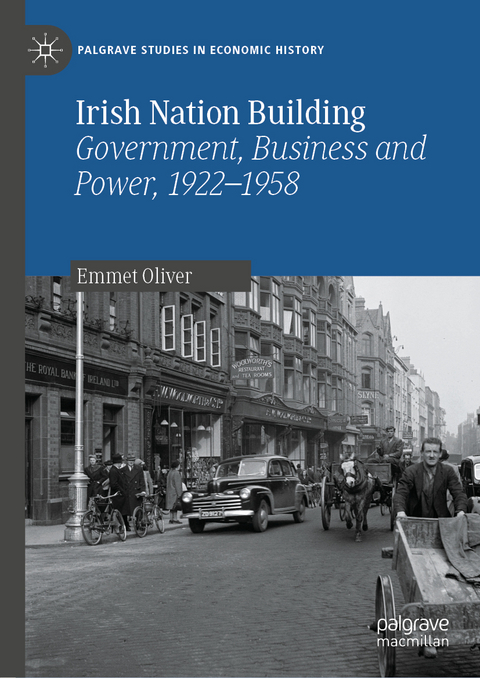
Irish Nation Building
Springer International Publishing (Verlag)
978-3-031-84930-5 (ISBN)
This book examines the early decades of economic nation building in Ireland. It draws on a large amount of previously unstudied archival material to construct a novel contribution to Irish business and economic history that focuses on government relations, business power and wider dynamics of power in a decolonising context.
The book adopts a different approach to the early decades of Irish independence, decentering the typical focus on party political developments, Church-state relations and Anglo-Irish relations. Instead, the book explores the role of Irish businesses and services and their engagement with the governing elites of the time. More than just offering a general survey of Irish businesses in the early years of independence, the chapters of this book illuminate and analyse the 'commanding heights' of the economy, the Marxist term for the core distribution channels of capital and labour. In particular, the book focuses on four key strategic sectors - banking, insurance, shipping and rail - to analyse the tensions between the new Irish nationalist political elite and embedded business interests from the pre-independence era, how these led to the transformation of the Irish economic model by the late 1950s, and its gradual integration into a newly globalising world economy. This book will be essential reading for students and researchers of economic and business history, and Irish history and independence broadly.
Emmet Oliver is an economic and business historian. He holds a PhD in business and financial history from Trinity College, Dublin. He has lectured in business history at Trinity College Dublin, and taught Irish history at Quinn Business School, University College Dublin (UCD). He spent a number of years working at the Irish government's economic development arm, IDA Ireland. Before teaching and researching in academic institutions, he was a financial and economics writer with Bloomberg News London and The Irish Times.
Chapter 1: Jettisoning the 'Antique Furniture' Post Independence.- Chapter 2: Government-Business Relations and the Politics of Intervention in Independent Ireland.- Chapter 3: Contending with Capital - Investors, Government Intervention and Ireland's Slow Journey to Rail Nationalisation.- Chapter 4: 'Suiting ourselves'- Banks and Government Discord Amid Ireland's 'Lost Decade'.- Chapter 5: Negotiated Exit and Crony Capitalist Connections- Ireland's Modified Insurance Intervention.- Chapter 6: Confined to Port -Ireland's Abandoned Bid to Create Pre-War Shipping Sector.- Chapter 7: Conclusion: Accommodating the 'Other Side'.
| Erscheinungsdatum | 17.03.2025 |
|---|---|
| Reihe/Serie | Palgrave Studies in Economic History |
| Zusatzinfo | XVIII, 234 p. 9 illus., 3 illus. in color. |
| Verlagsort | Cham |
| Sprache | englisch |
| Maße | 148 x 210 mm |
| Themenwelt | Geisteswissenschaften ► Geschichte ► Regional- / Ländergeschichte |
| Technik | |
| Wirtschaft ► Allgemeines / Lexika | |
| Wirtschaft ► Volkswirtschaftslehre | |
| Schlagworte | banking for development • business and government • business in Ireland • capital drain • Capitalism • economic history of Ireland's services sector • growth of finance in Ireland • Irish business history • Irish economic history • Irish industry • nation building • Railways • structural analysis of business |
| ISBN-10 | 3-031-84930-2 / 3031849302 |
| ISBN-13 | 978-3-031-84930-5 / 9783031849305 |
| Zustand | Neuware |
| Informationen gemäß Produktsicherheitsverordnung (GPSR) | |
| Haben Sie eine Frage zum Produkt? |
aus dem Bereich


