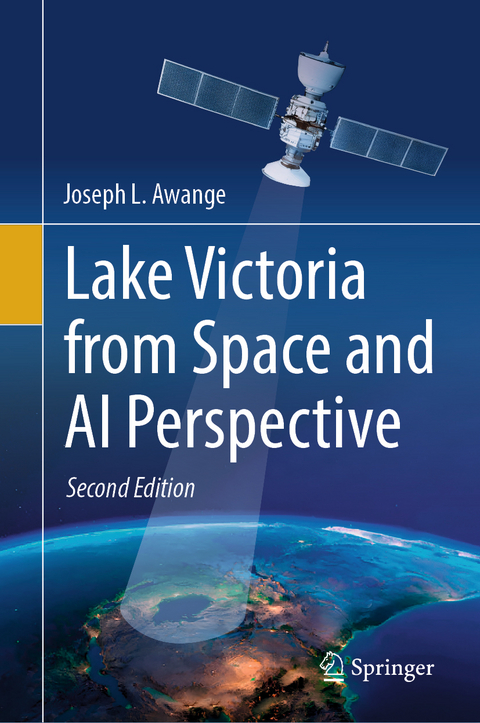
Lake Victoria from Space and AI Perspective
Springer International Publishing (Verlag)
978-3-031-84735-6 (ISBN)
This second edition showcases groundbreaking Artificial Intelligence (AI) applications that transform over 20 years of satellite observations from the GRACE and GRACE-FO missions into a comprehensive 50-year hydrological dataset for Africa s Lake Victoria Basin (LVB). This innovative approach will unlock unprecedented understanding of critical water challenges that have bedevilled the lake basin due to data scarcity. The book unravels the mysterious 2018 2019 surge in lake water levels, the disruptive floating islands affecting hydropower and livelihoods, and the complex groundwater dynamics beneath the surface. By combining cutting-edge AI with remote sensing and socio-economic analysis, this interdisciplinary study will reveal how natural climate variability and human activities jointly influence water security, flood-drought cycles, agriculture, and regional economies. It offers actionable insights for climate scientists, water resource managers, engineers, and policymakers dedicated to Africa s sustainable development.
Praised by Professor C.K. Shum of The Ohio State University as a transformative interdisciplinary study that redefines our understanding of Africa s largest lake system, this edition is essential for anyone seeking to harness technology for impactful environmental management and unlock the future of water resource management where AI meets real-world solutions.
Joseph Awange is a professor of Environmental Geoinformatics at the Department of Land Surveying and Geo-Informatics (LSGI, The Hong Kong Polytechnic University) having previously worked at Curtin University (Australia). His research interests are sensing of environmental changes employing geospatial and AI techniques, hydroclimate, climate variability/change, climate extremes and mathematical geosciences (algebraic & numerical solutions). He obtained his BSc and MSc degrees in Surveying (University of Nairobi, Kenya). Joseph was awarded a merit scholarship by the German Academic Exchange Program (DAAD), which facilitated his obtaining a second MSc degree and PhD in Geodesy at Stuttgart University (Germany) under the supervision of the late Prof Erik W. Grafarend (one of the world's renown geodesists). In 2002-2004, he was awarded the prestigious Japan Society of Promotion of Science (JSPS; Japan) Fellowship to pursue postdoctoral research in Environmental Geodesy at Kyoto University. His research output has been globally recognized through prestigious Awards (i) Alexander von Humboldt (AvH) Fellowships (2008-2011 Ludwig Leichhardt Memorial Fellowship for experienced researchers, 2015 & 2019 AvH support in acknowledgment of his scientific achievements in his specific academic field and in recognition of his contribution towards scientific cooperation with German colleagues), (ii) 2015 JSPS Fellowship, and (iii), Brazil Frontier of Science (Brazil). Joseph who holds a Postgraduate Diploma in Environmental Impact Assessment (EIA) from Murdoch University (Australia) is currently serving as the Acquisition Manager for Springer Nature (world-leading research, educational and professional publisher) in charge of Earth Sciences, Geography, and Environment books. He attained International Editorial role in Springer Earth Science Books and has authored more than 25 scholarly books with the prestigious Springer publisher and more than 250 peer-reviewed high-impact journal publications.
Part I. Global and Lake Victoria's Water Resources.- Chapter 1. Global Freshwater Resources.- Chapter 2. Lake Victoria's Water Resources.- Chapter 3. Challenges: Sustainability and Obsolete Treaties.- Chapter 4. Lake Level: Dam Operations Versus Droughts.- Part II. Remote Sensing Techniques.- Chapter 5. Satellite Remote Sensing.- Chapter 6. GNSS Reflectometry and Applications.- Chapter 7. Improved Remotely Sensed Satellite Products.- Part III. Sensing the Lake and Its Basin.- Chapter 8. Physical Dynamics of the Lake: Is It Dying?.- Chapter 9. Rapid 2002-2006 Fall: Anthropogenic Induced?.- Chapter 10. Rapid 2002-2006 Fall: Climate Induced?.- Chapter 11. Climate Change and Its Economic Implications.- Chapter 12. Lake Victoria Basin: Droughts and Food Security.- Chapter 13. Early Warning System: Is NDVI the Answer?.
| Erscheinungsdatum | 07.01.2026 |
|---|---|
| Zusatzinfo | XIX, 414 p. 151 illus., 138 illus. in color. |
| Verlagsort | Cham |
| Sprache | englisch |
| Maße | 155 x 235 mm |
| Themenwelt | Technik ► Umwelttechnik / Biotechnologie |
| Schlagworte | floating island • groundwater • Lakes • Lake Victoria • Water • Water hyacinth • water level |
| ISBN-10 | 3-031-84735-0 / 3031847350 |
| ISBN-13 | 978-3-031-84735-6 / 9783031847356 |
| Zustand | Neuware |
| Informationen gemäß Produktsicherheitsverordnung (GPSR) | |
| Haben Sie eine Frage zum Produkt? |
aus dem Bereich