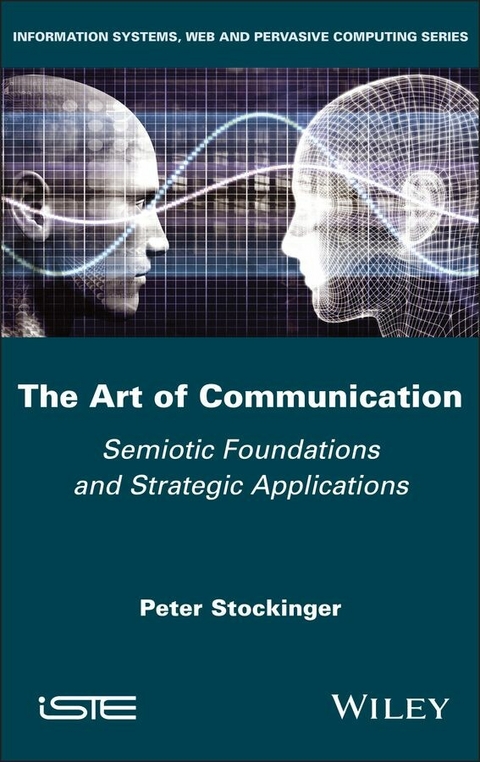
The Art of Communication (eBook)
530 Seiten
Wiley-Iste (Verlag)
978-1-394-35195-4 (ISBN)
The Art of Communication combines over two decades of research and teaching into a comprehensive guide on strategic communication.
Grounded in the theoretical and methodological frameworks of 'situated communication' and 'communication project', this book highlights an understanding of both traditional and emerging communication practices. It particularly focuses on new genres, such as branding, design and digital communication strategies, and introduces the innovative concept of 'textscapes' - specially crafted environments to fulfill communicative objectives.
This book is enriched with practical examples and is particularly relevant in multicultural and international settings, providing essential insights for adapting communication strategies to diverse cultural contexts.
Peter Stockinger is Professor of Language, Information and Communication Sciences at the Institut national des langues et civilisations orientales (Inalco), Paris, France. He also conducts research at the Centre Internet et Société (CIS), CNRS.
The Art of Communication combines over two decades of research and teaching into a comprehensive guide on strategic communication. Grounded in the theoretical and methodological frameworks of 'situated communication' and 'communication project', this book highlights an understanding of both traditional and emerging communication practices. It particularly focuses on new genres, such as branding, design and digital communication strategies, and introduces the innovative concept of 'textscapes' specially crafted environments to fulfill communicative objectives. This book is enriched with practical examples and is particularly relevant in multicultural and international settings, providing essential insights for adapting communication strategies to diverse cultural contexts.
Introduction
The aim of this book is to present and discuss the main elements of a semiotic and pragmatic approach to communication. Together, these elements form a general framework for understanding what we call a situated semiotic theory of communicative doing.
This theoretical and methodological framework provides perspectives and conceptual tools for the interpretation (comparative description and simulation) of all kinds of communication activity. In this book, we focus on specialized communication projects, specifically strategic or influence communication. These are projects dedicated to the design and implementation of campaigns that pursue explicit objectives in different fields of activity such as, for example, organizational communication, political communication or development communication (see, for example, Cabañero-Verzosa (2003)1).
The situated semiotic approach to communication that we propose to develop in this book is not limited to these specialized practices of communicative doing. It is also intended to cover everyday communication activities and practices, in which information exchanges take place at all times and in a completely natural way. In other words, the theoretical and methodological framework that we seek to present here is intended to provide conceptual tools for describing and simulating natural forms of communicative doing (“natural” in the sense that these forms are acquired from birth and according to the socialization processes specific to a given culture).
What exactly do we mean by a theoretical framework? It includes the knowledge we draw on in order to understand one or a set of communication activities: to understand, either in order to engage in and carry out (or to contribute to carrying out) a communication activity, or in order to learn, sometimes to understand “better”, or sometimes to do “better”.
The knowledge we need, or at least are able to draw upon, consists first and foremost of the ideas we have about the object we are interested in. An idea is a mental image (or representation) of the object of our interest. A central feature of any mental image is that it allows us to recognize (with varying degrees of success) that the domain of reference is something we already (more or less) know and master. Of course, the mental image – the representation – of a domain can be uncertain and vague or, on the contrary, precise and detailed. It can be efficient and appropriate to our needs, part of a practical knowledge, based on tradition or experience, part of a common knowledge, or rather reserved for a community of initiates.
Our aim, then, is to identify and problematize the most diverse ideas “about communication”, and to transform them into a structured set of concepts that make up this semiotically and pragmatically inspired theoretical framework, which we hope will help us methodically approach a communication activity. Like any conceptual framework, the one proposed in this book represents a certain level of expertise, seems to be relatively stable, but always remains fallible and therefore open to revision.
Our work on constructing and clarifying the conceptual framework is based on several types of information sources, all equally important. The first, of course, is provided by a variety of primary data corpora. No research project – even the most abstract or the most “heuristic” – can be carried out in the absence of empirical data, which serve for expertise and experimentation. In our case, the data we have a particular interest in are those generated by, and at the same time that document, a communication campaign project throughout its entire life cycle, from conception to implementation to achievement, and its appropriation by a given audience.
A second type of source includes paradigms and research that already exist in our field, as well as those from other fields of knowledge, which can help us to better understand our own. Our work is part of an extremely prolific field of multidisciplinary and interdisciplinary research on the various domains, practices and sectors of communication. Today, it hardly seems possible to master all of the theoretical currents that structure and develop this field of research. In addition to the applied research that comes more directly from the various sectors of contemporary communication (such as organizational communication, social media communication, influence communication, international communication, etc.), our main point of reference is research in discourse analysis, rhetoric and, of course, semiotics and pragmatics. For decades now, this research has provided both theoretical and practical contributions central to the understanding of communication as a practice of information production and appropriation that is common to the human species (and beyond) and, at the same time, historically and socially differentiated into the most diverse practices and ecosystems (see, as examples only, Barthes 1957, 1964; Perelman and Olbrechts-Tyteca 1971; Eco 1975; Greimas 1976; Halliay 1978; Fairclough 1995; Hess-Lüttich 2001; Danesi 2013, 2018; Nöth 2016).
While attempting to be as open as possible, and to consider a wide variety of theoretical and practical approaches to communication, the core of the framework presented in this book remains faithful to the phenomenological, semiotic and pragmatic tradition of language, in general, and communication, in particular. Taking a more historical and longer-term view, in addition to the monumental work of Edmund Husserl, we cite as references, by way of example: the interpretive sociology and anthropology of Alfred Schütz (1932, 1979), Max Weber (2002), George H. Mead (1934), Peter Berger and Thomas Luckmann (1966) and Clifford Geertz (1973); the sociolinguistic and ethno-methodological research on language and communication carried out by researchers such as Dell Hymes (1962), Harold Garfinkel (1967), Erving Goffman (1973) and John Gumperz (1982); the important debate between Jürgen Habermas and Niklas Luhmann on communicative doing (“kommunikatives Handeln”, in German) and its anchoring in a given communication ecosystem (Habermas 1981; Luhmann 1984).
A third type of source, equally essential to the development of our theoretical framework, is the diverse expertise of communication professionals themselves, and even the commentary and discourse on (influence) communication produced by both its enthusiasts and its opponents. We here refer to not only the abundant professional literature (consisting of multiple methods, case studies, expert reports, etc.), but also to the countless comments (on “buzz”, on “infox”, etc.), often anonymous, about a particular communication campaign and/or influence communication in general. These heterogeneous testimonies provide an invaluable testing ground for the value and solidity of theoretical knowledge used to describe, understand and, ultimately, manipulate (in the technical sense of the term) actions of the communication campaign genre.
However, it also goes without saying that the conceptual construction of a theoretical framework based on a multitude of highly heterogeneous data sources must respect the minimal epistemological requirements of any scientific project, namely the conceptual coherence of a proposed vision, its empirical relevance and its intrinsically revisable character.
The term methodological framework, on the other hand, refers to a global vision of the methods and techniques (the know-how) already in existence or yet to be invented for dealing with an object in the light of the vision (the theory) by means of which this object is made intelligible. Methodology is an indispensable part of any theoretical construction of an object. In addition to its vital importance in mobilizing a theory to understand and manage concrete cases of communication, it also “serves” to verify and test a given vision: a theory. In other words, it can serve to identify the weak points and the flaws in an existing theory that call for its critical revision.
The starting point of our research – and its central conceptual issue – is the critical and systematic reconstruction of the notion of communication activity. Intuitively speaking, we regard any agitation as embodying a communication activity whenever it is a process that responds (or appears to respond) to an objective by providing information that is relevant; in other words, information whose particular value can be appreciated in its ability to satisfy the objective.
This process can be expressed and orchestrated in the form of common or specialized communication activities, produced naturally and spontaneously, or in a premeditated, explicitly purposeful way. It can take the form of a simple, direct, almost instantaneous activity between two individuals. However, it can also take the form of a complex activity – a communication campaign, for example – which is supported and progressively concretized by a whole series of actions taking place in multiple places, over a more or less long period of time, and involving entire populations of individual and/or collective...
| Erscheint lt. Verlag | 7.1.2025 |
|---|---|
| Reihe/Serie | ISTE Invoiced |
| Sprache | englisch |
| Themenwelt | Technik ► Elektrotechnik / Energietechnik |
| Technik ► Nachrichtentechnik | |
| Schlagworte | Branding • Design • digital communication • situated communication • Strategic Communication • textscapes |
| ISBN-10 | 1-394-35195-X / 139435195X |
| ISBN-13 | 978-1-394-35195-4 / 9781394351954 |
| Informationen gemäß Produktsicherheitsverordnung (GPSR) | |
| Haben Sie eine Frage zum Produkt? |
 EPUB (Adobe DRM)
Kopierschutz: Adobe-DRM
Adobe-DRM ist ein Kopierschutz, der das eBook vor Mißbrauch schützen soll. Dabei wird das eBook bereits beim Download auf Ihre persönliche Adobe-ID autorisiert. Lesen können Sie das eBook dann nur auf den Geräten, welche ebenfalls auf Ihre Adobe-ID registriert sind.
Details zum Adobe-DRM
Dateiformat: EPUB (Electronic Publication)
EPUB ist ein offener Standard für eBooks und eignet sich besonders zur Darstellung von Belletristik und Sachbüchern. Der Fließtext wird dynamisch an die Display- und Schriftgröße angepasst. Auch für mobile Lesegeräte ist EPUB daher gut geeignet.
Systemvoraussetzungen:
PC/Mac: Mit einem PC oder Mac können Sie dieses eBook lesen. Sie benötigen eine
eReader: Dieses eBook kann mit (fast) allen eBook-Readern gelesen werden. Mit dem amazon-Kindle ist es aber nicht kompatibel.
Smartphone/Tablet: Egal ob Apple oder Android, dieses eBook können Sie lesen. Sie benötigen eine
Geräteliste und zusätzliche Hinweise
Buying eBooks from abroad
For tax law reasons we can sell eBooks just within Germany and Switzerland. Regrettably we cannot fulfill eBook-orders from other countries.
aus dem Bereich