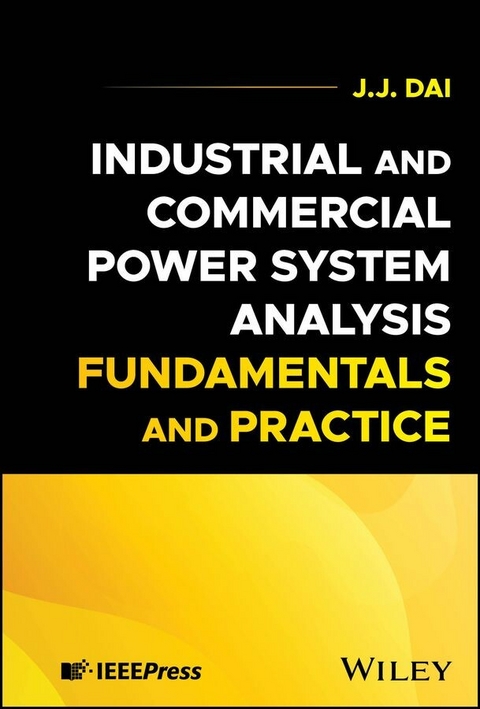
Industrial and Commercial Power System Analysis Fundamentals and Practice (eBook)
477 Seiten
Wiley-IEEE Press (Verlag)
978-1-394-26504-6 (ISBN)
Understand industrial and commercial power systems with this essential guide
Power system analysis is an essential component of new system design, system expansion, and existing system operation. A wide range of published standards and computing tools is available for the analysis of industrial and commercial power systems. This is the first book to provide specific information and practical analysis. Industrial and Commercial Power System Analysis: Fundamentals and Practice fills this gap with a handy, accessible reference for students and practicing engineers. Its chapters cover basic equipment and system configurations and their associated computer models, operating conditions, numerical solution essentials, and analysis objectives and approaches. The result is a volume which directly contributes to the skills needed to apply power systems analysis software in research and industrial applications.
Readers will also find:
- An introductory chapter outlining the basic characteristics of industrial and commercial power systems
- Detailed discussion of topics including modeling and simulation techniques, data requirements and data preparation, tuning and validation, study scenario selections, and many more
- Applicable industrial codes and standards
- Concrete examples of industrial and commercial power system analysis in practice
Industrial and Commercial Power System Analysis: Fundamentals and Practice is ideal for undergraduates, graduates, or practicing engineers looking for an up-to-date reference on the essential tools and standards of power system analysis.
J.J. Dai, PhD, is a retired physical scientist and electrical engineer. He has authored and co-authored more than 30 technical papers in the field of power system modeling and analysis. He is a registered Professional Engineer in the state of California, USA, a Member of IEEE, and a past Chairman of the Power System Analysis Subcommittee of the IEEE Industrial Applications Society (IAS). He has been actively involved in the development of IEEE standards on industrial and commercial power system analysis.
Understand industrial and commercial power systems with this essential guide Power system analysis is an essential component of new system design, system expansion, and existing system operation. A wide range of published standards and computing tools is available for the analysis of industrial and commercial power systems. This is the first book to provide specific information and practical analysis. Industrial and Commercial Power System Analysis: Fundamentals and Practice fills this gap with a handy, accessible reference for students and practicing engineers. Its chapters cover basic equipment and system configurations and their associated computer models, operating conditions, numerical solution essentials, and analysis objectives and approaches. The result is a volume which directly contributes to the skills needed to apply power systems analysis software in research and industrial applications. Readers will also find: An introductory chapter outlining the basic characteristics of industrial and commercial power systemsDetailed discussion of topics including modeling and simulation techniques, data requirements and data preparation, tuning and validation, study scenario selections, and many moreApplicable industrial codes and standardsConcrete examples of industrial and commercial power system analysis in practice Industrial and Commercial Power System Analysis: Fundamentals and Practice is ideal for undergraduates, graduates, or practicing engineers looking for an up-to-date reference on the essential tools and standards of power system analysis.
1
Industrial and Commercial (I&C) Power System
1.1 General Background
Industrial and commercial (I&C) power systems are intricate electrical networks specially designed and operated to deliver reliable electrical power to industrial plants and facilities, as well as for commercial enterprises and buildings. A typical I&C electrical power system comprises several key components or subsystems, including:
- electric power equipment and controls.
- lighting systems.
- power supply for instrument and control systems.
- air conditioning system.
- indicating and alarm equipment.
- receptacles for electrical devices.
- bonding and grounding systems.
- emergency, essential, and miscellaneous power systems.
- Uninterruptible power supply (UPS) systems.
- Electrical vehicle (EV) chargers.
These systems are composed of various electrical equipment and components, including loads, drives, transformers, lines, cables, reactors, capacitors, switches and protective devices, etc. The systems are powered by either local or regional power utilities or installed on-site generators, or renewable power generations, or a mixture of various energy resources. I&C power systems could be configured in mash or radial, depending on the power supply availability and reliability requirements. Most systems have the capability to reconfigure the network topology to meet different operation scenarios.
The complexity and scale of I&C power systems have grown extensively in recent decades. Some oil and gas fields and facilities could have a total of load amount in gigawatts (GW) level with the voltage rating going up to as high as 220 kV. Three-phase power distribution is commonly employed for high voltage (line-to-line voltage ≥1 kV) systems, while three-phase, two-phase, and single-phase power distributions can be used for lower voltage systems. In normal cases, I&C power systems are connected to power grids, and both are in parallel operation, except in special situations such as on an island, in the desert, or in other remote areas. However, it is not unusual for an I&C power system to temperately separate from the grids and operate in islanding conditions in either planned or unplanned scenarios. For such an operating condition, special design, analysis, and control will be required.
1.2 I&C Power System Single-Line Presentation
For system design, study, and maintenance purposes, I&C power systems are represented by single-line diagrams. A single-line diagram is a schematic that shows the electrical connections of an I&C power system with major equipment and components, including sources, branches, and loads. It is a simplified presentation of a three-phase system due to the symmetry in a balanced three-phase electrical system. Figure 1.1 shows a sample I&C power system single-line diagram that includes a utility connection, two on-site generators, an in-plant distribution system with lines and cables, circuit breakers and switches, transformers, and loads.
1.3 Components and Equipment in I&C Power Systems
Key components and equipment that are needed for successful power supply, distribution, and conversion in I&C power systems are described in the following five categories.
1.3.1 Power Supply and Generation
Power supply and generation units are responsible for electricity to energize and operate local loads. Normally, they include utility or grid supply, on-site generation by conventional generators, and renewable resources and energy storages.
- Utility power supply. This is the main source of electrical power supply by local power utility companies through transmission lines or distribution networks. For increasing reliability, multiple lines or even multiple sources can be interconnected to the I&C facility from utilities or grids. Each point of the interconnection is regarded as the point of common coupling (PCC), which usually is on the high-voltage side of the main transformer.
Figure 1.1 A sample I&C power system single-line diagram with symbols for typical components.
- On-site power generation. Due to system reliability requirements or economic considerations, large I&C power systems or systems with critical loads often have on-site installed generators. For example, in industrial plants, combined heat and power (CHP) generation set can be installed to simultaneously generate electricity and heat for processing applications, which can bring more efficiency, cost savings, and enhanced reliability to the operation. With renewable resource technology development, solar photovoltaic (PV) and wind turbine systems are also deployed inside I&C power systems to convert energies from sunlight and wind into electricity using solar panels and wind turbines, respectively, which increase the system cost savings and sustainability and create environmental benefits. As backup and optional power sources, diesel and natural gas generation units sometimes are also deployed to the I&C power system.
- Energy storage. Energy storage devices such as batteries, flywheels, pumped water, compressed air, thermal or heat pumps, supercapacitors, and others in bio, chemical, or mechanical forms can also be installed and integrated to become a part of critical components at I&C power systems. These devices provide energy and power for power backup, islanding operation, black start, and similar purposes and can improve system efficiency, reliability and resiliency, and green energy support. It needs to be pointed out that the electrical characteristics and controls of these devices are very different from conventional power generation equipment.
The size and configurations of the on-site power generation can be designed and tailored to satisfy the specific needs of the facility. Figure 1.2 shows a typical I&C power system with two utility connections at 46 and 69 kV and two on-site synchronous generators at 5 and 25 MVA, respectively.
1.3.2 Power Distribution
Power distribution networks in I&C power systems are an infrastructure that ensures the electric powers are delivered from the power sources discussed above to loads connected throughout the system efficiently, safely, and reliability. The main electrical components and apparatus in the I&C power system distribution network are described below.
- Substation. Substations play an important role in transforming voltage to different levels in I&C power systems to meet equipment ratings and provide various essential operation and protection functions. Substations consist of lines, cables, transformers, switchgears, breakers, protection devices, meters, etc. Figure 1.3 is a sample substation schematic.
- Transformers. Transformers are primarily installed to change voltage levels between different clusters of I&C power systems. The utility power imported via the transmission system is normally at high voltage and needs to be stepped down inside I&C power systems. Step-up transformers are also used in I&C power systems when on-site generation is at lower voltages. Transformers come with different structures and designs, some are with three-cores, and some are with single core. There are also special-purpose transformers such as ground transformers, zig-zag transformers, transformers with a dedicated phase shift between two sides, open-delta (three-phase windings are in delta connection with open-circuit), etc. From the cooling method point of view, both dry-type and oil-immersed-type transformers are widely used in I&C power systems. Voltage transformer/potential transformer (VT/PT) and current transformer (CT) are also extensively used in I&C power systems, mainly for measuring and protection applications. Figure 1.4 illustrates several typical transformer symbols used in single-line diagrams.
Figure 1.2 Typical I&C power system with utility power supply and on-site generation.
Source: Figure 4-10 of [1]. Reprinted with permission from IEEE.
Figure 1.3 A sample substation schematic.
Source: Figure 15-2 of [1]. Reprinted with permission from IEEE.
- Switchgear. Switchgear is a set of equipment assemblies, including breakers, switches, sensors, inductors and capacitors, and protection devices that are used for controlling and protecting electrical circuits, providing isolation, and safeguarding against overloads and faults. Figure 1.5 is a schematic of a switchgear showing only the breakers at both medium voltage (upstream of the transformer) and low voltage (downstream of the transformer) levels.
Figure 1.4 Transformer schematic. (a) Power transformer, (b) voltage transformer, (c) current transformer, and (d) auto transformer.
Source: Figures 10-1 and 11-3 of [1]. Reprinted with permission from IEEE.
Figure 1.5 A sample switchgear schematic.
Source: Figure 2-5 of [1]. Reprinted with permission from IEEE.
- Distribution lines/cables. Lines and cables form distribution networks in I&C power systems....
| Erscheint lt. Verlag | 3.1.2025 |
|---|---|
| Sprache | englisch |
| Themenwelt | Technik ► Elektrotechnik / Energietechnik |
| Schlagworte | computer modeling • computer software • conceptual and detailed design • IEEE Standards • Industrial and commercial power systems • mathematical solutions • network modeling • numerical simulation • operation validation • power generation, distribution and load modeling • Power system analysis |
| ISBN-10 | 1-394-26504-2 / 1394265042 |
| ISBN-13 | 978-1-394-26504-6 / 9781394265046 |
| Informationen gemäß Produktsicherheitsverordnung (GPSR) | |
| Haben Sie eine Frage zum Produkt? |
 EPUB (Adobe DRM)
Kopierschutz: Adobe-DRM
Adobe-DRM ist ein Kopierschutz, der das eBook vor Mißbrauch schützen soll. Dabei wird das eBook bereits beim Download auf Ihre persönliche Adobe-ID autorisiert. Lesen können Sie das eBook dann nur auf den Geräten, welche ebenfalls auf Ihre Adobe-ID registriert sind.
Details zum Adobe-DRM
Dateiformat: EPUB (Electronic Publication)
EPUB ist ein offener Standard für eBooks und eignet sich besonders zur Darstellung von Belletristik und Sachbüchern. Der Fließtext wird dynamisch an die Display- und Schriftgröße angepasst. Auch für mobile Lesegeräte ist EPUB daher gut geeignet.
Systemvoraussetzungen:
PC/Mac: Mit einem PC oder Mac können Sie dieses eBook lesen. Sie benötigen eine
eReader: Dieses eBook kann mit (fast) allen eBook-Readern gelesen werden. Mit dem amazon-Kindle ist es aber nicht kompatibel.
Smartphone/Tablet: Egal ob Apple oder Android, dieses eBook können Sie lesen. Sie benötigen eine
Geräteliste und zusätzliche Hinweise
Buying eBooks from abroad
For tax law reasons we can sell eBooks just within Germany and Switzerland. Regrettably we cannot fulfill eBook-orders from other countries.
aus dem Bereich