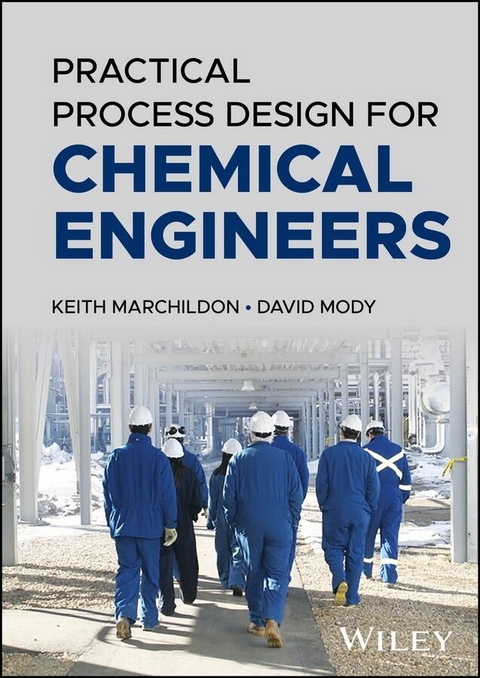
Practical Process Design for Chemical Engineers (eBook)
828 Seiten
Wiley (Verlag)
978-1-394-20386-4 (ISBN)
In-depth and practical textbook resource on chemical engineering processes, ranging from fundamentals to advanced aspects
Practical Process Design for Chemical Engineers presents an extensive overview of the fundamental and advanced aspects of chemical engineering processes. Spanning 20 chapters, the book delves into various processes, equipment, and methodologies essential for modern chemical engineering, from basic principles to specific applications such as reactors, separations, and process integration.
Each chapter systematically covers both theoretical concepts and practical applications, emphasizing process design, operational efficiency, environmental considerations, and safety. The book aims to equip chemical engineers with a robust toolkit for tackling diverse challenges in the industry, emphasizing innovation, sustainability, and the integration of new technologies.
Unlike conventional texts that often focus primarily on established methods and theoretical fundamentals, this book actively explores innovative technologies and strategies to enhance efficiency and minimize environmental impact. Additionally, the book places significant emphasis on practical experience and real-world applications, imbuing readers not only with theoretical knowledge but also with practical skills and an understanding of industry trends.
The book covers:
- Creativity, choice, and decision-making in chemical engineering, emphasizing the artistic and imaginative aspects of process design
- Solids processes such as size reduction, granulation, particle measurement and classification, and the conveyance of solids
- Principles and methods employed to mix diverse materials such as miscible and immiscible liquids, gases with liquids, and solids with liquids or gases
- Critical aspects of heat exchange in chemical processes, focusing on the heating, cooling, and phase changes of various substances
- Estimation of process engineering hours
With detailed discussions on process intensification and the latest developments in solvent and reactor technologies, and a focus on modern, sustainable practices alongside traditional engineering concepts, this book serves as a vital resource for students and professionals seeking to polish and hone their knowledge and practice in chemical engineering design.
Keith Marchildon P. Eng, PhD, was an engineer who made important and lasting contributions to Chemical Engineering in Canada. He pioneered the development of a number of chemical engineering refresher courses that have been offered outside of DuPont, locally and nationally, and was the author of several design handbook chapters published by Wiley. Keith served on the CCPE task force that defined the essential elements of the core knowledge of the Chemical Engineering Discipline that is used in assessing credentials of foreign-trained engineers.
David Mody, P. Eng. brings a broad experience to the book through his industrial and academic experience. He worked as a design engineer with Fluor Corporation for 17 years in the Fluor/ DuPont corporate alliance group, followed by 13 years as the final year design instructor of Chemical Engineering at Queen's University at Kingston.
In-depth and practical textbook resource on chemical engineering processes, ranging from fundamentals to advanced aspects Practical Process Design for Chemical Engineers presents an extensive overview of the fundamental and advanced aspects of chemical engineering processes. Spanning 20 chapters, the book delves into various processes, equipment, and methodologies essential for modern chemical engineering, from basic principles to specific applications such as reactors, separations, and process integration. Each chapter systematically covers both theoretical concepts and practical applications, emphasizing process design, operational efficiency, environmental considerations, and safety. The book aims to equip chemical engineers with a robust toolkit for tackling diverse challenges in the industry, emphasizing innovation, sustainability, and the integration of new technologies. Unlike conventional texts that often focus primarily on established methods and theoretical fundamentals, this book actively explores innovative technologies and strategies to enhance efficiency and minimize environmental impact. Additionally, the book places significant emphasis on practical experience and real-world applications, imbuing readers not only with theoretical knowledge but also with practical skills and an understanding of industry trends. The book covers: Creativity, choice, and decision-making in chemical engineering, emphasizing the artistic and imaginative aspects of process designSolids processes such as size reduction, granulation, particle measurement and classification, and the conveyance of solidsPrinciples and methods employed to mix diverse materials such as miscible and immiscible liquids, gases with liquids, and solids with liquids or gasesCritical aspects of heat exchange in chemical processes, focusing on the heating, cooling, and phase changes of various substancesEstimation of process engineering hours With detailed discussions on process intensification and the latest developments in solvent and reactor technologies, and a focus on modern, sustainable practices alongside traditional engineering concepts, this book serves as a vital resource for students and professionals seeking to polish and hone their knowledge and practice in chemical engineering design.
2
Documentation and Communication
All communication is essentially good. For chemical and chemical engineering projects, a set of formal documents has evolved over the years, which is almost universally used. The production of some of these documents is the sole prerogative of the process designer or process design team. Others have shared responsibility with other members of the project team, including management, to a greater or lesser extent.
Here is a summary of the possible documents that can accompany a project. The list is arranged chronologically. The names may differ from organization to organization, but the content and sequence are universal.
- Basic data – responsibility of management sponsor, laying out the goals and constraints of the projects.
- Process flow diagram (PFD) and the heat and material balance – graphically displaying the result of process synthesis, showing the flow and properties of internal and external streams. An accompanying process description document may also be provided for the purpose of clarity.
- Equipment list – evolving as equipment becomes better defined, providing key parameters that can be used for an initial and ongoing estimate of capital cost, and providing key information for other disciplines such as weights, size, and so on for preliminary design and estimating.
- Piping and instrumentation diagram (P&ID) – showing interconnections and interactions between vessels and the required instrumentation hardware and controllers.
- Equipment data sheets – showing details, as they are calculated, about each major piece of equipment; added by other specialists and vendors so that quotes can be provided.
- Instrument data sheets.
- Functional specifications for distributed control system (DCS) to augment the P&IDs.
- Scope of work and cost estimation.
- Notes from process hazard review.
- Input to applications for environmental permits.
- After the project has been approved and before plant start-up, training manual and operating instructions.
- Maintenance instructions.
- Record of design calculations for future troubleshooting and modification of the system.
This is a formidable list and does not apply in full to every project. For a large project, several people may be involved in creating these documents. Of course, if management eventually decides against proceeding with the project, then some documents (e.g. operating instructions) would be curtailed or never be written.
Here is an overview of the general content of each document.
2.1 Basic Data
Projects always start with a sponsor, i.e., someone who can authorize the money. That person or persons may be wishing to make a new product and will convey in the basic data document the production rate and characteristics (e.g. purity) of that product. The sponsor may be a government agency and perhaps wish to build a facility to deal with a waste stream. Again, the rate is given, and, in this case, the purity of the stream leaving the facility is specified. In particular cases, there may be additional requirements and constraints. The key is to ensure that the process designer and the project team deliver what the sponsor asks for. The document also serves as a reference point for any subsequent negotiation between the sponsor and the team as the details of the project start to emerge.
Sponsors and designers will engage in producing a workable document and may wish to refer to writings on this subject, such as Read (2000), Manganaro (2002), Ainsworth and Brocklebank (2003), Pavone (2006), Buckbee (2010), Lagace (2011), Ogle and Carpenter (2014), and Toghraei (2015).
2.2 Process Flow Diagram (PFD)
The PFD can be drawn for any process but is most commonly illustrated for continuous processes. It consists of a sheet on which schematics of the major vessels are located. The interconnections between the vessels are shown with arrows. Every flow stream is indicated with a number. The streams are listed in a table outside the diagram, showing their properties, e.g., phase, flow rate of each of the components in the stream (kg s−1), temperature, pressure, and physical properties. In some jurisdictions, this information is listed on the diagram itself, but this can introduce clutter and make it difficult to list extra information about the streams, so it is simplest to have it separated in a table. The details of the flows, in the initial version of the PFD, may be simply what the process designer wishes them to be, with no reference to the actual equipment that will produce these flows. Design of the equipment can come later. Nasby (2012) saw PFDs as communication tools.
The example shown in Figure 2.1 is a chemical reactor feeding into the side of a distillation column, with recycle from the top of the distillation column back to near the entrance point of the reactor. Near the top of the column, there is a waste or purge stream. At the bottom of the column, almost pure product B emerges ready for sale. This is a very common scenario in chemical process systems, which deals with the situation where one possibility is that the reaction of A to B approaches equilibrium. Another is that B has a tendency to degrade into C and B is removed as quickly as possible. The seven streams are numbered as follows:
- 1. raw material feed stream,
- 2. the exit from the reactor,
- 3. the recycle return flow to the reactor,
- 4. the pure B product stream from the bottom of the distillation column, and
- 5. 6 and 7 – the streams around the C-purge unit.
Figure 2.1 Reactor with recycle.
This is the way the process is intended to operate and for which the designer has specified the size, geometry, and operating conditions. Subsequently, the details of the vessels will be worked out and will appear in the equipment data sheets. A process description similar to the description above is a useful document for communication to other members of the team.
For simplicity in this example (Figure 2.1), all components A, B, and C have the same molecular weights. The order of volatilities is “A” (most volatile), “C”, and “B”.
The flow data are useful to other members of the team, particularly the pipe designers who need to know the flow and properties of the stream and any corrosion potential. The principal vessels on the chart may have names attached to them, but in many cases, this is not done to avoid giving a competitor information in case the sheet falls into the wrong hands. PFDs are generally quite guarded by the enterprise and released to other employees only with a need to know. For aesthetic purposes, the vessels are usually shown with rounded corners rather than squared corners.
The choice of flows for this process is dictated by the amount of product that the manufacturer wants this process to yield. Some of the vessels, when eventually chosen, would be quite capable of outperforming their rate in this particular flow sheet. All of the flows have to be consistent with one another and one way would be to count the atomic species in the streams in the PFD. The numbers in the flow table should be checked for consistency with the reaction kinetics or conversions and the vessel sizes.
The flow table can and should display more data than shown, especially the phases of the stream. In this case, only stream 6 and stream 3 before the condenser are vapor; all the rest is liquid.
2.2.1 PFD for Batch Processes
The continuous version of the PFD does not lend itself to batch processes because the flow streams are not constant. There is, in fact, no hard and fast rule that diagrams have to appear on a flow sheet; however, they do assist engineering personnel in interpreting the sheet for any process. In batch processing, there may be a single vessel which undergoes various cycles or there could be two or more vessels all of which need to be described.
Consider the example of a single vessel undergoing four cycles of operation from start to finish (Figure 2.2). In the first cycle, the pressure rises autogenously with temperature. In the second cycle, the pressure is kept constant by virtue of the release of volatile material from the vessel. In the third cycle, the pressure is reduced. In the fourth cycle, the material is expelled from the vessel. A single image of the vessel would suffice, but an alternative is to show an image for each cycle since the valves or pumps can be shown as on or off for each cycle. In this case, four copies of the vessel could be printed on the process flow sheet. The figure shows two of the cycles, with the time-wise progression of the variables during the initial pressurization and then during the emptying.
Sometimes a batch process uses an extra feed somewhere along its process path. This is known as a batch-fed process. A particular cycle in which this feed is introduced is separated into two cycles. The additional feed also has a time line for the time it takes to be introduced: its time, pressure, temperature, flow, and composition are listed out in the same manner as the actual emissions of the main process vessel. Note that this is an addition rather than an emission. Once again, the full rate out of the vessel is useful to the piping designer. In these situations, it is useful to document the instantaneous flow rate for sizing pipes,...
| Erscheint lt. Verlag | 3.1.2025 |
|---|---|
| Sprache | englisch |
| Themenwelt | Naturwissenschaften ► Chemie |
| Technik | |
| Schlagworte | chemical engineering equipment • chemical engineering process design • Chemical Engineering Processes • chemical engineering process integration • chemical engineering reactors • chemical engineering sustainability |
| ISBN-10 | 1-394-20386-1 / 1394203861 |
| ISBN-13 | 978-1-394-20386-4 / 9781394203864 |
| Informationen gemäß Produktsicherheitsverordnung (GPSR) | |
| Haben Sie eine Frage zum Produkt? |
 EPUB (Adobe DRM)
Kopierschutz: Adobe-DRM
Adobe-DRM ist ein Kopierschutz, der das eBook vor Mißbrauch schützen soll. Dabei wird das eBook bereits beim Download auf Ihre persönliche Adobe-ID autorisiert. Lesen können Sie das eBook dann nur auf den Geräten, welche ebenfalls auf Ihre Adobe-ID registriert sind.
Details zum Adobe-DRM
Dateiformat: EPUB (Electronic Publication)
EPUB ist ein offener Standard für eBooks und eignet sich besonders zur Darstellung von Belletristik und Sachbüchern. Der Fließtext wird dynamisch an die Display- und Schriftgröße angepasst. Auch für mobile Lesegeräte ist EPUB daher gut geeignet.
Systemvoraussetzungen:
PC/Mac: Mit einem PC oder Mac können Sie dieses eBook lesen. Sie benötigen eine
eReader: Dieses eBook kann mit (fast) allen eBook-Readern gelesen werden. Mit dem amazon-Kindle ist es aber nicht kompatibel.
Smartphone/Tablet: Egal ob Apple oder Android, dieses eBook können Sie lesen. Sie benötigen eine
Geräteliste und zusätzliche Hinweise
Buying eBooks from abroad
For tax law reasons we can sell eBooks just within Germany and Switzerland. Regrettably we cannot fulfill eBook-orders from other countries.
aus dem Bereich