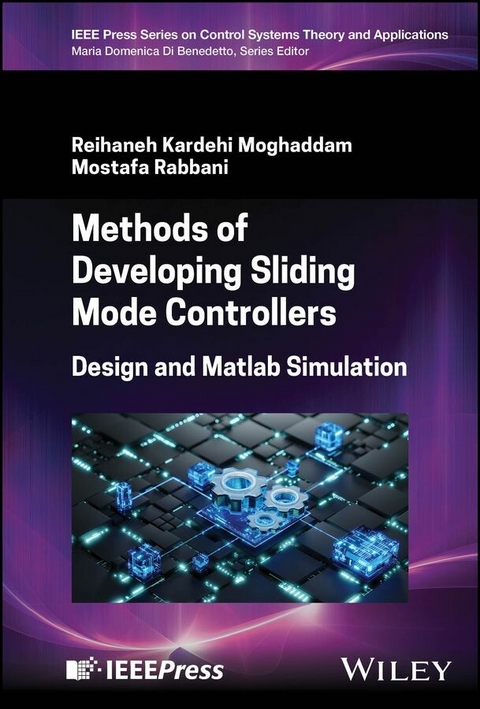
Methods of Developing Sliding Mode Controllers (eBook)
254 Seiten
Wiley-IEEE Press (Verlag)
978-1-394-31450-8 (ISBN)
Comprehensive, fast-access guide to different types of sliding mode controllers and their programming and simulation in MATLAB and Simulink
Methods of Developing Sliding Mode Controllers delivers a practical review of sliding mode controllers (SMCs) and their challenges with coverage of related theorems, stability analysis, and how to program and simulate SMCs in MATLAB and Simulink. The book details the latest methods of their development and their applications in the automotive, aerospace, and robotics industries.
Initial chapters detail a range of different types of controllers. A combination of sliding and backstepping control is introduced and simulated and the phenomenon of chattering and effective solutions to reduce it are provided, along with suitable examples and analytical tables of the results. The final two chapters are related to fixed-time and event-triggered SMCs. Extensive Matlab/Simulink supported examples and simulation program code/block diagrams are included throughout.
Methods of Developing Sliding Mode Controllers: Design and Matlab Simulation explores sample topics including:
- Classic SMCs, covering variable structures, including relays and feedback control with switching gains, as well as controller design and theoretical foundations
- Terminal SMCs, covering nonsingular and fast variations, dynamic SMCs, and fuzzy SMCs, covering fuzzy approximation and equivalent control as well as indirect design
- Super twisting SMCs, adaptive SMCs, and backstepping SMCs, covering the backstepping method and chaotic duffing oscillator equations
- Sign, Epsilon-sign, saturation, hyperbolic tangent, and generalized hyperbolic tangent functions for chatter reduction
Methods of Developing Sliding Mode Controllers: Design and Matlab Simulation is a concise yet comprehensive and highly practical reference on the subject for graduate/postgraduate students in electrical engineering, mechanical engineering, and biomedical engineering along with academics and professionals in fields related to SMCs.
Reihaneh Kardehi Moghaddam, Department of Electrical Engineering, Mashhad Branch, Islamic Azad University, Mashhad, Iran, and School of Computing, Macquarie University, Sydney, Australia. Dr. Kardehi Moghaddam's main fields of research are optimization of extracted power from renewable energy sources, nonlinear fractional order sliding mode controllers, intelligent optimization methods and deep neural networks. She has supervised four doctoral dissertations and 45+ Master's dissertations.
Mostafa Rabbani, PhD researcher, Department of Electrical Engineering, Azad University of Mashhad, Mashhad, Iran. His main field of research is nonlinear control of uncertain nonlinear systems.
Comprehensive, fast-access guide to different types of sliding mode controllers and their programming and simulation in MATLAB and Simulink Methods of Developing Sliding Mode Controllers delivers a practical review of sliding mode controllers (SMCs) and their challenges with coverage of related theorems, stability analysis, and how to program and simulate SMCs in MATLAB and Simulink. The book details the latest methods of their development and their applications in the automotive, aerospace, and robotics industries. Initial chapters detail a range of different types of controllers. A combination of sliding and backstepping control is introduced and simulated and the phenomenon of chattering and effective solutions to reduce it are provided, along with suitable examples and analytical tables of the results. The final two chapters are related to fixed-time and event-triggered SMCs. Extensive Matlab/Simulink supported examples and simulation program code/block diagrams are included throughout. Methods of Developing Sliding Mode Controllers: Design and Matlab Simulation explores sample topics including: Classic SMCs, covering variable structures, including relays and feedback control with switching gains, as well as controller design and theoretical foundations Terminal SMCs, covering nonsingular and fast variations, dynamic SMCs, and fuzzy SMCs, covering fuzzy approximation and equivalent control as well as indirect design Super twisting SMCs, adaptive SMCs, and backstepping SMCs, covering the backstepping method and chaotic duffing oscillator equations Sign, Epsilon-sign, saturation, hyperbolic tangent, and generalized hyperbolic tangent functions for chatter reduction Methods of Developing Sliding Mode Controllers: Design and Matlab Simulation is a concise yet comprehensive and highly practical reference on the subject for graduate/postgraduate students in electrical engineering, mechanical engineering, and biomedical engineering along with academics and professionals in fields related to SMCs.
| Erscheint lt. Verlag | 31.12.2024 |
|---|---|
| Reihe/Serie | IEEE Press Series on Control Systems Theory and Applications |
| Sprache | englisch |
| Themenwelt | Technik ► Elektrotechnik / Energietechnik |
| Schlagworte | Adaptive SMCs • Backstepping SMCs, ---- • Classic SMCs • Dynamic SMCs • fuzzy approximation • Fuzzy SMCs • Lyapunov • Nonlinear Systems • Simulink, Fast nonsingular SMC, Inverted pendulum • Sliding mode controller, Sliding surface, Event-triggering controller, Fixed time, Matlab programming • SMC design • Super twisting SMCs • Terminal SMCs |
| ISBN-10 | 1-394-31450-7 / 1394314507 |
| ISBN-13 | 978-1-394-31450-8 / 9781394314508 |
| Informationen gemäß Produktsicherheitsverordnung (GPSR) | |
| Haben Sie eine Frage zum Produkt? |
 PDF (Adobe DRM)
Kopierschutz: Adobe-DRM
Adobe-DRM ist ein Kopierschutz, der das eBook vor Mißbrauch schützen soll. Dabei wird das eBook bereits beim Download auf Ihre persönliche Adobe-ID autorisiert. Lesen können Sie das eBook dann nur auf den Geräten, welche ebenfalls auf Ihre Adobe-ID registriert sind.
Details zum Adobe-DRM
Dateiformat: PDF (Portable Document Format)
Mit einem festen Seitenlayout eignet sich die PDF besonders für Fachbücher mit Spalten, Tabellen und Abbildungen. Eine PDF kann auf fast allen Geräten angezeigt werden, ist aber für kleine Displays (Smartphone, eReader) nur eingeschränkt geeignet.
Systemvoraussetzungen:
PC/Mac: Mit einem PC oder Mac können Sie dieses eBook lesen. Sie benötigen eine
eReader: Dieses eBook kann mit (fast) allen eBook-Readern gelesen werden. Mit dem amazon-Kindle ist es aber nicht kompatibel.
Smartphone/Tablet: Egal ob Apple oder Android, dieses eBook können Sie lesen. Sie benötigen eine
Geräteliste und zusätzliche Hinweise
Buying eBooks from abroad
For tax law reasons we can sell eBooks just within Germany and Switzerland. Regrettably we cannot fulfill eBook-orders from other countries.
aus dem Bereich