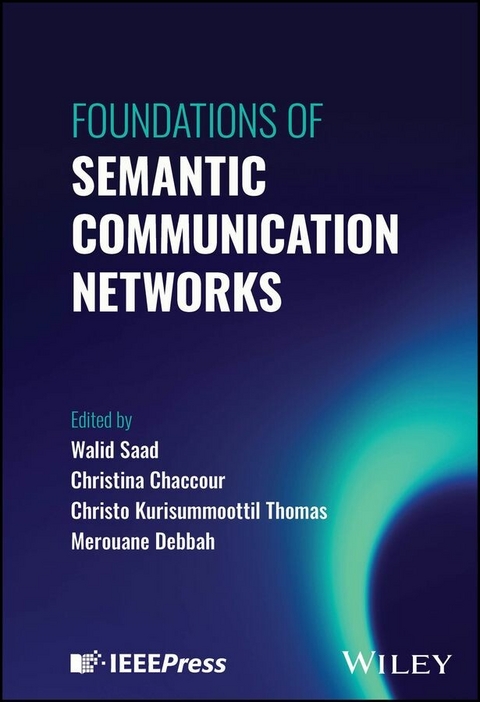
Foundations of Semantic Communication Networks (eBook)
418 Seiten
Wiley-IEEE Press (Verlag)
978-1-394-24790-5 (ISBN)
Comprehensive overview of the principles, theories, and techniques needed to build end-to-end semantic communication systems, with case studies included.
In this rapidly evolving landscape, the integration of connected intelligence applications highlights the pressing need for networks to gain intelligence in a non-siloed and ad hoc manner. The traditional incremental approach to network design is no longer sufficient to support the diverse and dynamic requirements of these emerging applications. This necessitates a paradigm shift towards more intelligent and adaptive network architectures.
From theory to application, Foundations of Semantic Communication Networks describes and provides a comprehensive understanding of everything needed to build end-to-end semantic communication systems. This book covers various interdisciplinary topics such as the mathematical foundations of semantic communications, information theoretical perspectives, joint-source channel coding, semantic-aware resource management strategies, interoperability under heterogeneous semantic communication users, advanced artificial intelligence (AI) and machine reasoning techniques for enabling connected intelligent applications, secure and privacy-preserving semantic communication systems, and the coexistence and interoperability of semantic, goal-oriented, and legacy systems.
The book examines unique features of end-to-end networking with semantic communications, including instilling reasoning behaviors in communication nodes, the role of the semantic plane in information filtering, control of communication and computing resources, transmit and receive signaling schemes, and connected intelligence device control. It emphasizes the importance of data semantics and age of information metrics. The book also discusses the profound impact of semantic communications on the telecom industry, highlighting changes in network performance, resource management, traffic, as well as spectral and energy efficiency.
Furthermore, the book provides insights into the mathematical constructs and AI theories for formulating semantic information, such as topology and category theory. It explores real-world applications, case studies, and future research directions as wireless technologies transition to 6G and beyond.
Written by four recognized experts in the field with a wealth of expertise from academia, industry, and research institutions, Foundations of Semantic Communication Networks addresses sample topics, including:
- Proposing new formulations using rigorous mathematical frameworks such as category theory and algebraic topology
- Focusing on real-world scenarios, addressing multiple access and networking challenges through collaborative frameworks for multi-modal transmissions, examining multiple access schemes to enhance transmission efficiency, and ensuring coexistence with legacy systems
- Enabling efficient large-scale systems for 6G and beyond wireless systems through AI-native air interfaces and semantic-aware resource allocation strategies
- Utilizing causality and neuro-symbolic artificial intelligence for minimalistic transmissions, and achieving generalizability and transferability across contexts and data distributions to develop high-fidelity semantic communication systems
- Examining security vulnerabilities associated with deep neural networks in semantic communications, and proposing encrypted, privacy-preserving semantic communication systems (ESCS) as a solution
Foundations of Semantic Communication Networks is an excellent forward-thinking resource on the subject for readers with a strong background in the subject matter, including graduate-level students, academics, practitioners, and industry researchers.
Walid Saad is a Professor with the Department of Electrical and Computer Engineering, Virginia Tech, USA, where he leads the Network Science, Wireless, and Security (NEWS) Laboratory.
Christina Chaccour is a Network Solutions Manager at Ericsson Inc., USA, where she spearheads product solutions for 5G-Advanced, 6G, and AI integration across North America.
Christo Kurisummoottil Thomas is a Post-Doctoral Fellow with the Department of Electrical and Computer Engineering, Virginia Tech, USA.
Merouane Debbah is a Professor at Khalifa University of Science and Technology, UAE, and founding Director of the KU 6G Research Center.
Comprehensive overview of the principles, theories, and techniques needed to build end-to-end semantic communication systems, with case studies included. In this rapidly evolving landscape, the integration of connected intelligence applications highlights the pressing need for networks to gain intelligence in a non-siloed and ad hoc manner. The traditional incremental approach to network design is no longer sufficient to support the diverse and dynamic requirements of these emerging applications. This necessitates a paradigm shift towards more intelligent and adaptive network architectures. From theory to application, Foundations of Semantic Communication Networks describes and provides a comprehensive understanding of everything needed to build end-to-end semantic communication systems. This book covers various interdisciplinary topics such as the mathematical foundations of semantic communications, information theoretical perspectives, joint-source channel coding, semantic-aware resource management strategies, interoperability under heterogeneous semantic communication users, advanced artificial intelligence (AI) and machine reasoning techniques for enabling connected intelligent applications, secure and privacy-preserving semantic communication systems, and the coexistence and interoperability of semantic, goal-oriented, and legacy systems. The book examines unique features of end-to-end networking with semantic communications, including instilling reasoning behaviors in communication nodes, the role of the semantic plane in information filtering, control of communication and computing resources, transmit and receive signaling schemes, and connected intelligence device control. It emphasizes the importance of data semantics and age of information metrics. The book also discusses the profound impact of semantic communications on the telecom industry, highlighting changes in network performance, resource management, traffic, as well as spectral and energy efficiency. Furthermore, the book provides insights into the mathematical constructs and AI theories for formulating semantic information, such as topology and category theory. It explores real-world applications, case studies, and future research directions as wireless technologies transition to 6G and beyond. Written by four recognized experts in the field with a wealth of expertise from academia, industry, and research institutions, Foundations of Semantic Communication Networks addresses sample topics, including: Proposing new formulations using rigorous mathematical frameworks such as category theory and algebraic topology Focusing on real-world scenarios, addressing multiple access and networking challenges through collaborative frameworks for multi-modal transmissions, examining multiple access schemes to enhance transmission efficiency, and ensuring coexistence with legacy systems Enabling efficient large-scale systems for 6G and beyond wireless systems through AI-native air interfaces and semantic-aware resource allocation strategies Utilizing causality and neuro-symbolic artificial intelligence for minimalistic transmissions, and achieving generalizability and transferability across contexts and data distributions to develop high-fidelity semantic communication systems Examining security vulnerabilities associated with deep neural networks in semantic communications, and proposing encrypted, privacy-preserving semantic communication systems (ESCS) as a solution Foundations of Semantic Communication Networks is an excellent forward-thinking resource on the subject for readers with a strong background in the subject matter, including graduate-level students, academics, practitioners, and industry researchers.
| Erscheint lt. Verlag | 24.12.2024 |
|---|---|
| Sprache | englisch |
| Themenwelt | Technik ► Elektrotechnik / Energietechnik |
| Schlagworte | 6G systems • 6G tech • AI-native • Artificial Intelligence (AI) • causal ai • cellular systems • generative AI • Joint-source channel coding • next-generation networks. • Semantic Communication • semantic information theory • semantic wireless • signal filtering • Signal Processing • wireless machine reasoning techniques • wireless networks • Wireless resource management |
| ISBN-10 | 1-394-24790-7 / 1394247907 |
| ISBN-13 | 978-1-394-24790-5 / 9781394247905 |
| Informationen gemäß Produktsicherheitsverordnung (GPSR) | |
| Haben Sie eine Frage zum Produkt? |
 PDF (Adobe DRM)
Kopierschutz: Adobe-DRM
Adobe-DRM ist ein Kopierschutz, der das eBook vor Mißbrauch schützen soll. Dabei wird das eBook bereits beim Download auf Ihre persönliche Adobe-ID autorisiert. Lesen können Sie das eBook dann nur auf den Geräten, welche ebenfalls auf Ihre Adobe-ID registriert sind.
Details zum Adobe-DRM
Dateiformat: PDF (Portable Document Format)
Mit einem festen Seitenlayout eignet sich die PDF besonders für Fachbücher mit Spalten, Tabellen und Abbildungen. Eine PDF kann auf fast allen Geräten angezeigt werden, ist aber für kleine Displays (Smartphone, eReader) nur eingeschränkt geeignet.
Systemvoraussetzungen:
PC/Mac: Mit einem PC oder Mac können Sie dieses eBook lesen. Sie benötigen eine
eReader: Dieses eBook kann mit (fast) allen eBook-Readern gelesen werden. Mit dem amazon-Kindle ist es aber nicht kompatibel.
Smartphone/Tablet: Egal ob Apple oder Android, dieses eBook können Sie lesen. Sie benötigen eine
Geräteliste und zusätzliche Hinweise
Buying eBooks from abroad
For tax law reasons we can sell eBooks just within Germany and Switzerland. Regrettably we cannot fulfill eBook-orders from other countries.
aus dem Bereich