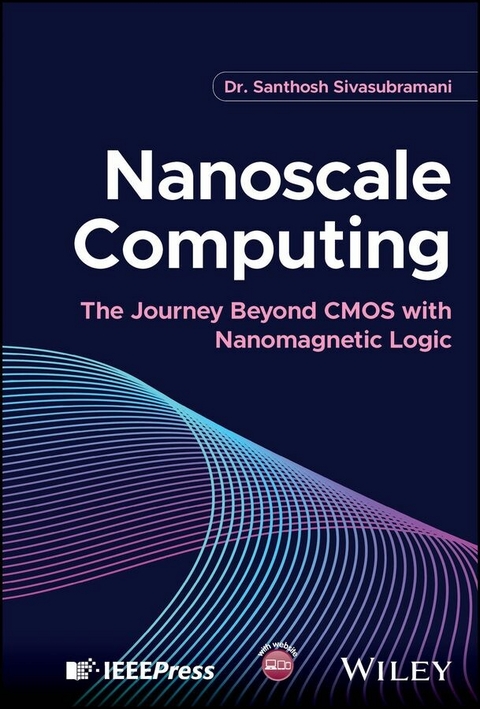
Nanoscale Computing (eBook)
419 Seiten
Wiley-IEEE Press (Verlag)
978-1-394-26357-8 (ISBN)
Understand the future of computing with this accessible, wide-ranging introduction to a promising field
Miniaturization and the emergence of nanotechnology have together constituted the most revolutionary development in recent decades of computing research and innovation. Nanomagnetic computing and logic have allowed engineers and programmers to move beyond the Complementary Metal-Oxide-Semiconductor (CMOS) and their associated methods into a new world of cutting-edge computing technology.
Nanoscale Computing offers the first-ever single-authored textbook on this vital subject, introducing the fundamentals of nanoscale computing, their suitability to the traditional limitations of CMOS computing, and their growing number of applications. The result is a key text for students, professionals, and researchers alike.
Nanoscale Computing readers will also find:
- An emphasis on practical applications, both current and future
- Detailed discussion of topics including nanomagnetic logic, edge computing, and more
- End of chapter quizzes and additional tutorials to facilitate learning
Nanoscale Computing is ideal for researchers and technology experts, as well as graduate and undergraduate students working in computer science, nanotechnology, magnetics, electronics, semiconductors, electron devices, circuits/systems, and multi-interdisciplinary related fields.
Santhosh Sivasubramani, PhD, currently serves as the working group chair for IEC/IEEE P62659?, focusing on the Standard for Nanomanufacturing - Large Scale Manufacturing for Nanoelectronics. Recognized as a Senior Member of IEEE, he contributes to the IEEE Nanotechnology Council Technical Committee 12 on Nanomagnetics, IEEE NTC/EDS Young Professionals, and the IEEE Task Force on Rebooting Computing. In 2023, he was honored with the IEEE Member Geographic Activities Young Professional Achievement Award. Dr. Santhosh plays a crucial role in shaping the future of nanoscale computing through his contributions to the IEEE International Roadmap of Devices and Systems: Beyond CMOS Working Group Report. Additionally, he serves as the Secretary of the IEEE NTC Standards Committee. Beyond his professional commitments, Dr. Santhosh actively contributes as a Track/Session Chair and program/organizing committee member for numerous IEEE International conferences. Additionally, he serves as an advisory board member for various faculty development programs and acts as a liaison for industry-academia partnerships. He is also the Founder of RSL Quantum.
Understand the future of computing with this accessible, wide-ranging introduction to a promising field Miniaturization and the emergence of nanotechnology have together constituted the most revolutionary development in recent decades of computing research and innovation. Nanomagnetic computing and logic have allowed engineers and programmers to move beyond the Complementary Metal-Oxide-Semiconductor (CMOS) and their associated methods into a new world of cutting-edge computing technology. Nanoscale Computing offers the first-ever single-authored textbook on this vital subject, introducing the fundamentals of nanoscale computing, their suitability to the traditional limitations of CMOS computing, and their growing number of applications. The result is a key text for students, professionals, and researchers alike. Nanoscale Computing readers will also find: An emphasis on practical applications, both current and future Detailed discussion of topics including nanomagnetic logic, edge computing, and more End of chapter quizzes and additional tutorials to facilitate learning Nanoscale Computing is ideal for researchers and technology experts, as well as graduate and undergraduate students working in computer science, nanotechnology, magnetics, electronics, semiconductors, electron devices, circuits/systems, and multi-interdisciplinary related fields.
| Erscheint lt. Verlag | 24.12.2024 |
|---|---|
| Sprache | englisch |
| Themenwelt | Naturwissenschaften ► Chemie |
| Technik ► Maschinenbau | |
| Schlagworte | architecture design • Beyond CMOS • bio-nanoelectronics • edge AI Devices • edge computing • hybrid computing • IoT applications • magnetic materials • Material Design • Nanomagnetic Logic • Nanoscale computing • neuromorphic computing • Quantum Computing • scalability challenges • spin-transfer torque • Spintronics |
| ISBN-10 | 1-394-26357-0 / 1394263570 |
| ISBN-13 | 978-1-394-26357-8 / 9781394263578 |
| Informationen gemäß Produktsicherheitsverordnung (GPSR) | |
| Haben Sie eine Frage zum Produkt? |
 PDF (Adobe DRM)
Kopierschutz: Adobe-DRM
Adobe-DRM ist ein Kopierschutz, der das eBook vor Mißbrauch schützen soll. Dabei wird das eBook bereits beim Download auf Ihre persönliche Adobe-ID autorisiert. Lesen können Sie das eBook dann nur auf den Geräten, welche ebenfalls auf Ihre Adobe-ID registriert sind.
Details zum Adobe-DRM
Dateiformat: PDF (Portable Document Format)
Mit einem festen Seitenlayout eignet sich die PDF besonders für Fachbücher mit Spalten, Tabellen und Abbildungen. Eine PDF kann auf fast allen Geräten angezeigt werden, ist aber für kleine Displays (Smartphone, eReader) nur eingeschränkt geeignet.
Systemvoraussetzungen:
PC/Mac: Mit einem PC oder Mac können Sie dieses eBook lesen. Sie benötigen eine
eReader: Dieses eBook kann mit (fast) allen eBook-Readern gelesen werden. Mit dem amazon-Kindle ist es aber nicht kompatibel.
Smartphone/Tablet: Egal ob Apple oder Android, dieses eBook können Sie lesen. Sie benötigen eine
Geräteliste und zusätzliche Hinweise
Buying eBooks from abroad
For tax law reasons we can sell eBooks just within Germany and Switzerland. Regrettably we cannot fulfill eBook-orders from other countries.
aus dem Bereich