


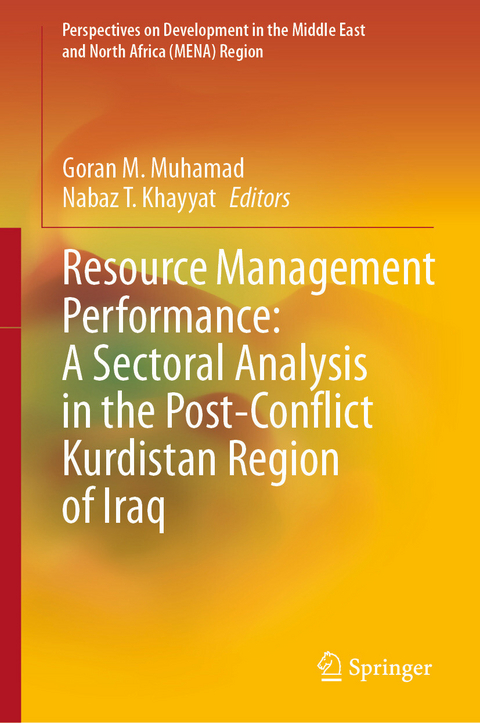
Resource Management Performance: A Sectoral Analysis in the Post-Conflict Kurdistan Region of Iraq (eBook)
VI, 448 Seiten
Springer Nature Singapore (Verlag)
978-981-97-7725-9 (ISBN)
This book investigates the intricacies of resource management performance across various sectors within the Kurdistan Region of Iraq. With 13 in-depth studies, it examines the region's evolution from an agricultural society to an emerging market since the collapse of the Saddam Hussein regime in 2003. Oil and gas revenue, comprising over 85 percent of fiscal revenues, has attracted multinational companies and international humanitarian organizations, although external factors such as the ISIS conflict and global economic downturns have hindered their performance. Additionally, conflicts with Baghdad and the fallout of the ISIS war have led to double embargoes and economic crises, exacerbated by the region's provision for 2 million refugees and internally displaced persons. International entities like the IOM and UNDP have played vital roles in supporting the region's development amid these challenges. Despite these obstacles, the Kurdistan Region demonstrates significant economic potential. By scrutinizing resource management in sectors such as education and electricity, this book offers valuable insights and policy recommendations for researchers, decision-makers, and organizations invested in the region's growth and stability.
This book investigates the intricacies of resource management performance across various sectors within the Kurdistan Region of Iraq. With 13 in-depth studies, it examines the region's evolution from an agricultural society to an emerging market since the collapse of the Saddam Hussein regime in 2003. Oil and gas revenue, comprising over 85 percent of fiscal revenues, has attracted multinational companies and international humanitarian organizations, although external factors such as the ISIS conflict and global economic downturns have hindered their performance. Additionally, conflicts with Baghdad and the fallout of the ISIS war have led to double embargoes and economic crises, exacerbated by the region's provision for 2 million refugees and internally displaced persons. International entities like the IOM and UNDP have played vital roles in supporting the region's development amid these challenges. Despite these obstacles, the Kurdistan Region demonstrates significant economic potential. By scrutinizing resource management in sectors such as education and electricity, this book offers valuable insights and policy recommendations for researchers, decision-makers, and organizations invested in the region's growth and stability.
| Erscheint lt. Verlag | 23.12.2024 |
|---|---|
| Reihe/Serie | Perspectives on Development in the Middle East and North Africa (MENA) Region |
| Zusatzinfo | VI, 448 p. 93 illus. |
| Sprache | englisch |
| Themenwelt | Naturwissenschaften |
| Sozialwissenschaften ► Politik / Verwaltung ► Europäische / Internationale Politik | |
| Sozialwissenschaften ► Soziologie ► Spezielle Soziologien | |
| Technik ► Elektrotechnik / Energietechnik | |
| Wirtschaft ► Volkswirtschaftslehre ► Makroökonomie | |
| Schlagworte | Aid and Development and Humanitarian Assistance • Aid and Development in Kurdistan • Kurdistan Region of Iraq • Natural Resource Management in Kurdistan • The Kurdistan Region of Iraq Economy |
| ISBN-10 | 981-97-7725-9 / 9819777259 |
| ISBN-13 | 978-981-97-7725-9 / 9789819777259 |
| Informationen gemäß Produktsicherheitsverordnung (GPSR) | |
| Haben Sie eine Frage zum Produkt? |
 PDF (Wasserzeichen)
DRM: Digitales Wasserzeichen
Dieses eBook enthält ein digitales Wasserzeichen und ist damit für Sie personalisiert. Bei einer missbräuchlichen Weitergabe des eBooks an Dritte ist eine Rückverfolgung an die Quelle möglich.
Dateiformat: PDF (Portable Document Format)
Mit einem festen Seitenlayout eignet sich die PDF besonders für Fachbücher mit Spalten, Tabellen und Abbildungen. Eine PDF kann auf fast allen Geräten angezeigt werden, ist aber für kleine Displays (Smartphone, eReader) nur eingeschränkt geeignet.
Systemvoraussetzungen:
PC/Mac: Mit einem PC oder Mac können Sie dieses eBook lesen. Sie benötigen dafür einen PDF-Viewer - z.B. den Adobe Reader oder Adobe Digital Editions.
eReader: Dieses eBook kann mit (fast) allen eBook-Readern gelesen werden. Mit dem amazon-Kindle ist es aber nicht kompatibel.
Smartphone/Tablet: Egal ob Apple oder Android, dieses eBook können Sie lesen. Sie benötigen dafür einen PDF-Viewer - z.B. die kostenlose Adobe Digital Editions-App.
Buying eBooks from abroad
For tax law reasons we can sell eBooks just within Germany and Switzerland. Regrettably we cannot fulfill eBook-orders from other countries.


