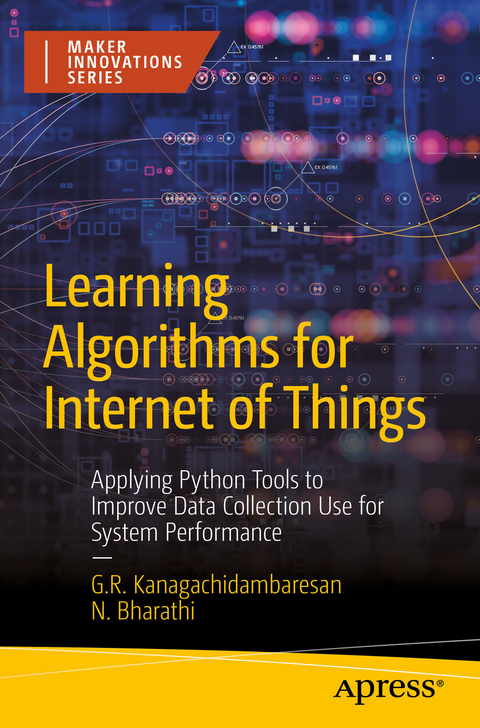
Learning Algorithms for Internet of Things (eBook)
XIX, 299 Seiten
Apress (Verlag)
979-8-8688-0530-1 (ISBN)
The advent of Internet of Things (IoT) has paved the way for sensing the environment and smartly responding. This can be further improved by enabling intelligence to the system with the support of machine learning and deep learning techniques. This book describes learning algorithms that can be applied to IoT-based, real-time applications and improve the utilization of data collected and the overall performance of the system.
Many societal challenges and problems can be resolved using a better amalgamation of IoT and learning algorithms. 'Smartness' is the buzzword that is realized only with the help of learning algorithms. In addition, it supports researchers with code snippets that focus on the implementation and performance of learning algorithms on IoT based applications such as healthcare, agriculture, transportation, etc. These snippets include Python packages such as Scipy, Scikit-learn, Theano, TensorFlow, Keras, PyTorch, and more.
Learning Algorithms for Internet of Things provides you with an easier way to understand the purpose and application of learning algorithms on IoT.
What you'll Learn
- Supervised algorithms such as Regression and Classification.
- Unsupervised algorithms, like K-means clustering, KNN, hierarchical clustering, principal component analysis, and more.
- Artificial neural networks for IoT (architecture, feedback, feed-forward, unsupervised).
- Convolutional neural networks for IoT (general, LeNet, AlexNet, VGGNet, GoogLeNet, etc.).
- Optimization methods, such as gradient descent, stochastic gradient descent, Adagrad, AdaDelta, and IoT optimization.
Who This Book Is For
Students interested in learning algorithms and their implementations, as well as researchers in IoT looking to extend their work with learning algorithms
The advent of Internet of Things (IoT) has paved the way for sensing the environment and smartly responding. This can be further improved by enabling intelligence to the system with the support of machine learning and deep learning techniques. This book describes learning algorithms that can be applied to IoT-based, real-time applications and improve the utilization of data collected and the overall performance of the system.Many societal challenges and problems can be resolved using a better amalgamation of IoT and learning algorithms. Smartness is the buzzword that is realized only with the help of learning algorithms. In addition, it supports researchers with code snippets that focus on the implementation and performance of learning algorithms on IoT based applications such as healthcare, agriculture, transportation, etc. These snippets include Python packages such as Scipy, Scikit-learn, Theano, TensorFlow, Keras, PyTorch, and more.Learning Algorithms for Internet of Things provides you with an easier way to understand the purpose and application of learning algorithms on IoT.What you ll Learn Supervised algorithms such as Regression and Classification. Unsupervised algorithms, like K-means clustering, KNN, hierarchical clustering, principal component analysis, and more. Artificial neural networks for IoT (architecture, feedback, feed-forward, unsupervised). Convolutional neural networks for IoT (general, LeNet, AlexNet, VGGNet, GoogLeNet, etc.). Optimization methods, such as gradient descent, stochastic gradient descent, Adagrad, AdaDelta, and IoT optimization.Who This Book Is For Students interested in learning algorithms and their implementations, as well as researchers in IoT looking to extend their work with learning algorithms
| Erscheint lt. Verlag | 19.12.2024 |
|---|---|
| Reihe/Serie | Maker Innovations Series |
| Zusatzinfo | XIX, 299 p. 64 illus. |
| Sprache | englisch |
| Themenwelt | Mathematik / Informatik ► Informatik ► Netzwerke |
| Mathematik / Informatik ► Informatik ► Programmiersprachen / -werkzeuge | |
| Technik ► Elektrotechnik / Energietechnik | |
| Technik ► Nachrichtentechnik | |
| Schlagworte | Artificial Neural Network • Convolution Neural Networks • Deep learning • internet of things • Long Short-Term Memory • machine learning • Optimization • Python • Recurrent Neural Network • Reinforcement • supervised • unsupervised |
| ISBN-13 | 979-8-8688-0530-1 / 9798868805301 |
| Informationen gemäß Produktsicherheitsverordnung (GPSR) | |
| Haben Sie eine Frage zum Produkt? |
 PDF (Wasserzeichen)
DRM: Digitales Wasserzeichen
Dieses eBook enthält ein digitales Wasserzeichen und ist damit für Sie personalisiert. Bei einer missbräuchlichen Weitergabe des eBooks an Dritte ist eine Rückverfolgung an die Quelle möglich.
Dateiformat: PDF (Portable Document Format)
Mit einem festen Seitenlayout eignet sich die PDF besonders für Fachbücher mit Spalten, Tabellen und Abbildungen. Eine PDF kann auf fast allen Geräten angezeigt werden, ist aber für kleine Displays (Smartphone, eReader) nur eingeschränkt geeignet.
Systemvoraussetzungen:
PC/Mac: Mit einem PC oder Mac können Sie dieses eBook lesen. Sie benötigen dafür einen PDF-Viewer - z.B. den Adobe Reader oder Adobe Digital Editions.
eReader: Dieses eBook kann mit (fast) allen eBook-Readern gelesen werden. Mit dem amazon-Kindle ist es aber nicht kompatibel.
Smartphone/Tablet: Egal ob Apple oder Android, dieses eBook können Sie lesen. Sie benötigen dafür einen PDF-Viewer - z.B. die kostenlose Adobe Digital Editions-App.
Buying eBooks from abroad
For tax law reasons we can sell eBooks just within Germany and Switzerland. Regrettably we cannot fulfill eBook-orders from other countries.
aus dem Bereich