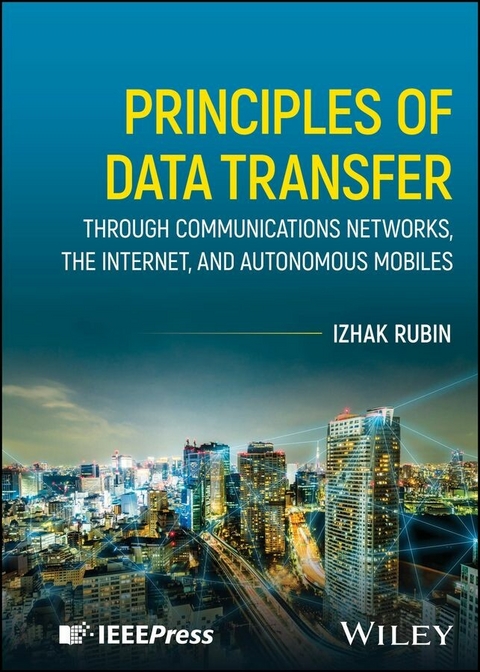
Principles of Data Transfer Through Communications Networks, the Internet, and Autonomous Mobiles (eBook)
1523 Seiten
Wiley-IEEE Press (Verlag)
9781394267767 (ISBN)
Understand the principles and practical basis of global telecommunications and data communications networks with this essential text
Our increasingly connected world is more reliant than ever on data transport and the communication networking technologies of the moment. Ever-expanding wireless communications and the Internet of Things have brought connectivity into more areas of our lives than ever before. Virtually every workplace and industry is now reliant at some level on data transfer.
Principles of Data Transfer through Communications Networks, the Internet, and Autonomous Mobiles offers a comprehensive yet accessible overview of the principles and methods of computer communications and mobile wireless network systems. It's designed to equip a vast range of students and professionals with the necessary toolkit to manage data flows between and across network systems at various scales. Drawing upon decades of teaching and practical experience, it's a must-own resource for anyone looking to understand the core mechanics that power our world of mass communications.
Readers will also find:
- Coverage of cutting-edge technologies such as autonomous vehicular highways that draw upon novel communications technologies
- Detailed discussion of design and performance behavior for major communication networking technologies
- Treatment designed for readers with no prior knowledge of computer science or programming
Principles of Data Transfer through Communications Networks, the Internet, and Autonomous Mobiles is ideal for students in data communications, telecommunications and wireless networking technology courses, as well as professionals working in data communications industries or those who make use of data transfer communications networks as part of their work.
Izhak Rubin, PhD, is Distinguished Professor Emeritus of Electrical and Computer Engineering at UCLA, California, USA. He has decades of experience in research and development studies of the Internet, and has published very widely on networking methods, performance modeling, and analysis techniques. He has served as the editor of leading professional journals, and has been elected as an IEEE Life Member Fellow.
Understand the principles and practical basis of global telecommunications and data communications networks with this essential text Our increasingly connected world is more reliant than ever on data transport and the communication networking technologies of the moment. Ever-expanding wireless communications and the Internet of Things have brought connectivity into more areas of our lives than ever before. Virtually every workplace and industry is now reliant at some level on data transfer. Principles of Data Transfer through Communications Networks, the Internet, and Autonomous Mobiles offers a comprehensive yet accessible overview of the principles and methods of computer communications and mobile wireless network systems. It s designed to equip a vast range of students and professionals with the necessary toolkit to manage data flows between and across network systems at various scales. Drawing upon decades of teaching and practical experience, it s a must-own resource for anyone looking to understand the core mechanics that power our world of mass communications. Readers will also find: Coverage of cutting-edge technologies such as autonomous vehicular highways that draw upon novel communications technologiesDetailed discussion of design and performance behavior for major communication networking technologiesTreatment designed for readers with no prior knowledge of computer science or programming Principles of Data Transfer through Communications Networks, the Internet, and Autonomous Mobiles is ideal for students in data communications, telecommunications and wireless networking technology courses, as well as professionals working in data communications industries or those who make use of data transfer communications networks as part of their work.
List of Figures
Figure 1 Coverage of Topics as Divided into Parts I–III.
Figure 1.1 Illustrative Communications Network
Figure 1.2 Message Fields and Wrapping Headers
Figure 1.4 Services Provided by Open Systems Interconnection (OSI) Layers
Figure 1.5 The Open Systems Interconnection (OSI) Layered Reference Model
Figure 1.6 The TCP/IP Internet Model
Figure 1.7 Vehicles on a Highway
Figure 1.8 Three Level Hierarchical Network
Figure 1.9 Hierarchical Organization of Conducting Links in a Leaf
Figure 1.11 Inter-regional Road System in California (Truncated)
Figure 1.12 Union Pacific Railroad System
Figure 1.13 Enterprise Computer Communications Network
Figure 1.14 ARPANET 1980 Network Layout
Figure 1.15 A Cellular Network
Figure 1.16 LTE Cellular Network Radio Access System Architecture
Figure 1.17 Wi-Fi-Aided Network
Figure 1.18 Satellite Communications
Figure 2.6 Signal Representation via Fourier Series
Figure 2.7 (a) A Rectangular Pulse of Width ; (b) Spectrum of a Rectangular Pulse with Width
Figure 2.8 Build-up and Replay of a Data Stream
Figure 2.9 A Bursty Flow Alternating Between Spurt (Active) and Pause (Inactive) Periods
Figure 2.10 The Voice over IP (VoIP) Streaming Process
Figure 2.11 (a) RTP Header; (b) Voice over IP (VoIP) Packet
Figure 2.12 Illustrative Packet Replay Scenario
Figure 2.13 Illustrative Array of Image Pixels
Figure 3.1 Message Transport across a Digital Communications System
Figure 3.2 Signal Perturbed by Noise
Figure 3.3 Analog Signal Modulation Techniques
Figure 3.4 Illustrative Spectral Spans of Modulated Signals
Figure 3.5 Illustrative Digital Signal Modulations
Figure 3.6 Modulation/Coding Schemes Used by IEEE 802.11n Wi-Fi
Figure 3.7 CQI, MCS, and Spectral Efficiency for LTE
Figure 4.1 Traffic of Vehicles Moving Along a Highway
Figure 4.2 Multilevel Traffic Model
Figure 4.3 Realizations of (a) Continuous-Time and (b) Discrete-Time Arrival Point Processes
Figure 4.4 A Realization of a Counting Process Associated with the Displayed Point Process
Figure 4.5 Flows Across a Network Graph
Figure 5.1 Offered, Carried, and Throughput Traffic (Load) Rates
Figure 5.2 Output Flow Rate vs. Input Flow Rate
Figure 5.3 Average Message Delay vs. Normalized Throughput
Figure 5.7 Minimum Transport Layer QoE Performance Requirements for IP-HDTV
Figure 6.1 Vehicle Merging Demonstrating on Ramp Multiplexing
Figure 6.2 Input and Output Service Modules in a Packet Router
Figure 6.3 Multiplexer—DeMultiplexer System Arrangement
Figure 6.4 Sharing a Downlink Wireless Communications Channel on a TDM Basis
Figure 6.5 (a) Joint Time–Frequency Plane, (b) TDM Schemes, and (c) FDM Scheme
Figure 6.6 A TDM Circuit Consisting of a Single Time Slot per Frame in Frequency Band F1
Figure 6.7 Resource Allocation and Scheduling at a Multiplexing Node
Figure 6.8 Scheduling Parameters
Figure 7.1 A Basic Queueing System Model
Figure 7.2 Realization of a System Size Process
Figure 7.3 Equality of Areas Used to Derive Little’s Formula
Figure 7.4 The Single Server Queueing System
Figure 7.5 Mean System Size vs. Traffic Intensity for the Queueing System
Figure 7.7 Blocking Probability vs. Message Capacity for the System
Figure 7.8 The Multi-server Queueing System
Figure 7.9 A Service System That Contains No Queueing facility
Figure 7.10 A Jackson-Type Queueing Network
Figure 7.11 Illustrative Queueing Network
Figure 7.12 Illustrative Tandem Queueing Network
Figure 7.13 Illustrative Discrete Event Simulation of a Queueing System: Program Routines
Figure 7.14 Global Parameters of the Simulation Program
Figure 7.15 Initialization of the Simulation Program
Figure 7.16 The Main Program Routine
Figure 7.17 The Simulation’s Timing( ) Routine
Figure 7.18 Simulation Performance Updating
Figure 7.19 The Simulation’s Arrive( ) Routine
Figure 7.20 The Simulation’s Departure( ) Routine
Figure 7.21 The Simulation’s Report( ) Routine
Figure 8.1 A Multiple Access Network
Figure 8.4 A 3-Color Cellular Space Division Multiple Access Network
Figure 8.6 Illustrative Baseband (Non-spread) Spectrum and Spread Signal Spectrum in a CDMA System
Figure 8.7 Illustrative Message and Chip Symbols in a CDMA System
Figure 8.8 Uplink and Downlink Signaling and Traffic Channels in a DAMA System
Figure 8.9 (a) Hub Polling in a Ring Network; (b) Hub Polling in a Multi-dropped Tree Network
Figure 8.15 Average Number of Packet Transmissions vs. Throughput (S) Under the Slotted ALOHA Scheme
Figure 8.16 Average Packet Delay (D [slots]) vs. Throughput (S) Under the Slotted ALOHA...
| Erscheint lt. Verlag | 18.12.2024 |
|---|---|
| Sprache | englisch |
| Themenwelt | Technik ► Elektrotechnik / Energietechnik |
| Schlagworte | Artificial Intelligence • autonomous highways • Autonomous Systems • Computer Networks • connected self driving vehicles • cross-layer protocols • Data Communications • internet of things • medium access control • Performance Evaluation. • telecommunications • The Internet • topology synthesis • traffic management • wireless networks |
| ISBN-13 | 9781394267767 / 9781394267767 |
| Informationen gemäß Produktsicherheitsverordnung (GPSR) | |
| Haben Sie eine Frage zum Produkt? |
 EPUB (Adobe DRM)
Kopierschutz: Adobe-DRM
Adobe-DRM ist ein Kopierschutz, der das eBook vor Mißbrauch schützen soll. Dabei wird das eBook bereits beim Download auf Ihre persönliche Adobe-ID autorisiert. Lesen können Sie das eBook dann nur auf den Geräten, welche ebenfalls auf Ihre Adobe-ID registriert sind.
Details zum Adobe-DRM
Dateiformat: EPUB (Electronic Publication)
EPUB ist ein offener Standard für eBooks und eignet sich besonders zur Darstellung von Belletristik und Sachbüchern. Der Fließtext wird dynamisch an die Display- und Schriftgröße angepasst. Auch für mobile Lesegeräte ist EPUB daher gut geeignet.
Systemvoraussetzungen:
PC/Mac: Mit einem PC oder Mac können Sie dieses eBook lesen. Sie benötigen eine
eReader: Dieses eBook kann mit (fast) allen eBook-Readern gelesen werden. Mit dem amazon-Kindle ist es aber nicht kompatibel.
Smartphone/Tablet: Egal ob Apple oder Android, dieses eBook können Sie lesen. Sie benötigen eine
Geräteliste und zusätzliche Hinweise
Buying eBooks from abroad
For tax law reasons we can sell eBooks just within Germany and Switzerland. Regrettably we cannot fulfill eBook-orders from other countries.
aus dem Bereich