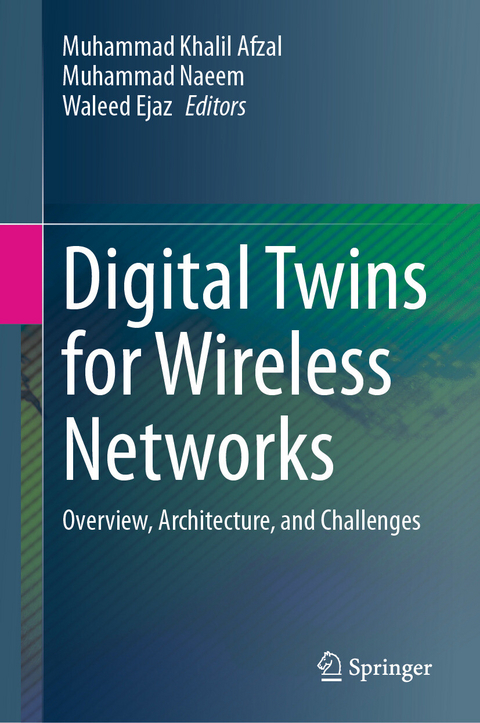
Digital Twins for Wireless Networks (eBook)
XIX, 159 Seiten
Springer Nature Switzerland (Verlag)
978-3-031-73679-7 (ISBN)
The sixth-generation (6G) communication systems are anticipated to provide network connectivity for an extensive range of use cases in a variety of emerging vertical industries. Consequently, a new set of challenging requirements and more stringent key performance indicators have to be considered, a novel architecture has to be designed, and unique enabling technologies shall be developed in order to fulfil the technical, regulatory, and business demands of the communication service customers.
6G networks are expected to offer even faster speeds, lower latency, and greater capacity compared to 5G networks, which will enable new applications and use cases that are currently not possible. Improved quality of life by enabling various applications (emerging Internet of everything applications) such as healthcare, brain-computer interactions, and extended reality is the main focus of future wireless services. Quality of experience, latency, and reliability are the key requirements of these applications. To meet these diverse requirements there is a need to assist wireless systems with unique technologies. Self-sustaining wireless systems (intelligence, seamless and ubiquitous connectivity) and proactive-online-learning-enables systems (Intelligent analytics) are two trends in future wireless systems. The digital twin technology is one of the most promising technologies that can be instrumental in realizing the technical and business objectives of 6G communication systems.
A digital twin is a virtual imitation of a physical object or system. In a wireless system, a digital twin can be used to model and analyse the behaviour of the network and its components, such as antennas, transmitters, receivers, sensors, and other devices in wireless networks. One of the key benefits of using a digital twin for a wireless system is that it can help network operators and engineers to optimize the performance of the wireless network by simulating different scenarios and configurations. Other benefits include improve efficiency, cost saving, and enhanced security. In 6G networks, a digital twin could be used to simulate and optimize the performance. This could include simulating different network topologies, testing the performance of different network protocols and algorithms, and optimizing the placement of network infrastructure.
To create a digital twin of a wireless network, a detailed model of the network and its components must be developed, based on real-world data and conditions. This model can then be used to simulate the behaviour of the network under different conditions and settings and to visualize the results in real time.
| Erscheint lt. Verlag | 10.12.2024 |
|---|---|
| Zusatzinfo | XIX, 159 p. 42 illus., 41 illus. in color. |
| Sprache | englisch |
| Themenwelt | Mathematik / Informatik ► Informatik ► Netzwerke |
| Technik | |
| Schlagworte | AI for digital twins • Digital twin challenges • Digital Twins • Digital twins and machine learning • Digital twins for 6G • Digital twins for smart cities • Digital twins for smart grid • Digital twins for wireless networks • Federated learning for digital twins • Framework for digital twins |
| ISBN-10 | 3-031-73679-6 / 3031736796 |
| ISBN-13 | 978-3-031-73679-7 / 9783031736797 |
| Informationen gemäß Produktsicherheitsverordnung (GPSR) | |
| Haben Sie eine Frage zum Produkt? |
 PDF (Wasserzeichen)
DRM: Digitales Wasserzeichen
Dieses eBook enthält ein digitales Wasserzeichen und ist damit für Sie personalisiert. Bei einer missbräuchlichen Weitergabe des eBooks an Dritte ist eine Rückverfolgung an die Quelle möglich.
Dateiformat: PDF (Portable Document Format)
Mit einem festen Seitenlayout eignet sich die PDF besonders für Fachbücher mit Spalten, Tabellen und Abbildungen. Eine PDF kann auf fast allen Geräten angezeigt werden, ist aber für kleine Displays (Smartphone, eReader) nur eingeschränkt geeignet.
Systemvoraussetzungen:
PC/Mac: Mit einem PC oder Mac können Sie dieses eBook lesen. Sie benötigen dafür einen PDF-Viewer - z.B. den Adobe Reader oder Adobe Digital Editions.
eReader: Dieses eBook kann mit (fast) allen eBook-Readern gelesen werden. Mit dem amazon-Kindle ist es aber nicht kompatibel.
Smartphone/Tablet: Egal ob Apple oder Android, dieses eBook können Sie lesen. Sie benötigen dafür einen PDF-Viewer - z.B. die kostenlose Adobe Digital Editions-App.
Buying eBooks from abroad
For tax law reasons we can sell eBooks just within Germany and Switzerland. Regrettably we cannot fulfill eBook-orders from other countries.
aus dem Bereich