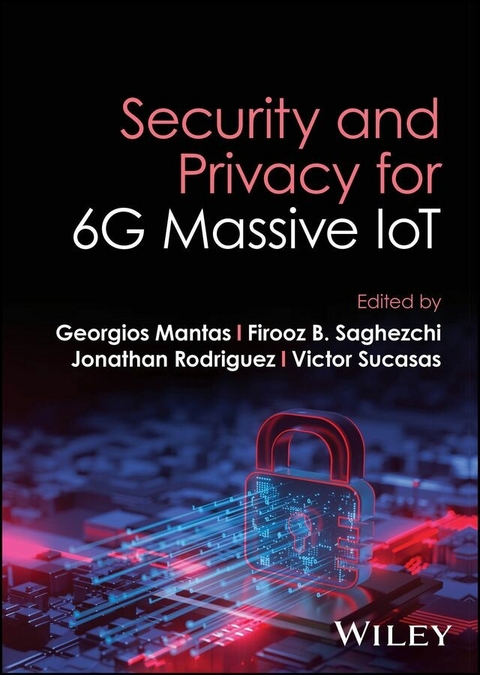
Security and Privacy for 6G Massive IoT (eBook)
520 Seiten
Wiley (Verlag)
978-1-119-98799-4 (ISBN)

Anticipate the security and privacy threats of the future with this groundbreaking text
The development of the next generation of mobile networks (6G), which is expected to be widely deployed by 2030, promises to revolutionize the Internet of Things (IoT), interconnecting a massive number of IoT devices (massive IoT) on a scale never before envisioned. These devices will enable the operation of a wide spectrum of massive IoT applications such as immersive smart cities, autonomous supply chain, flexible manufacturing and more. However, the vast number of interconnected IoT devices in the emerging massive IoT applications will make them vulnerable to an unprecedented variety of security and privacy threats, which must be anticipated in order to harness the transformative potential of these technologies.
Security and Privacy for 6G Massive IoT addresses this new and expanding threat landscape and the challenges it poses for network security companies and professionals. It offers a unique and comprehensive understanding of these threats, their likely manifestations, and the solutions available to counter them. The result creates a foundation for future efforts to research and develop further solutions based on essential 6G technologies.
Readers will also find:
- Analysis based on the four-tier network architecture of 6G, enhanced by Edge Computing and Edge Intelligence
- Detailed coverage of 6G enabling technologies including blockchain, distributed machine learning, and many more
- Scenarios, use cases, and security and privacy requirements for 6G Massive IoT applications
Security and Privacy for 6G Massive IoT is ideal for research engineers working in the area of IoT security and designers working on new 6G security products, among many others.
Georgios Mantas (PhD) is a Researcher at the Instituto de Telecomunicações - Aveiro, Portugal, and a part-time Senior Lecturer in Digital Security & Management with the Faculty of Engineering and Science at the University of Greenwich, Chatham Maritime, UK. He is a member of the IEEE, and has published widely on IoT security and privacy subjects.
Firooz B. Saghezchi (PhD) is a Senior Researcher at the Chair for Distributed Signal Processing of RWTH Aachen University, Aachen, Germany. He is a Senior Member of the IEEE and has published widely on wireless communications and cybersecurity subjects.
Jonathan Rodriguez (PhD, DSc) is Professor of Mobile and Satellite Communications in the Faculty of Computing, Engineering, and Science at the University of South Wales, Pontypridd, UK. His career-long contribution and impact to mobile communications and security research have led to his DSc award in 2022.
Victor Sucasas (PhD) is a Senior Director in the Cryptography Research Center at the Technology Innovation Institute (TII), Abu Dhabi, UAE. He leads the Confidential Computing Team, covering privacy enhancing technologies. He is a Senior IEEE and ComSoc member, and an EAI fellow, and has published widely on security and privacy issues.
Anticipate the security and privacy threats of the future with this groundbreaking text The development of the next generation of mobile networks (6G), which is expected to be widely deployed by 2030, promises to revolutionize the Internet of Things (IoT), interconnecting a massive number of IoT devices (massive IoT) on a scale never before envisioned. These devices will enable the operation of a wide spectrum of massive IoT applications such as immersive smart cities, autonomous supply chain, flexible manufacturing and more. However, the vast number of interconnected IoT devices in the emerging massive IoT applications will make them vulnerable to an unprecedented variety of security and privacy threats, which must be anticipated in order to harness the transformative potential of these technologies. Security and Privacy for 6G Massive IoT addresses this new and expanding threat landscape and the challenges it poses for network security companies and professionals. It offers a unique and comprehensive understanding of these threats, their likely manifestations, and the solutions available to counter them. The result creates a foundation for future efforts to research and develop further solutions based on essential 6G technologies. Readers will also find: Analysis based on the four-tier network architecture of 6G, enhanced by Edge Computing and Edge Intelligence Detailed coverage of 6G enabling technologies including blockchain, distributed machine learning, and many more Scenarios, use cases, and security and privacy requirements for 6G Massive IoT applications Security and Privacy for 6G Massive IoT is ideal for research engineers working in the area of IoT security and designers working on new 6G security products, among many others.
1
Threat Landscape for 6G-Enabled Massive IoT
Maria Papaioannou1, Georgios Mantas1,2, Firooz B. Saghezchi3, Georgios Kambourakis4, Felipe Gil-Castiñeira5, Raúl Santos de la Cámara6, and Jonathan Rodriguez7
1Faculty of Engineering and Science, University of Greenwich, Chatham Maritime, UK
2Instituto de Telecomunicações, Aveiro, Portugal
3Chair for Distributed Signal Processing, RWTH Aachen University, Aachen, Germany
4Department of Information and Communication Systems Engineering, School of Engineering, University of the Aegean, Samos, Greece
5Telematics Engineering Department, University of Vigo, Vigo, Spain
6R&D Department, HI Iberia Ingenier..a y Proyectos, S.L., Madrid, Spain
7Faculty of Computing, Engineering and Science, University of South Wales, Pontypridd, UK
1.1 Introduction
The strict network performance requirements of the emerging disruptive massive Internet of Everything (IoT) applications cannot be satisfied by the currently developing 5th Generation (5G) mobile networks due to the inherent limitations of these networks [1–5]. Therefore, the focus on the next 6th Generation (6G) of mobile networks with significantly improved key performance indicators (e.g. 1 Tbps peak data rate, 0.1 ms air latency, 1 μs delay jitter, and 1 Gb/m2 area traffic capacity) is inevitable to overcome the limitations of 5G and truly meet the stringent network performance requirements of the emerging disruptive massive IoT applications [2, 5].
6G mobile networks are expected to be commercially available from 2030 onwards and be a key enabler to support a great number of applications with a vast number of interconnected IoT devices [1, 2, 4, 5]. This massive number of 6G-enabled IoT devices will serve for reliable and efficient operation of different verticals such as smart cities, smart homes, smart manufacturing, smart education/training, Connected Autonomous Vehicles (CAVs), and intelligent healthcare. For example, 6G-enabled IoT devices can be used for either healthcare monitoring purposes, e.g. to timely detect any health deterioration of patients suffering from chronic diseases, or collecting mass quantities of data from a wide spectrum of smart city applications (e.g. urban planning, garbage collection), to increase the quality of the services provided to the citizens and reduce the operational costs of the public administrations. However, the high volume of 6G-enabled IoT devices and the increasing number of their interconnections will increase the vulnerabilities of the 6G-enabled massive IoT applications and pose significant security and privacy risks. Therefore, this chapter gives a comprehensive overview of representative massive IoT applications envisioned to be deployed in the 6G era to improve people’s lives and identifies the threat landscape of these applications. The aim is to shed light on their potential key threats and identify security and privacy issues that should be addressed before the 6G-enabled massive IoT applications build trust among all relevant stakeholders and realize their full potential.
Following the Introduction, the rest of the chapter is organized as follows: Section 1.2 presents the vision and values of 6G. Section 1.3 discusses a set of representative massive IoT applications envisioned to be deployed in the 6G era to improve people’s lives. Section 1.4 gives an overview of a 6G network architecture to enable massive IoT. In Section 1.5, the major security objectives of 6G-enabled massive IoT are discussed. Section 1.6 provides a categorization of the security threats targeting the 6G networks based on the security objectives that they intend to compromise. Finally, the chapter is concluded in Section 1.7.
1.2 6G Vision and Core Values
The 6G vision, as conceptualized by European 6G Flagship Project Hexa-X [2, 6], aims to strengthen and enhance the connections between three distinct worlds: the human world, encompassing our senses, bodies, intelligence, and values; the digital world, comprising information, communication, and computing; and the physical world of objects and organisms. This integration will establish a seamless cyber–physical continuum, leveraging networks as powerful tools to enhance our quality of life. However, it is imperative that future networks, facilitating interactions between these worlds, are designed with core principles in mind, including sustainability, trustworthiness, and digital inclusion. Figure 1.1 presents the Hexa-X 6G vision, illustrating the interactions between these worlds and the fundamental values that 6G should uphold. This vision of technological and societal transformation holds the potential for unprecedented economic growth and addressing societal challenges in the 2030s and beyond, as explored further in the subsequent sections. Moreover, achieving this vision will necessitate a fundamental paradigm shift in the design of mobile networks. Multiple key requirements must be reconciled, including catering to the exponential growth in traffic and the proliferation of devices, subnetworks, and markets while upholding high standards of energy efficiency, security, privacy, trust, and efficient deployment for coverage, capacity, and specialized operations. This will enable sustainable growth and foster innovation across sectors and industries.
Figure 1.1 The Hexa-X 6G vision of connected worlds and key values.
Source: Maria Papaioannou.
Additionally, the trend of enhancing human intelligence will persist through closer integration and seamless intertwining of network and digital technologies. With advancements in artificial intelligence (AI) and machine learning (ML), machines will continue to transform data into reasoning and practical insights, enabling humans to better understand and interact with our world. The interactions between the three worlds will pave the way for advanced sensing capabilities, robust experimentation in the digital world, and high-performance and reliable actuation abilities. As the current dedicated machines in domestic and industrial settings evolve into collaborative multipurpose robots and drones, these future networks will incorporate new interfaces for haptic feedback and human–machine interaction, allowing control and interaction with these machines from anywhere to become an integral part of the network.
1.3 Emerging Massive IoT Applications Enabled by 6G
The new types of upcoming IoT-enabled interactions such as holographic communications, five-sense communications, and Wireless Brain–Computer Interfaces (WBCI) or Wireless Mind–Machine Interfaces (WMMI) are anticipated to lead to new massive IoT applications with far more stringent performance requirements (e.g. sub-ms latency, Tbps data throughput, extreme energy efficiency, and ultralow energy consumption) that will not be matched by 5G capabilities [7]. Therefore, 6G is expected to outperform 5G, meet the new demanding levels of performance requirements of the future massive IoT applications, and become their major key enabler [8, 9]. In this section, we discuss a set of representative 6G-enabled massive IoT applications envisioned to be deployed in the 6G era to improve people’s lives.
To organize the discussion of representative 6G-enabled massive IoT applications in a more comprehensive manner, the clustering into use case families (i.e. groups of use cases formed based on the type of usage as well as the research challenges and values addressed), as proposed in [10, 11] in the context of the European 6G Flagship Project Hexa-X [6], has been adopted. In particular, the following six use case families have been considered, as also shown in Figure 1.2, to categorize representative 6G-enabled massive IoT applications: (i) enabling sustainability, (ii) massive twinning, (iii) telepresence, (iv) robots to cobots, (v) trusted embedded networks, and (vi) hyperconnected resilient network infrastructures. These six families of 6G use cases comprise a first baseline to guide the future research directions on 6G, relying on the view of the current European research activities on 6G driven through the 5G PPP and 6G-IA initiatives [3]. Thus, these six use case families are not meant to be exhaustive but are representative of use cases foreseen in the 6G era. In addition, it is worthwhile mentioning that although the use cases described below have been included in the most relevant family, this assignment is not exclusive as there are use cases that may have connections to multiple use case families [11]. Besides, the below-mentioned use cases include several usages characterized as evolutionary or disruptive. The evolutionary ones are those that extend and enhance the 5G usages with new capabilities, while the disruptive ones open up new horizons where 6G could benefit and transform society [3].
Figure 1.2 Categorization of the representative use case families and respective use cases for 6G-enabled massive IoT applications.
Source: Maria Papaioannou.
1.3.1 Enabling Sustainability
The emergence of the 6G system will enable a wide spectrum of applications that go far beyond the...
| Erscheint lt. Verlag | 10.12.2024 |
|---|---|
| Sprache | englisch |
| Themenwelt | Technik ► Elektrotechnik / Energietechnik |
| Technik ► Nachrichtentechnik | |
| Schlagworte | 6G • 6G, 6G network architecture • 6G network architecture • Blockchain • federated learning • Intrusion Detection • massive IoT • Multi-Party Computation • Physical Layer Security • privacy • Privacy-Preserving Machine Learning • Quantum Security • secure edge intelligence • security • tactile Internet • threat analysis |
| ISBN-10 | 1-119-98799-7 / 1119987997 |
| ISBN-13 | 978-1-119-98799-4 / 9781119987994 |
| Informationen gemäß Produktsicherheitsverordnung (GPSR) | |
| Haben Sie eine Frage zum Produkt? |
 EPUB (Adobe DRM)
Kopierschutz: Adobe-DRM
Adobe-DRM ist ein Kopierschutz, der das eBook vor Mißbrauch schützen soll. Dabei wird das eBook bereits beim Download auf Ihre persönliche Adobe-ID autorisiert. Lesen können Sie das eBook dann nur auf den Geräten, welche ebenfalls auf Ihre Adobe-ID registriert sind.
Details zum Adobe-DRM
Dateiformat: EPUB (Electronic Publication)
EPUB ist ein offener Standard für eBooks und eignet sich besonders zur Darstellung von Belletristik und Sachbüchern. Der Fließtext wird dynamisch an die Display- und Schriftgröße angepasst. Auch für mobile Lesegeräte ist EPUB daher gut geeignet.
Systemvoraussetzungen:
PC/Mac: Mit einem PC oder Mac können Sie dieses eBook lesen. Sie benötigen eine
eReader: Dieses eBook kann mit (fast) allen eBook-Readern gelesen werden. Mit dem amazon-Kindle ist es aber nicht kompatibel.
Smartphone/Tablet: Egal ob Apple oder Android, dieses eBook können Sie lesen. Sie benötigen eine
Geräteliste und zusätzliche Hinweise
Buying eBooks from abroad
For tax law reasons we can sell eBooks just within Germany and Switzerland. Regrettably we cannot fulfill eBook-orders from other countries.
aus dem Bereich