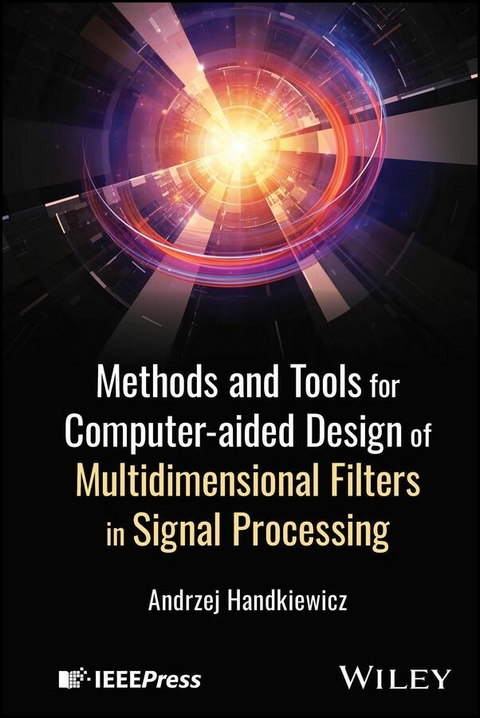
Methods and Tools for Computer-aided Design of Multidimensional Filters in Signal Processing (eBook)
233 Seiten
Wiley-IEEE Press (Verlag)
978-1-394-26363-9 (ISBN)
Understand and apply the tools of computer-aided design to analog signal processing
Signal processing is done mostly with digital circuits, but because the signals generated by our environment are themselves analog, some incorporation of analog circuitry is unavoidable. The design and construction of analog circuits is difficult and time-consuming out of all proportion to the number and prominence of these circuits in signal processing systems. In recent years, groundbreaking computer-aided tools have emerged to facilitate and hasten the design of these circuits.
Methods and Tools for Computer-aided Design of Multidimensional Filters in Signal Processing offers an introduction to these tools and their applications. It will focus particularly on VHDL, the most popular language used to describe hardware, and an essential tool in presenting circuits which are too complex to present graphically. Offering a design method based in C++ and a variety of techniques for fabricating integrated circuits, this is a must-own volume for researchers and engineers working on signal processing methods.
Methods and Tools for Computer-aided Design of Multidimensional Filters in Signal Processing readers will also find:
- A design strategy based on gyrator-capacitor circuits as prototype filters
- Options for implementing circuits as either continuous or discrete time filters
- Concrete example of a filter implemented in SI technique
Methods and Tools for Computer-aided Design of Multidimensional Filters in Signal Processing is ideal for researchers working on signal processing, as well as engineers, programmers, and other experts developing computer tools for filter design.
Andrzej Handkiewicz, PhD, is Professor in the Faculty of Technology at Jacob of Paradise Academy in Gorzow Wlkp., Poland. He is a member of numerous Polish and international scientific societies and an acknowledged global expert in circuit design for signal processing systems.
Understand and apply the tools of computer-aided design to analog signal processing Signal processing is done mostly with digital circuits, but because the signals generated by our environment are themselves analog, some incorporation of analog circuitry is unavoidable. The design and construction of analog circuits is difficult and time-consuming out of all proportion to the number and prominence of these circuits in signal processing systems. In recent years, groundbreaking computer-aided tools have emerged to facilitate and hasten the design of these circuits. Methods and Tools for Computer-aided Design of Multidimensional Filters in Signal Processing offers an introduction to these tools and their applications. It will focus particularly on VHDL, the most popular language used to describe hardware, and an essential tool in presenting circuits which are too complex to present graphically. Offering a design method based in C++ and a variety of techniques for fabricating integrated circuits, this is a must-own volume for researchers and engineers working on signal processing methods. Methods and Tools for Computer-aided Design of Multidimensional Filters in Signal Processing readers will also find: A design strategy based on gyrator-capacitor circuits as prototype filtersOptions for implementing circuits as either continuous or discrete time filtersConcrete example of a filter implemented in SI technique Methods and Tools for Computer-aided Design of Multidimensional Filters in Signal Processing is ideal for researchers working on signal processing, as well as engineers, programmers, and other experts developing computer tools for filter design.
1
Filter Design Based on Lossless Prototype Circuits
From the beginning of the first applications, the filter design was based on ladder LC (inductance, capacitance) structures. Theoretical research on LC circuits was initiated by R. M. Foster (1924). Resistively (R) terminated, they are low sensitive to the changes of the circuit parameters (Orchard, 1966; Orchard et al., 1985). RLC circuits, as passive ones, are stable and moreover, as lossless ones, they are low noise as will be presented in Section 1.4. Such features make the RLC circuits still popular, and they are used as so-called prototype circuits for their counterpart networks fabricated in the form of integrated circuits in OTA-C, SI, and SC techniques. It is assumed that the counterpart circuits realized in the chosen technique inherit the features of the prototype circuits (Handkiewicz, 2002).
In this book the gyrator–capacitor (gC) circuits as the prototype ones are used. The gyrator, introduced by B. D. H. Tellegen (1948), similarly to the inductance and capacitance is a lossless element. In opposition to R, L, and C elements being one-port devices, the gyrator (g) is a two-port network. The symbol of the gyrator is presented in Fig. 1.1. The admittance matrix of the ideal gyrator is as follows:
Hence, the dependence of the currents with respect to voltages can be described by the matrix relation
where , , and the symbol denotes the transposition.
The gC circuits considered in the monograph can be not only two-port networks but also systems with any number of ports. However, the most important feature is multidimensionality – the capacitances of the circuit can be assigned to operators in different dimensions. For example, in an acoustic filter, as it is a one-dimensional circuit, the time is assigned to the single operator by the Laplace transform (). For the sampled acoustic signal, the discrete time is assigned to the operator of the transform . The relationship between the and domains is given by , where is the sampling period. To obtain a description of filters in the frequency domain , the equality resulting from the relationship between the Laplace transform and the Fourier transform is used. In the image filter, being a two-dimensional network, there are two operator variables , of the transform, corresponding to the discrete variables , , denoting the row and column numbers in the image. In the case of video processing, there is also a third dimension, which is the frame number in this sequence. The three-dimensional digital equivalent network in the domains , , is derived from the prototype gC circuit in the domains , , using a bilinear transformation (2.3), as the relationship between these variables.
Figure 1.1 Symbol of ideal gyrator with currents and voltages represented on its ports.
We will start this chapter with a simple example of a third-order elliptic filter. In the diagram, we will present both its ladder LC structure and the corresponding gyrator–capacitor implementation. However, the most important thing is the textual description of this gC circuit in VHDLA. The description of a circuit in this language has a double meaning. On the one hand, it allows you to analyze the more complex networks, for which the graphics representation is not very transparent. On the other hand, this description is a starting point for the symbolic analysis of the designed gC circuit in the gCstudio environment. In the resulting file, we will show the effect of such an analysis in the form of so-called structural numbers (SN). Filter design involves calculating the parameters g and C of the circuit for given transfer function coefficients. For this purpose, the NANOstudio environment is used with the optimizer tool, a detailed description of which can be found in this chapter. Sections 1.2 and 1.3 describe the synthesis, possible in the presented environments, of a seventh-order elliptic filter and a so-called filter pair. In Section 1.4, the balance of powers transferred in the lossless system allows for sensitivity analysis of the considered gyrator–capacitor circuits.
1.1 Design Example of a Simple gC Circuit
A third-order elliptic filter of the LC ladder structure is shown in the upper part and its gC counterpart circuit in the lower part of Fig. 1.2. Both the numerator and the denominator of the transfer function
Figure 1.2 Ladder structure of elliptic LC filter and its gC counterpart circuit.
of the filter are third-order polynomials. The coefficients of these polynomials can be obtained in the Matlab or Octave environments using the ellip function. Calling, for example, in Octave , where the arguments of the function ellip mean the order , the ripple in the passband dB), the attenuation in the band-stop dB), and the cut-off frequency rad/s), respectively, gives vectors of the coefficients ordered in descending powers of the variable:
By designing the example gC circuit in Fig. 1.2, we mean finding its parameters for given transfer function coefficients. For this purpose, two environments have been developed: gCstudio for symbolic analysis of the gC circuit and NANOstudio, which enables, among others, solving the system of equations obtained by matching of coefficients presented in symbolic form using gCstudio, with the coefficients given in (1.4). We will discuss both of these environments in Sections 1.1.1 and 1.1.2 by illustrating their operation for the considered example.
1.1.1 gCstudio Environment
The goal of the gCstudio environment is the symbolic analysis of the gyrator–capacitor circuits. Coefficients of the numerator and denominator polynomials of the transfer functions for all output ports relative to all input ports are computed as functions of gC circuit parameters. As it shown in Fig. 1.2, these parameters are the conductances of the input and output ports, the transconductances of the gyrators , and the capacitances . Transfer functions can be rational functions of many operator variables , depending on the dimensions assigned to the capacitances.
The gCstudio environment is dedicated to compilation in GCC (GNU Compiler Collection). The basics of the compilation in a Linux operating system will be presented in Section 2.1. For the environment gCstudio, two types of makefile scripts are provided with the source files for Linux and Windows operating systems, respectively. The chosen script ought to be renamed to makefile and executed by the make command, which will create a compiled file in the bin directory.
A detailed description of installing gCstudio in the Linux operating system is as follows:
- 1. create a shared directory, for example, named gCstudio, and move the source subdirectories lib and src to it,
- 2. create a subdirectory bin in the shared directory,
- 3. enter the directory src: cd src,
- 4. copy makefile_unix : cp makefile_unix makefile,
- 5. execute the make clean command – the *.o files in the src directory are deleted (this is not necessary for the first compilation),
- 6. execute the command make all – the automatic compilation described in the file makefile is executed, and
- 7. run gc_analyser in the bin subdirectory: ./gc_analyser or, after copying, in any other directory with examples. After starting the program, follow the displayed instructions.
The gCstudio directory contains both the compiled program and its source version.
Installation is also possible in the Windows operating system. It is then necessary to use the MinGW tools. In the created folder, for example, named MinGW, you should:
- 1. add the path to MinGWbin in system settings,
- 2. enter the directory src in the command window (cmd): cd src,
- 3. copy makefile_win: copy makefile_win makefile,
- 4. run the make command (compilation automation after removing old files): mingw32-make,
- 5. go to bin and run the program: gc_analyser.exe.
After running the program compiled in Linux with the command ./gc_analyser, there is displayed a prompt to enter the name of the VHDLA file with a description of the gyrator–capacitor circuit, as it is shown in the following listing:
Symbolic analysis is performed when option 1 (compute SN solution) is selected. Option 2 allows to get a Matlab script with matrices whose determinants are polynomials of the transfer function denominator and numerator.
For the circuit whose diagram is shown at the bottom of Fig. 1.2, the file named 3ellip1D.vhdla is as follows:
According to the VHDLA language syntax, terminals are declared in the file header. In the body of the architecture, they are declared, as the variables, the node voltages of the circuit, and then all circuit elements are listed. The order of the element’s listing is arbitrary. The name of the capacitance begins with the letter C, followed by...
| Erscheint lt. Verlag | 10.12.2024 |
|---|---|
| Sprache | englisch |
| Themenwelt | Technik ► Elektrotechnik / Energietechnik |
| Schlagworte | Circuit theory • Digital Circuits • discrete time filters • field programmable gate arrays • filter banks • Integrated Circuit Technology • Multidimensional Systems • Operational transconductance amplifiers • switched capacitor • switched current |
| ISBN-10 | 1-394-26363-5 / 1394263635 |
| ISBN-13 | 978-1-394-26363-9 / 9781394263639 |
| Informationen gemäß Produktsicherheitsverordnung (GPSR) | |
| Haben Sie eine Frage zum Produkt? |
 EPUB (Adobe DRM)
Kopierschutz: Adobe-DRM
Adobe-DRM ist ein Kopierschutz, der das eBook vor Mißbrauch schützen soll. Dabei wird das eBook bereits beim Download auf Ihre persönliche Adobe-ID autorisiert. Lesen können Sie das eBook dann nur auf den Geräten, welche ebenfalls auf Ihre Adobe-ID registriert sind.
Details zum Adobe-DRM
Dateiformat: EPUB (Electronic Publication)
EPUB ist ein offener Standard für eBooks und eignet sich besonders zur Darstellung von Belletristik und Sachbüchern. Der Fließtext wird dynamisch an die Display- und Schriftgröße angepasst. Auch für mobile Lesegeräte ist EPUB daher gut geeignet.
Systemvoraussetzungen:
PC/Mac: Mit einem PC oder Mac können Sie dieses eBook lesen. Sie benötigen eine
eReader: Dieses eBook kann mit (fast) allen eBook-Readern gelesen werden. Mit dem amazon-Kindle ist es aber nicht kompatibel.
Smartphone/Tablet: Egal ob Apple oder Android, dieses eBook können Sie lesen. Sie benötigen eine
Geräteliste und zusätzliche Hinweise
Buying eBooks from abroad
For tax law reasons we can sell eBooks just within Germany and Switzerland. Regrettably we cannot fulfill eBook-orders from other countries.
aus dem Bereich