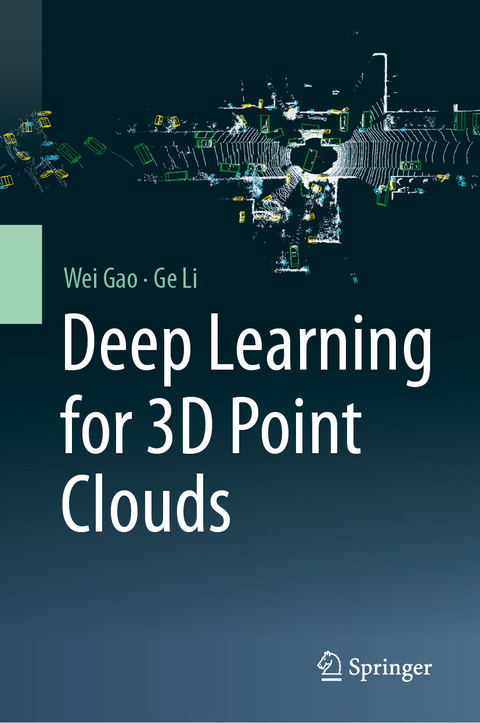
Deep Learning for 3D Point Clouds (eBook)
322 Seiten
Springer Nature Singapore (Verlag)
978-981-97-9570-3 (ISBN)
As an efficient 3D vision solution, point clouds have been widely applied into diverse engineering scenarios, including immersive media communication, autonomous driving, reverse engineering, robots, topography mapping, digital twin city, medical analysis, digital museum, etc. Thanks to the great developments of deep learning theories and methods, 3D point cloud technologies have undergone fast growth during the past few years, including diverse processing and understanding tasks. Human and machine perception can be benefited from the success of using deep learning approaches, which can significantly improve 3D perception modeling and optimization, as well as 3D pre-trained and large models. This book delves into these research frontiers of deep learning-based point cloud technologies.
The subject of this book focuses on diverse intelligent processing technologies for the fast-growing 3D point cloud applications, especially using deep learning-based approaches. The deep learning-based enhancement and analysis methods are elaborated in detail, as well as the pre-trained and large models with 3D point clouds. This book carefully presents and discusses the newest progresses in the field of deep learning-based point cloud technologies, including basic concepts, fundamental background knowledge, enhancement, analysis, 3D pre-trained and large models, multi-modal learning, open source projects, engineering applications, and future prospects.
Readers can systematically learn the knowledge and the latest developments in the field of deep learning-based point cloud technologies. This book provides vivid illustrations and examples, and the intelligent processing methods for 3D point clouds. Readers can be equipped with an in-depth understanding of the latest advancements of this rapidly developing research field.
As an efficient 3D vision solution, point clouds have been widely applied into diverse engineering scenarios, including immersive media communication, autonomous driving, reverse engineering, robots, topography mapping, digital twin city, medical analysis, digital museum, etc. Thanks to the great developments of deep learning theories and methods, 3D point cloud technologies have undergone fast growth during the past few years, including diverse processing and understanding tasks. Human and machine perception can be benefited from the success of using deep learning approaches, which can significantly improve 3D perception modeling and optimization, as well as 3D pre-trained and large models. This book delves into these research frontiers of deep learning-based point cloud technologies.The subject of this book focuses on diverse intelligent processing technologies for the fast-growing 3D point cloud applications, especially using deep learning-based approaches. The deep learning-based enhancement and analysis methods are elaborated in detail, as well as the pre-trained and large models with 3D point clouds. This book carefully presents and discusses the newest progresses in the field of deep learning-based point cloud technologies, including basic concepts, fundamental background knowledge, enhancement, analysis, 3D pre-trained and large models, multi-modal learning, open source projects, engineering applications, and future prospects.Readers can systematically learn the knowledge and the latest developments in the field of deep learning-based point cloud technologies. This book provides vivid illustrations and examples, and the intelligent processing methods for 3D point clouds. Readers can be equipped with an in-depth understanding of the latest advancements of this rapidly developing research field.
| Erscheint lt. Verlag | 6.12.2024 |
|---|---|
| Zusatzinfo | XVI, 322 p. 118 illus., 98 illus. in color. |
| Sprache | englisch |
| Themenwelt | Informatik ► Grafik / Design ► Digitale Bildverarbeitung |
| Mathematik / Informatik ► Informatik ► Software Entwicklung | |
| Informatik ► Theorie / Studium ► Kryptologie | |
| Informatik ► Theorie / Studium ► Künstliche Intelligenz / Robotik | |
| Naturwissenschaften | |
| Technik ► Elektrotechnik / Energietechnik | |
| Schlagworte | 3D Computer Vision • 3D perception • 3D Point Clouds • Human Perception Modeling • Immersive Media Systems • Large Foundation Models • multi-modal learning • point cloud analysis • Point Cloud Applications • Point Cloud Coding • Point Cloud Processing • Point Cloud Understanding • Pre-trained Models |
| ISBN-10 | 981-97-9570-2 / 9819795702 |
| ISBN-13 | 978-981-97-9570-3 / 9789819795703 |
| Informationen gemäß Produktsicherheitsverordnung (GPSR) | |
| Haben Sie eine Frage zum Produkt? |
 PDF (Wasserzeichen)
DRM: Digitales Wasserzeichen
Dieses eBook enthält ein digitales Wasserzeichen und ist damit für Sie personalisiert. Bei einer missbräuchlichen Weitergabe des eBooks an Dritte ist eine Rückverfolgung an die Quelle möglich.
Dateiformat: PDF (Portable Document Format)
Mit einem festen Seitenlayout eignet sich die PDF besonders für Fachbücher mit Spalten, Tabellen und Abbildungen. Eine PDF kann auf fast allen Geräten angezeigt werden, ist aber für kleine Displays (Smartphone, eReader) nur eingeschränkt geeignet.
Systemvoraussetzungen:
PC/Mac: Mit einem PC oder Mac können Sie dieses eBook lesen. Sie benötigen dafür einen PDF-Viewer - z.B. den Adobe Reader oder Adobe Digital Editions.
eReader: Dieses eBook kann mit (fast) allen eBook-Readern gelesen werden. Mit dem amazon-Kindle ist es aber nicht kompatibel.
Smartphone/Tablet: Egal ob Apple oder Android, dieses eBook können Sie lesen. Sie benötigen dafür einen PDF-Viewer - z.B. die kostenlose Adobe Digital Editions-App.
Buying eBooks from abroad
For tax law reasons we can sell eBooks just within Germany and Switzerland. Regrettably we cannot fulfill eBook-orders from other countries.
aus dem Bereich