Surface and Interface Analysis (eBook)
976 Seiten
Wiley (Verlag)
978-1-394-21836-3 (ISBN)
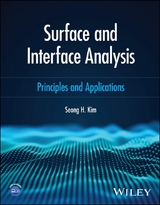
Comprehensive textbook covering characterization techniques to understand the chemistry and structure of materials on surfaces and at interfaces
Surface and Interface Analysis is a comprehensive textbook resource that covers everything readers need to know about surface energy, molecular speciation, and optical and physical characterization techniques. Assuming only basic knowledge of general chemistry (electronic orbitals, organic functional groups), physics (electromagnetic waves, Maxwell equations), physical chemistry (Schrödinger equation, harmonic oscillator), and mathematics (wave equations, covariance matrix), this textbook helps readers understand the underlying principles of the discussed characterization techniques and enables them to transform theoretical knowledge into applied skills through a Maieutic pedagogical approach.
Written by a highly qualified professor, Surface and Interface Analysis: Principles and Applications includes information on:
- Relationship between atomic and molecular orbitals and compositional analysis principles based on measurements of photoelectrons, Auger electrons, X-rays, and secondary ions emitted from the surface
- Governance of electromagnetic wave propagation in a dielectric medium and what can be learned from analyzing the electromagnetic wave reflected from the interface
- Surface metrology using light reflection (non-contact) and scanning probe (contact) and analysis of mechanical properties through indentation
- Artifacts and misinterpretations that may be encountered during analysis
Surface and Interface Analysis is an ideal textbook resource on the subject for graduate students in the fields of solid state physics, optics, materials science, chemistry, and engineering who want to learn and apply advanced materials characterization methods, along with undergraduate students in advanced elective courses.
Seong H. Kim, PhD, is Distinguished Professor at the Department of Chemical Engineering of The Pennsylvania State University, USA. He is also affiliated with the Department of Materials Science and Engineering and the Department of Chemistry. He received his BS and MS degrees from Yonsei University, South Korea, and his PhD from Northwestern University, USA. He then worked as a postdoctoral researcher at the University of California, Berkeley, USA, before joining the faculty of chemical engineering at Penn State.
Comprehensive textbook covering characterization techniques to understand the chemistry and structure of materials on surfaces and at interfaces Surface and Interface Analysis is a comprehensive textbook resource that covers everything readers need to know about surface energy, molecular speciation, and optical and physical characterization techniques. Assuming only basic knowledge of general chemistry (electronic orbitals, organic functional groups), physics (electromagnetic waves, Maxwell equations), physical chemistry (Schr dinger equation, harmonic oscillator), and mathematics (wave equations, covariance matrix), this textbook helps readers understand the underlying principles of the discussed characterization techniques and enables them to transform theoretical knowledge into applied skills through a Maieutic pedagogical approach. Written by a highly qualified professor, Surface and Interface Analysis: Principles and Applications includes information on: Relationship between atomic and molecular orbitals and compositional analysis principles based on measurements of photoelectrons, Auger electrons, X-rays, and secondary ions emitted from the surface Governance of electromagnetic wave propagation in a dielectric medium and what can be learned from analyzing the electromagnetic wave reflected from the interface Surface metrology using light reflection (non-contact) and scanning probe (contact) and analysis of mechanical properties through indentation Artifacts and misinterpretations that may be encountered during analysis Surface and Interface Analysis is an ideal textbook resource on the subject for graduate students in the fields of solid state physics, optics, materials science, chemistry, and engineering who want to learn and apply advanced materials characterization methods, along with undergraduate students in advanced elective courses.
Preface
This textbook is written to help graduate students or novice researchers to expand upon what they have learned in undergraduate chemistry, physics, and math classes to comprehend fundamental principles of surface and interface characterization techniques that are widely used in materials‐related research fields. Surface and interface characterization is essential for the advancement of almost all materials research areas including renewable materials for sustainable energy; catalytic materials for chemical synthesis; electronic materials for quantum computing, sensing, and communications; biological materials to uncover the rules of life and produce food; and support of manufacturing through quality control and failure analysis. In recent decades, advances in computer‐aided equipment control and visualization software have made the operation and data collection of complicated characterization techniques highly user‐friendly. Also, the pace of invention of new materials and the need to test them in mission‐specific applications has become faster. This has shifted the focus of materials characterization training from learning fundamental characterization principles sufficiently to routinely and efficiently operating user‐friendly instruments.
When we look at typical undergraduate curricula in the STEM fields, students take many basic science courses in sequence over several years. After finishing all these courses independently, most students do not see the necessity to integrate individually studied concepts and construct their own deeper knowledge that can be applied to materials characterization. We have witnessed that many students take or rely on short training sessions for instrument operation and data collection, then interpret or analyze the data by comparison to the literature (often online) without having deep knowledge of the working principles. Although this approach could be viewed as “pragmatic” for data generation for manuscript submission, it has been the root cause for the spread of incorrect information and misinterpretations in the literature. Moreover, without deep knowledge of the fundamental principles, it is difficult for students to design new experiments that have not been described in the literature, which is an educational necessity for future generations of research scientists.
Although comprehending deep knowledge of multiple techniques sounds like a big challenge, I believe that all students can find their own ways to deal with this challenge – mastering the characterization principles and utilizing them efficiently – once they see how to integrate what they have learned so far to construct a proper foundation and gain expertise to step into a new research field. There are many excellent technical books that introduce specific topics in depth; but I have often found that those books start from a very high level and go too fast into advanced applications, frequently leading to students feeling overwhelmed and discouraged. When I, too, studied those books in my early career, I felt a high “activation barrier” to finishing even the first chapter.
This textbook is intended to show how to “bridge” the gap between the knowledge gained from college education and the knowledge needed to confidently and independently study advanced technical books and papers. I hope this book will lower the barrier for students to start digging into deeper‐level books and literatures and utilize what they already know properly to grasp advanced theoretical concepts needed for more appropriate and nuanced application of modern characterization techniques.
Please note that basic fundamentals that students are expected to know from their undergraduate chemistry, physics, and math classes could not be described in detail in this book. I know that not all readers have the same educational background as mine. Without going far outside, I see students in my research group have very different backgrounds and took different classes. To some students, certain physical concepts or terms might be completely new. Even for students who took relevant classes, a large fraction of previous course materials may have already faded from memory. I remind them that what they have not learned or what they may need to brush up on can typically be found easily through searching the plethora of resources available on the internet. By simply typing a few key words in the internet, most information can be found that is necessary to digest the materials covered in this book.
I might be one of the last generations who physically searched and used encyclopedia and chemical abstract numbers in the library. In the past, finding relevant information was very time‐consuming. Nowadays, most information that students need can be found on the internet. I encourage students to use the internet as frequently as needed. At the same time, I urge students to use the internet as a starting point, not as a sole source. Although obtaining the results of a web search is now exceedingly fast, truly processing the information found can be slow and time‐consuming. The ease of finding information does not necessarily mean that digesting it is also easy. It takes time and effort to understand the information at the level at which you can use it efficiently when you need it. So, don’t be discouraged if learning those concepts is not as quick as the click of a mouse button. This book is designed to help students to connect the information found on the internet to the working principle of state‐of‐the‐art characterization methods, especially focusing on surface and interface analysis of materials.
The book is organized in the following order. In Chapter 1, a list is compiled of various characterization methods used for surface and interface analyses. Many of these analyses are conducted in ultrahigh vacuum (UHV) conditions. So, we first will study the reason for that by reviewing the kinetic theory of gases, such as inter‐particle collisions in the gas phase and gas‐surface collisions. We will also consider these aspects from the thermodynamics point of view – i.e., surface energy. Then, we will move onto experimental methods for elemental analysis of surfaces. One of the most widely used methods is x‐ray photoelectron spectroscopy (XPS). This ubiquity is probably because XPS can be applied to almost all surfaces as long as the sample can be introduced into UHV, and because it can provide both qualitative and quantitative information for about 90 elements in the periodic table (except hydrogen, helium, and unstable elements that are heavier than uranium). Moreover, thanks to technical advancements made by instrumentation industries, XPS operation has become relatively easy to learn. After several hours of training sessions, new users can reach the “skillful” level for independent operation and data collection. In addition, the availability of a plethora of XPS data in the literature has made this technique the first‐to‐try for elemental surface analysis. Although XPS can be somewhat expensive because most users may have to pay fees to get data, relatively easy access to the instrument and data sets has made XPS very popular. However, at the same time, this ease has made XPS analysis vulnerable to unintended errors in analysis. So, I have chosen XPS as the first technique to be studied in depth. Chapter 2 starts with brushing up on the atomic orbital theory and the surface‐sensitivity principle.
To my own students, I often say that I am wary of the data collected by someone who does not know how the instrument works and why the experiment is conducted in that specific way. That is because, without knowing those principles, it is easy to make mistakes in sample preparation and instrument operation, and we end up wasting a lot of time by trying to interpret the data collected improperly or incorrectly. It would be “fortunate” if we find errors in measurement or data collection and re‐do the experiment, instead of publishing inaccurate data and conclusions. Here I direct readers to read a perspective article by G. H. Major, et al. published in Journal of Vacuum Science & Technology A 2023, 41(3):038501. For these reasons, the instrumentation principles of typical XPS systems are covered in Chapter 2. Then, the chapter delves into qualitative and quantitative analysis as well as depth profiling using XPS. This chapter also touches x‐ray absorption spectroscopy such as near‐edge x‐ray absorption fine structure (NEXAF, also known as x‐ray absorption near‐edge spectroscopy, XANES) and extended x‐ray absorption fine structure (EXAFS), but not as in‐depth as XPS.
In Chapter 3, elemental analysis with electron irradiation – specifically, Auger electron spectroscopy (AES) – is covered. Energy‐disperse x‐ray spectroscopy (EDX or EDS) and electron probe micro‐analysis (EPMA) are somewhat relevant, but not discussed in depth because they provide (to my view) bulk information (since the probe depth is large). Since the basic principle of AES somewhat overlaps with XPS, the theoretical coverage is kept light. In Chapter 4, secondary ion mass spectrometry (SIMS) is described, which is an elemental analysis with ion bombardment. Again, the basic principle of SIMS is somewhat touched in the depth profiling of XPS; so, the theoretical discussion on the ion–surface interaction is kept minimal. Another technique based on ion bombardment is ion scattering spectroscopy (ISS, also known as low‐energy ion...
| Erscheint lt. Verlag | 3.12.2024 |
|---|---|
| Sprache | englisch |
| Themenwelt | Naturwissenschaften ► Chemie |
| Technik ► Maschinenbau | |
| Schlagworte | characterization • electromagnetic waves • electronic orbitals • Maxwell Equations • molecular speciation • Optical • organic functional groups • physical characterization characterization techniques • Physical Chemistry • Surface energy |
| ISBN-10 | 1-394-21836-2 / 1394218362 |
| ISBN-13 | 978-1-394-21836-3 / 9781394218363 |
| Informationen gemäß Produktsicherheitsverordnung (GPSR) | |
| Haben Sie eine Frage zum Produkt? |
 EPUB (Adobe DRM)
Kopierschutz: Adobe-DRM
Adobe-DRM ist ein Kopierschutz, der das eBook vor Mißbrauch schützen soll. Dabei wird das eBook bereits beim Download auf Ihre persönliche Adobe-ID autorisiert. Lesen können Sie das eBook dann nur auf den Geräten, welche ebenfalls auf Ihre Adobe-ID registriert sind.
Details zum Adobe-DRM
Dateiformat: EPUB (Electronic Publication)
EPUB ist ein offener Standard für eBooks und eignet sich besonders zur Darstellung von Belletristik und Sachbüchern. Der Fließtext wird dynamisch an die Display- und Schriftgröße angepasst. Auch für mobile Lesegeräte ist EPUB daher gut geeignet.
Systemvoraussetzungen:
PC/Mac: Mit einem PC oder Mac können Sie dieses eBook lesen. Sie benötigen eine
eReader: Dieses eBook kann mit (fast) allen eBook-Readern gelesen werden. Mit dem amazon-Kindle ist es aber nicht kompatibel.
Smartphone/Tablet: Egal ob Apple oder Android, dieses eBook können Sie lesen. Sie benötigen eine
Geräteliste und zusätzliche Hinweise
Buying eBooks from abroad
For tax law reasons we can sell eBooks just within Germany and Switzerland. Regrettably we cannot fulfill eBook-orders from other countries.
aus dem Bereich