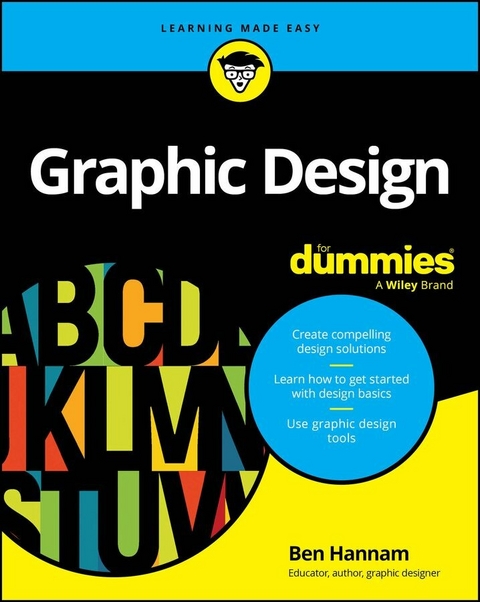
Graphic Design For Dummies (eBook)
394 Seiten
For Dummies (Verlag)
978-1-394-26597-8 (ISBN)
The complete, full-color graphic design guide for beginners
The field of graphic design is constantly evolving, with new design tools, methods, technology, and modes of expression being introduced all the time. Graphic Design For Dummies will teach you how to get started, introducing you to basic design principles as well as the latest best practices, software, and trends. You'll learn how to successfully plan and execute compelling design projects, even if you're not a trained designer. This fun and friendly book will empower you with the information you need to create design solutions. You'll also have the opportunity to test your skills with a series of interactive design activities, starting with step-by-step guidance and slowly building up your skills until you're ready to fly solo. Unleash your inner graphic designer with this Dummies guide.
- Create compelling visuals for a wide range of tasks and purposes
- Learn the basic concepts of graphic design and get the tools you need to start
- Get hands-on experience by following tutorials to create great designs
- Become proficient in graphic design-no art degree needed
Graphic Design For Dummies is a practical and user-friendly resource for those looking to create better design solutions quickly.
Ben Hannam, MFA, has been teaching graphic design since 2003. He currently serves as Associate Professor and Chair of Communication Design at Elon University while also managing his own graphic design agency. He is the author of A Graphic Design Student's Guide to Freelance: Practice Makes Perfect and Oh @#$%! I'm Graduating: A Student's Guide to Creating a Killer Portfolio.
The complete, full-color graphic design guide for beginners The field of graphic design is constantly evolving, with new design tools, methods, technology, and modes of expression being introduced all the time. Graphic Design For Dummies will teach you how to get started, introducing you to basic design principles as well as the latest best practices, software, and trends. You'll learn how to successfully plan and execute compelling design projects, even if you're not a trained designer. This fun and friendly book will empower you with the information you need to create design solutions. You'll also have the opportunity to test your skills with a series of interactive design activities, starting with step-by-step guidance and slowly building up your skills until you're ready to fly solo. Unleash your inner graphic designer with this Dummies guide. Create compelling visuals for a wide range of tasks and purposes Learn the basic concepts of graphic design and get the tools you need to start Get hands-on experience by following tutorials to create great designs Become proficient in graphic design no art degree needed Graphic Design For Dummies is a practical and user-friendly resource for those looking to create better design solutions quickly.
Chapter 1
What Is Graphic Design?
IN THIS CHAPTER
Getting your feet wet in graphic design
Specializing in graphic design
Setting hourly rates and flat fees and using retainer agreements
Ibelieve design is an instrument of organization, a means of relating objects to people, a medium for persuasion, and a way for humans to cope with the complexity of daily life. I believe there is no “right” way to solve a design problem because I’ve seen other designers solve design problems brilliantly in ways that I would have never thought of. Graphic design is a thinking person’s game where you solve problems by creating a visual language from type, illustrations, images, and other elements.
My goal as a designer is to reach my audience with whatever medium is necessary in order to communicate most effectively. Call me an optimist, but I believe that graphic design can help make the world a better place because when people communicate effectively with one other, we build stronger relationships, reduce misunderstandings, resolve conflicts, and facilitate understanding and growth.
Graphic design is all around us, and we are immersed in its artifacts. As you sit there reading this page, I bet there are no less than ten things around you that a graphic designer has created. From the laundry logo inside your shirt to the operating system on your mobile phone and to the cover design on this book — design is all around us. Yet, for many people, the design and creation processes are opaque and often unappreciated. Sometimes, it isn’t until graphic design fails — like the 2,000 “butterfly ballot” used in Palm Beach County, Florida, where presidential candidates’ names were listed on both sides of the ballot and led some voters to vote for the wrong candidate — that people understand exactly how important good design is.
Fortunately, graphic design is not defined solely by its failures but is celebrated for its many successes. It has profoundly shaped the world by enhancing communication, influencing mass media, building powerful brands, and driving marketing strategies. Beyond these, graphic design plays a crucial role in cultural and social expression, contributes significantly to the economy, enriches education and learning, and champions environmental and social responsibility. Graphic design enhances how we understand and interact with the world around us.
Graphic design can be described as the art and practice of planning ideas and experiences using visuals and text. It can be used in branding, advertising, web design, print media, and other fields to convey information, evoke emotions, and guide visual interactions. Often, graphic designers specialize in a particular aspect of design and hone their skills to master their craft.
Welcome to Graphic Design
Allow me to officially welcome you to the wonderful world of graphic design! It’s a fascinating discipline where you are likely to take on the role of artist, hustler, risk-taker, mathematician, creator, innovator, collaborator, typographer, scientist, composer, iconographer, technology guru, social observer, businessman, and so much more.
I’ve been working as a graphic designer for more than 30 years, and I love the discipline as much today as I did when I first started. Graphic design is a career path that is flexible, constantly evolving, and necessary. The work we do is both beneficial and broad in so many ways. It’s a journey that will require you to continually learn, grow, and adapt. For some, ever-present change can be frustrating, and for others, it embodies a spirit of freedom and personal expression.
I’m not going to lie; there will be moments when the road may get bumpy, but with each project, client, and experience, you will get stronger, faster, and conceptually deeper while navigating the terrain more confidently with less effort. There’s likely not going to be a moment where you feel that you’ve arrived at the goal line, but the journey is amazing, and I highly recommend it to anyone.
No matter if you’re reading this because you have a design problem you need to solve or if you’re considering a career in graphic design, graphic design is an empowering process and discipline. You have the opportunity to create and communicate using visual language and connect with others. Not only that, but graphic design is damn fun.
So, allow me to be the first to welcome you and encourage you not to just dip your toe in. Jump on into the wonderful world of graphic design. I’ve been expecting you!
Specialization in Graphic Design
There are many subsets in the graphic design discipline, though some graphic designers will often specialize in a particular area. Perhaps an area aligns with your specific interests, or maybe you will choose a higher-demand area that commands a higher salary.
If you’re interested in researching graphic design salary ranges, then you might want to search for “design salary survey.” One of my favorite design salary survey resources is Aquent, a staffing agency in Boston, Massachusetts, that specializes in placing employees in creative industries. Its salary survey can be found online at https://aquent.com/lp/salary-guide.
Specialization can help graphic designers stand out in a crowded market by offering unique skills and services and can help differentiate them from other designers in the field. Here are six areas of specialization within graphic design:
- Branding and logo design: Branding and logo designers often focus on creating visual elements to represent or promote a brand. This can include creating logos, color palettes, typography, and brand guidelines to create a cohesive and recognizable identity that resonates with a particular audience.
- Web and digital design: Web and digital designers often focus on creating websites, apps, and digital interfaces. This includes user experience (UX) design, user interface (UI) design, and creating layouts and graphics that are optimized for digital platforms.
- Print design: Print designers often focus on creating design solutions for physical media such as postcards, magazines, books, brochures, posters, and other printed media. Print designers pay particular attention to layout, typography, illustrations, and photography and work with printers to create their design solutions in a physical form.
- Illustration and motion graphics: Designers specializing in illustration create illustrations, create visual stories, and enhance communication for a variety of mediums, while motion designers create kinetic design solutions to create animations, animated graphics, video content, commercials, and advertising.
- Exhibition design: Exhibition designers often focus on designing physical spaces, signage, wayfinding systems, exhibitions, and retail environments. Exhibition designers create visually engaging and functional spaces that enhance a user’s experience.
- Packaging design: Package designers often focus on designing packaging for products that are both aesthetic and functional. Package designers work to create attractive, protective, and informative packages that align with a company’s brand guidelines.
Despite specialization in the design discipline, many of these areas share a common foundation, particularly with using the design principles (discussed in Chapters 6-8) to solve design problems. Also, many of these different areas of specialization use similar hardware and software but may use additional software to expedite certain workflows and tasks.
Assessing Design Education and Training
Many people interested in graphic design struggle with understanding what education and training they need. If you want to work in the design profession, do you need to go to college and get a degree in graphic design?
The short answer is that while a degree in graphic design can be beneficial for a career in the field, it’s not strictly necessary. I won’t lie; there are some big advantages to going to college and majoring in graphic design, but you can have a successful career without a degree.
One of the biggest advantages of studying graphic design is that a credentialed program will offer structured learning in design principles, typography, theory, and software skills. A good design program may also offer students networking opportunities, access to design labs, software, printing, and other resources like graphic design critiques to help improve your work that can be difficult or expensive to pay for independently.
That said, there are a variety of online courses, tutorials, and books that someone who is motivated to do so could use to teach themselves about the art and practice of graphic design. Self-motivated individuals can also freelance and gain practical experience. Also, starting in an entry-level position can provide on-the-job learning.
I’m a big fan of designers, no matter their level, using their skills to solve design problems. There are opportunities to help people who can’t pay expensive design fees while growing their skills at the same time. For example, I designed a cookbook for my church to help raise money to upgrade their playground equipment. Members of the church shared their favorite recipes, and I designed the cookbook for them. The money we raised selling the cookbook was the primary source of...
| Erscheint lt. Verlag | 4.12.2024 |
|---|---|
| Sprache | englisch |
| Themenwelt | Kunst / Musik / Theater ► Design / Innenarchitektur / Mode |
| Technik | |
| Schlagworte | Adobe Creative Suite • be a designer • beginner graphic design • design principles • Graphic Design • graphic design basics • graphic design book • graphic design book beginners • graphic designer book • graphic design fundamentals • graphic design intro |
| ISBN-10 | 1-394-26597-2 / 1394265972 |
| ISBN-13 | 978-1-394-26597-8 / 9781394265978 |
| Informationen gemäß Produktsicherheitsverordnung (GPSR) | |
| Haben Sie eine Frage zum Produkt? |
 EPUB (Adobe DRM)
Kopierschutz: Adobe-DRM
Adobe-DRM ist ein Kopierschutz, der das eBook vor Mißbrauch schützen soll. Dabei wird das eBook bereits beim Download auf Ihre persönliche Adobe-ID autorisiert. Lesen können Sie das eBook dann nur auf den Geräten, welche ebenfalls auf Ihre Adobe-ID registriert sind.
Details zum Adobe-DRM
Dateiformat: EPUB (Electronic Publication)
EPUB ist ein offener Standard für eBooks und eignet sich besonders zur Darstellung von Belletristik und Sachbüchern. Der Fließtext wird dynamisch an die Display- und Schriftgröße angepasst. Auch für mobile Lesegeräte ist EPUB daher gut geeignet.
Systemvoraussetzungen:
PC/Mac: Mit einem PC oder Mac können Sie dieses eBook lesen. Sie benötigen eine
eReader: Dieses eBook kann mit (fast) allen eBook-Readern gelesen werden. Mit dem amazon-Kindle ist es aber nicht kompatibel.
Smartphone/Tablet: Egal ob Apple oder Android, dieses eBook können Sie lesen. Sie benötigen eine
Geräteliste und zusätzliche Hinweise
Buying eBooks from abroad
For tax law reasons we can sell eBooks just within Germany and Switzerland. Regrettably we cannot fulfill eBook-orders from other countries.
aus dem Bereich