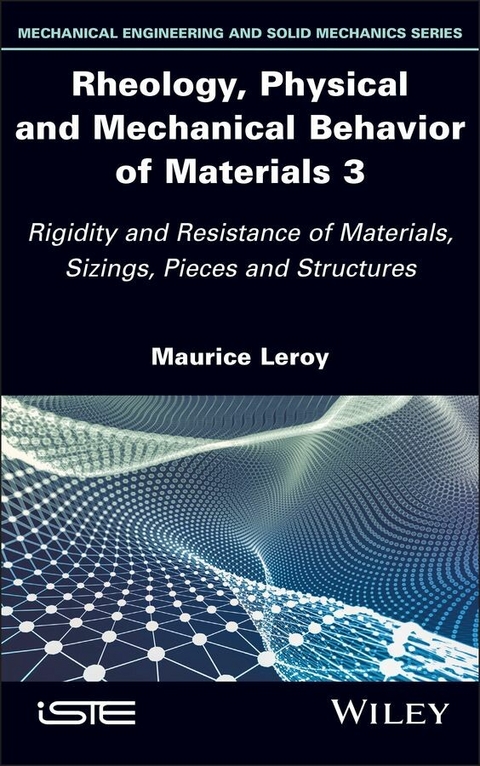
Rheology, Physical and Mechanical Behavior of Materials 3 (eBook)
568 Seiten
Wiley-Iste (Verlag)
978-1-394-34067-5 (ISBN)

This book studies metallic and composite materials and their mechanical properties in terms of stiffness and strength, illustrated through several case studies and exercises.
Rheology, Physical and Mechanical Behavior of Materials 3 introduces the concepts of stiffness, strength, elastic energy, generalized stress and strain, as well as the main criteria for dimensioning isotropic and anisotropic materials. It covers the elastic mechanics of pieces and structures using various techniques such as the force method, Maxwell's influence coefficients, Castigliano and Menabrea's work, Mohr's integrals and the displacement method, as well as the design and use of stiffness matrices. It also compares the behavior of static and dynamic impact actions and studies the elastic limits of plastic hinges, their influences and shear forces.
This book is aimed at those studying technical or technological training courses, researchers involved in the mechanics of deformation, and industrial design and manufacturing departments.
Maurice Leroy is a lecturer and professor at the University of Nantes, France, as well as director of the Composite and Metallic Formations research laboratory at the IUT. He was instrumental in the creation of France's first Materials Science and Engineering department.
This book studies metallic and composite materials and their mechanical properties in terms of stiffness and strength, illustrated through several case studies and exercises. Rheology, Physical and Mechanical Behavior of Materials 3 introduces the concepts of stiffness, strength, elastic energy, generalized stress and strain, as well as the main criteria for dimensioning isotropic and anisotropic materials. It covers the elastic mechanics of pieces and structures using various techniques such as the force method, Maxwell's influence coefficients, Castigliano and Menabrea's work, Mohr s integrals and the displacement method, as well as the design and use of stiffness matrices. It also compares the behavior of static and dynamic impact actions and studies the elastic limits of plastic hinges, their influences and shear forces. This book is aimed at those studying technical or technological training courses, researchers involved in the mechanics of deformation, and industrial design and manufacturing departments.
1
Elasticity, Rigidity
1.1. Elasticity and rigidity tensors
1.1.1. Hooke’s law
In the domain of low elastic deformations, the deformation is proportional to the stress:
where S is called elasticity. Similarly:
with C = S−1, where C is the rigidity.
Hooke’s law consists of nine equations with nine terms, totaling 81 Sijkl coefficients.
Through taking into account the physical phenomena, we can reduce the number of these coefficients to 36.
σij is a symmetric tensor, thus Sijkl = Sijlk, and εij is a symmetric tensor, thus, Sijkl = Sijlk.
1.1.2. Matrix notation
The tensors [σij] and [εij] are symmetrical. The notation can be simplified by adopting the following equivalences:
- For [σij]:
Table 1.1. Tensor and matrix notations of [σij]
xx yy zz yz, zy zx, xz xy, yx Tensor notation 11 22 33 23.32 31.13 12.21 Matrix notation 1 2 3 4 5 6 In other words, six coefficients are given as:
- For [εij] in relation to the strain tensor [eij], we obtain:
In Sijkl, the first two indices are contained in a single variant from 1 to 6 and the same is done for the last two indices. That is, Sijkl = Smn. The factors 1, 2 and 4 are introduced at the same time as follows:
- if m and n have the values of 1, 2, 3, Sijkl = Smn;
- if m or n have the values of 4, 5, 6, ;
- if m and n have the values of 4, 5, 6, .
1.1.3. Relationships between stresses and strains for isotropic bodies
In the classic works on elasticity, the relationships between the stresses and the strains are expressed as a function of different quantities of the coefficients Sij or Cij.
These are as follows:
- Young’s modulus: . This equation gives the relative elongation of a rod of section S subjected to an axial force F.
- Poisson’s ratio ν. At the same time as a cylinder lengthens, it also narrows: .
- The rigidity modulus, G: .
- The Lamé coefficients, λ and μ: , .
To establish the relationships between the coefficients Sij and Cij and the classic coefficients, we will develop the matrices that we have obtained for the isotropic solids and compare them with the classic equations.
Table 1.2. Classical expressions and notations matrix of deformations
| Classic expressions | Matrix notations |
|---|
| ε1 = S11 σ1 + S12 σ2 + S13σ3 |
| ε2 = S12 σ1 + S11 σ2 + S12σ3 |
| ε3 = S12 σ1 + S12 σ2 + S11σ3 |
| ε4 = 2 (S11 − S12) σ4 |
| ε5 = 2 (S11 − S12) σ5 |
| ε6 = 2 (S11 − S12) σ6 |
The comparison of the coefficients gives:
and:
and thus the equation G = E / [2 (1 + v)].
We express the stresses as a function of the strains (Table 1.3).
Table 1.3. Classical expressions and matrix notations of strains
| Classic expressions | Matrix notations |
|---|
| σ1 = (2μ + λ) ε1 + λ ε2 + λ ε3 | σ1 = C11 ε1 + C12 ε2 + C12 ε3 |
| σ2 = λ ε1 + (2μ + λ) ε2 + λ ε3 | σ2 = C12 ε1 + C11 ε2 + C12 ε3 |
| σ3 = λ ε1 + λ ε2 + (2 μ + λ) ε3 | σ3 = C12 ε1 + C12 ε2 + C11 ε3 |
| σ4 = μ ε4 |
| σ5 = μ ε5 |
| σ6 = μ ε6 |
According to the results of Table 1.3, we obtain:
1.1.4. Tensors [σ] and [ε] and deviators
The values of the traces in stresses and strains are as follows:
- tr [σ] = − 3 p or − p = σm, with σm, the average stress;
- tr [ε] = Θ dilatation with Θ/3 = εm, the average strain.
In the primary reference area, we have:
or:
or:
1.1.4.1. The case of isotropic materials in elasticity in the main reference area
Thus, we have:
or:
We will establish that .
We obtain the Lamé coefficients in the stresses:
and thus:
and thus:
The same is attained by permutation for SII and SIII, hence:
1.1.4.1.1. Relationship between stress and strain deviators
The relationship between the stress and strain deviators is independent of the reference area in use. Thus, for any reference area x, y, z, we obtain:
and thus, for example:
-
but according to [1.2]:
and two other relationships via permutation:
-
and thus:
- From [1.5]: shear strain for i ≠ j equal to:
with G, the elastic modulus for shearing (or transverse) (or μ) in Pascals.
- From [1.5]: the elongation strain is equal to:
EXAMPLE 1.1.–
We have that i = j:
but [1.2] gives:
and thus:
or:
With:
- Values that can be measured by tests: [1.6]
- Values that can be measured by permutation: [1.7]
REMARK.–
1.1.4.1.2. A few values: λ, E, G in daN/mm2
Table 1.4. Elasticity coefficients of materials
| λ 10−3 | E 10−3 | G 10−3 | ν |
|---|
| Steel | 9–13 | 20–22 | 7.9–8.4 | 0.27–0.31 |
| Brass | 8.5 | 11 | 4.1 | 0.33 |
| Copper | 9–13 | 13 | 4.8 | 0.33–0.38 |
| Lead | 3.5 | 1.6 | 0.56 | 0.43 |
| Glass | 2.7–3 | 6 | 2.38 | 0.26 |
The following relationships are obtained in the main reference area:
and thus the shift to the stress and deformation states for elastic isotropic material in Figure 1.1.
Figure 1.1. Representation of Mohr domains from stress and strain states
Table 1.5. Young’s moduli values (Ashby and Jones 1980)
| Material | E in GPs | Material | E in GPs |
|---|
| Diamond | 1000 | Niobium and alloys | 80–110 |
| Tungsten carbide WC | 450–650 | Silicon | 107 |
| Osmium | 551 | Zirconium and alloys | 96 |
| Cobalt/tungsten carbide cements | 400–530 | Silica glass and SiO2 (quartz) | 94 |
| Ti, Zr, and Hf borides | 500 | Zinc and alloys | 43–96 |
| Silicon carbide siC | 450 | Gold | 82 |
| Boron | 441 | Calcite... |
| Erscheint lt. Verlag | 4.12.2024 |
|---|---|
| Reihe/Serie | ISTE Invoiced |
| Sprache | englisch |
| Themenwelt | Naturwissenschaften ► Chemie |
| Technik ► Maschinenbau | |
| Schlagworte | composite materials • Displacement Method • elastic energy • Force Method • Maxwell's influence coefficients • mechanical behavior • Metallic materials • Mohr's integrals • rheology • Shear Forces • Stiffness • Strain • Strength • Stress |
| ISBN-10 | 1-394-34067-2 / 1394340672 |
| ISBN-13 | 978-1-394-34067-5 / 9781394340675 |
| Informationen gemäß Produktsicherheitsverordnung (GPSR) | |
| Haben Sie eine Frage zum Produkt? |
 EPUB (Adobe DRM)
Kopierschutz: Adobe-DRM
Adobe-DRM ist ein Kopierschutz, der das eBook vor Mißbrauch schützen soll. Dabei wird das eBook bereits beim Download auf Ihre persönliche Adobe-ID autorisiert. Lesen können Sie das eBook dann nur auf den Geräten, welche ebenfalls auf Ihre Adobe-ID registriert sind.
Details zum Adobe-DRM
Dateiformat: EPUB (Electronic Publication)
EPUB ist ein offener Standard für eBooks und eignet sich besonders zur Darstellung von Belletristik und Sachbüchern. Der Fließtext wird dynamisch an die Display- und Schriftgröße angepasst. Auch für mobile Lesegeräte ist EPUB daher gut geeignet.
Systemvoraussetzungen:
PC/Mac: Mit einem PC oder Mac können Sie dieses eBook lesen. Sie benötigen eine
eReader: Dieses eBook kann mit (fast) allen eBook-Readern gelesen werden. Mit dem amazon-Kindle ist es aber nicht kompatibel.
Smartphone/Tablet: Egal ob Apple oder Android, dieses eBook können Sie lesen. Sie benötigen eine
Geräteliste und zusätzliche Hinweise
Buying eBooks from abroad
For tax law reasons we can sell eBooks just within Germany and Switzerland. Regrettably we cannot fulfill eBook-orders from other countries.
aus dem Bereich