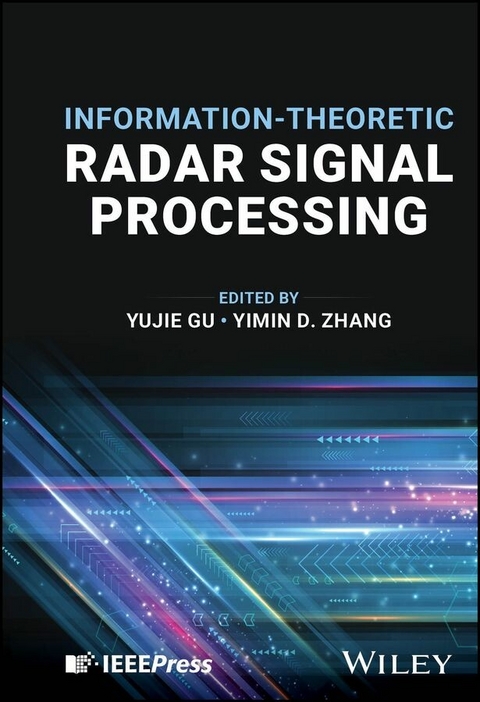
Information-Theoretic Radar Signal Processing (eBook)
788 Seiten
Wiley-IEEE Press (Verlag)
978-1-394-21694-9 (ISBN)
A comprehensive introduction to the emerging research in information-theoretic radar signal processing
Signal processing plays a pivotal role in radar systems to estimate, visualize, and leverage useful target information from noisy and distorted radar signals, harnessing their spatial characteristics, temporal features, and Doppler signatures. The burgeoning applications of information theory in radar signal processing provide a distinct perspective for tackling diverse challenges, including optimized waveform design, performance bound analysis, robust filtering, and target enumeration.
Information-Theoretic Radar Signal Processing provides a comprehensive introduction to radar signal processing from an information theory perspective. Covering both fundamental principles and advanced techniques, the book facilitates the integration of information theory into radar signal processing, broadening the scope and improving the performance. Tailored to the needs of researchers and students alike, it serves as a valuable resource for comprehending the information-theoretic aspects of radar signal processing.
Information-Theoretic Radar Signal Processing readers will also find:
- Presentation of alternative hypotheses in adaptive radar detection
- Detailed discussion of topics including resource management and power allocation
- Direction-of-arrival (DOA) estimation and integrated sensing and communications (ISAC)
Information-Theoretic Radar Signal Processing is ideal for graduate students, scientists, researchers, and engineers, who work on the broad scope of radar and sonar applications, including target detection, estimation, imaging, tracking, and classification using radio frequency, ultrasonic, and acoustic methods.
Yujie Gu, PhD, currently works as a Senior Radar Scientist at Aptiv Advanced Engineering Center, Agoura Hills, California. He is an Associate Editor of IEEE Transactions on Signal Processing, a Subject Editor-in-Chief of Electronics Letters, an Editor of Signal Processing, and an elected member of the Sensor Array and Multichannel (SAM) Signal Processing Technical Committee and the Signal Processing Theory and Methods (SPTM) Technical Committee of the IEEE Signal Processing Society. He is a Senior Member of IEEE.
Yimin D. Zhang, PhD, is currently an Associate Professor with the Department of Electrical and Computer Engineering at Temple University, Philadelphia, Pennsylvania. He is a Senior Area Editor of IEEE Transactions on Signal Processing, an Editor of Signal Processing, and an elected member of the Signal Processing Theory and Methods (SPTM) Technical Committee of the IEEE Signal Processing Society. He is a Fellow of IEEE, a Fellow of SPIE, and a Distinguished Lecturer of the IEEE Signal Processing Society.
A comprehensive introduction to the emerging research in information-theoretic radar signal processing Signal processing plays a pivotal role in radar systems to estimate, visualize, and leverage useful target information from noisy and distorted radar signals, harnessing their spatial characteristics, temporal features, and Doppler signatures. The burgeoning applications of information theory in radar signal processing provide a distinct perspective for tackling diverse challenges, including optimized waveform design, performance bound analysis, robust filtering, and target enumeration. Information-Theoretic Radar Signal Processing provides a comprehensive introduction to radar signal processing from an information theory perspective. Covering both fundamental principles and advanced techniques, the book facilitates the integration of information theory into radar signal processing, broadening the scope and improving the performance. Tailored to the needs of researchers and students alike, it serves as a valuable resource for comprehending the information-theoretic aspects of radar signal processing. Information-Theoretic Radar Signal Processing readers will also find: Presentation of alternative hypotheses in adaptive radar detectionDetailed discussion of topics including resource management and power allocationDirection-of-arrival (DOA) estimation and integrated sensing and communications (ISAC) Information-Theoretic Radar Signal Processing is ideal for graduate students, scientists, researchers, and engineers, who work on the broad scope of radar and sonar applications, including target detection, estimation, imaging, tracking, and classification using radio frequency, ultrasonic, and acoustic methods.
Preface
The roots of information theory can be traced back 100 years to the early works of Fisher [1], Nyquist [2], Hartley [3], and others. In [1], Fisher laid down a cornerstone by defining statistical information as the reciprocal of the variance of a statistical sample. This fundamental concept was later independently derived by Cramér and Rao, who utilized it to establish the lower bound on parameter estimation variance [4, 5]. Therefore, information theory has been naturally closely related to signal processing from the beginning.
After World War II, both disciplines of information theory and signal processing witnessed remarkable advancements. In 1948, Shannon published his groundbreaking article, “A mathematical theory of communication” [6], which served as a lodestar for the burgeoning discipline of information theory. In the same year, the Institute of Radio Engineers (IRE), the predecessor of the Institute of Electrical and Electronics Engineers (IEEE), inaugurated its first society, the Signal Processing Society. This historical coincidence further symbolized the close relationship between information theory and signal processing.
Information theory originally emerged to explore the communication of messages. Its core principles include quantification of information, source coding, and channel coding. Shannon’s contributions fostered a vibrant community of scholars, leading to the establishment of the IEEE Information Theory Society in 1951. His legacy continues to influence the fields of communications, information theory, and signal processing.
The earlier works of Woodward and Davies in the early 1950s [7, 8] marked the beginning of information-theoretic signal processing for radar applications. However, unlike communication systems, which aim to extract information from received signals in a cooperative framework, radar systems operate in noncooperative environments, seeking information about unknown targets, such as their range, velocity, and angle. This inherent disparity in understanding of information has resulted in a notable lag in the development of information-theoretic processing for radar systems compared with the communication counterparts.
Information theory experienced a resurgence within the radar signal processing community following a period of stagnation spanning over three decades. A key turning point was the publication of Bell’s PhD dissertation in 1988 [9], wherein mutual information was used for the first time as an optimization criterion to design radar waveforms that maximize the target information extracted from the received measurements. Since then, information theory has witnessed a renaissance in radar signal processing, especially in the era of multiple-input multiple-output (MIMO) radar. In 2005, Guo et al. [10] provided further insights into the theoretical connection between mutual information in information theory and minimum mean square error (MMSE) in estimation theory. Nowadays, information-theoretic criteria, including Fisher information, Shannon entropy, mutual information, and Kullback–Leibler divergence (also known as relative entropy), have become the foundation of adaptive radar systems and found great success in solving various radar signal processing problems. This book provides a comprehensive introduction to information-theoretic criteria, methods, and applications in radar signal processing with a focus on the latest theoretical and practical advances in selected important topics.
This book is intended not only for radar signal processing researchers, but also for postgraduate and PhD students, researchers, and engineers working on a broad spectrum of signal processing and its applications, including but not limited to radar systems. The readers are assumed to have some background in linear algebra, probability and statistics, compressive sensing, detection and estimation, control and optimization, information theory, as well as radar systems.
The book contains fourteen self-contained chapters, each focusing on a specific topic. These chapters, contributed by leading experts from academia, industry, and government, can be broadly categorized into six areas: target detection (Chapters 1–3), parameter estimation (Chapters 4 and 5), radar imaging (Chapters 6 and 7), target tracking (Chapters 8–10), resource management (Chapters 11 and 12), and performance bound analysis (Chapters 13 and 14).
- Target detection is the primary mission of many radar systems. In Chapter 1, the authors (Bo Tang, Jun Tang, and Petre Stoica) employ the relative entropy metric to design MIMO radar waveforms under various practical constraints in order to enhance the detection performance of radar systems. In Chapter 2, the authors (Pia Addabbo, Danilo Orlando, and Gaetano Giunta) utilize the Kullback–Leibler divergence criterion to develop adaptive detection architectures for solving multiple hypothesis testing problems in radar applications. In Chapter 3, the authors (Lei Huang and Hing Cheung So) develop a linear shrinkage minimum description length (MDL) criterion and two shrinkage coefficient-based detectors for source enumeration in a computationally efficient way.
- Parameter estimation is one of the fundamental functions of radar systems. In Chapter 4, the authors (Yujie Gu, Nathan A. Goodman, and Yimin D. Zhang) adopt the maximum mutual information criterion to optimize the compressive sensing kernel over the Stiefel manifold to achieve enhanced time delay estimation performance. In Chapter 5, the authors (Bin Liao, Qianhui You, and Peng Xiao) exploit the normalized ℓ1 Shannon entropy function to develop an entropy-enhanced one-bit compressive sensing algorithm for direction-of-arrival (DOA) estimation.
- Radar imaging becomes increasingly important in modern high-resolution radar systems, where man-made radar targets often extend over multiple range bins when illuminated by wideband radar signals. In Chapter 6, the authors (Zacharie Idriss, Raghu G. Raj, and Ram M. Narayanan) optimize radar waveforms for multistatic radar imaging by maximizing the mutual information between the received signal and the scene of interest, where natural scenes are sparsely represented by wavelet coefficients. In Chapter 7, the authors (Alejandro C. Frery and Abraão D. C. Nascimento) present information-theoretic results in conjunction with statistical inference for the processing and comprehension of synthetic aperture radar (SAR) and polarimetric SAR (PolSAR) imagery.
- Target tracking is another important task in radar applications to locate moving targets over time. In Chapter 8, the authors (Nianxia Cao, Pramod K. Varshney, Engin Masazade, and Sora Haley) propose an information-theoretic sensor selection algorithm for target tracking in sensor networks that strikes a balance between the computational complexity and the tracking performance. In Chapter 9, the authors (Siyuan Peng, Lujuan Dang, Badong Chen, and Jose C. Principe) introduce the minimum error entropy (MEE) criterion for the derivation of adaptive filters that exhibit robustness against non-Gaussian noise. In Chapter 10, the authors (Bryan Paul and Daniel W. Bliss) utilize the estimation information rate as a metric to dynamically manage radar systems, resulting in a target scheduling algorithm and a resource allocation scheme for the generalized radar tracking Bayesian filter.
- Resource management helps to improve cost efficiency of radar systems, including reducing system size, enhancing spectrum utilization, and minimizing power consumption. In Chapter 11, the authors (Hana Godrich, Athina Petropulu, and H. Vincent Poor) propose two power allocation strategies for target localization in distributed multiple-radar architectures that, respectively, prioritize estimation accuracy and power consumption. In Chapter 12, the authors (Kristine Bell, Chris Kreucher, and Muralidhar Rangaswamy) develop a fully adaptive radar resource management scheme that emulates the perception–action cycle of cognition and uses the mutual information criterion to design future radar waveforms for the optimized estimation of the state of a surveillance region.
- Performance bound analysis provides an efficient way to understand the performance of radar systems and insightful guidelines for radar system design and algorithm development. In Chapter 13, the authors (Yifeng Xiong, Fuwang Dong, and Fan Liu) derive the information-theoretic performance boundaries that govern the tradeoff between the sensing accuracy and communication rate in integrated sensing and communication (ISAC) systems. In Chapter 14, the authors (Zongyu Zhang, Zhiguo Shi, and Arye Nehorai) devise a global tight Ziv–Zakai bound as a linear combination of the a priori bound and the Cramér–Rao bound for evaluating the performance of multisource DOA estimation.
The organization of this book allows readers to gain a comprehensive and deep understanding of key radar signal processing topics through the lens of information theory, and to learn how information-theoretic criteria and methods can be applied to design and implement efficient and effective radar systems. The independence of each chapter also provides the flexibility for instructors to select a subset of chapters for university courses or short seminars.
References
- 1 Fisher, R.A. (1925)....
| Erscheint lt. Verlag | 27.11.2024 |
|---|---|
| Sprache | englisch |
| Themenwelt | Technik ► Elektrotechnik / Energietechnik |
| Schlagworte | adaptive radar detection • constant information rate radar • distributed multiple-radar architecture • DoA estimation • entropy criterion • MIMO radar detection • multistatic radar imaging • radar parameter estimation • radar target enumeration • waveform design |
| ISBN-10 | 1-394-21694-7 / 1394216947 |
| ISBN-13 | 978-1-394-21694-9 / 9781394216949 |
| Informationen gemäß Produktsicherheitsverordnung (GPSR) | |
| Haben Sie eine Frage zum Produkt? |
 EPUB (Adobe DRM)
Kopierschutz: Adobe-DRM
Adobe-DRM ist ein Kopierschutz, der das eBook vor Mißbrauch schützen soll. Dabei wird das eBook bereits beim Download auf Ihre persönliche Adobe-ID autorisiert. Lesen können Sie das eBook dann nur auf den Geräten, welche ebenfalls auf Ihre Adobe-ID registriert sind.
Details zum Adobe-DRM
Dateiformat: EPUB (Electronic Publication)
EPUB ist ein offener Standard für eBooks und eignet sich besonders zur Darstellung von Belletristik und Sachbüchern. Der Fließtext wird dynamisch an die Display- und Schriftgröße angepasst. Auch für mobile Lesegeräte ist EPUB daher gut geeignet.
Systemvoraussetzungen:
PC/Mac: Mit einem PC oder Mac können Sie dieses eBook lesen. Sie benötigen eine
eReader: Dieses eBook kann mit (fast) allen eBook-Readern gelesen werden. Mit dem amazon-Kindle ist es aber nicht kompatibel.
Smartphone/Tablet: Egal ob Apple oder Android, dieses eBook können Sie lesen. Sie benötigen eine
Geräteliste und zusätzliche Hinweise
Buying eBooks from abroad
For tax law reasons we can sell eBooks just within Germany and Switzerland. Regrettably we cannot fulfill eBook-orders from other countries.
aus dem Bereich