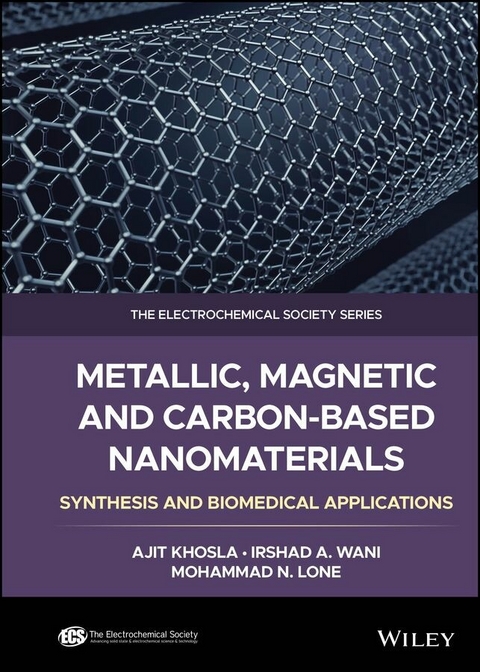
Metallic, Magnetic, and Carbon-Based Nanomaterials (eBook)
1023 Seiten
Wiley (Verlag)
978-1-119-87067-8 (ISBN)
A comprehensive guide to an explosively popular and transformative technology
Nanotechnology has revolutionized the manipulation of matter at the molecular level, with extraordinary consequences for a huge range of technological and scientific fields. Metallic, magnetic and carbon-based nanomaterials have been at the forefront of this revolution, with their impact felt especially strongly in biomedical industries. The future of drug delivery, imaging, diagnostics, and more will be transformed by nanotechnology and its ever-growing applications.
Metallic, Magnetic and Carbon-Based Nanomaterials offers a comprehensive introduction to these materials and their recent developments. Beginning with the foundational concepts of nanotechnology, its characterization, and its methods, the book moves through major categories of nanotechnology in turn. Detailed discussion of applications and future areas of research rounds out an indispensable volume.
Metallic, Magnetic and Carbon-Based Nanomaterials readers will also find:
- Fully up-to-date data on major nanotechnology synthesis techniques
- Detailed discussion of nanotechnologies including quantum dots, magnetic nanoparticles, graphene, and many more
- Analysis of applications including tumor biology investigation, in vivo animal imaging, and others
Metallic, Magnetic and Carbon-Based Nanomaterials is ideal for graduate students in pharmaceutical sciences, biomedical engineering, and materials sciences. It is also a useful reference book for researchers working in the areas of biomedical engineering and nanomaterials synthesis, as well as those working in toxicology, especially nanotoxicology.
Ajit Khosla, PhD, is a distinguished professor in the School of Advanced Materials and Nanotechnology at the Xidian University, and distinguished visiting professor at Soft & Wet Matter Engineering Laboratory (SWEL), Yamagata University, Yonezawa, Japan. Prof. Khosla is a fellow of the Electrochemical Society (United States) and the Royal Society of Chemistry (United kingdom) and holds 5 patents. He is founding Editor-in-Chief of Electrochemical Society's first gold open access journals, ECS Sensors Plus and Editor Electrochemical Society's family of journals.
Irshad A. Wani, PhD, is currently serving as an Assistant Professor in Chemistry at Postgraduate Department of Chemistry, Govt. Degree College Anantnag, University of Kashmir, India. Dr. Wani has received various prestigious awards notably ICTSGS Services Award (2021) conferred by SPAST foundation & B N Kailoo Memorial ISCAS Medal (2009) conferred by ISCAS, India etc. He has a good track record of publications & has published research papers in various esteemed international journals. He is serving as a peer reviewer of various international journals and is also a life member of various scientific societies.
Mohammad N. Lone, PhD, is currently serving as an Assistant Professor in Chemistry at Department of Chemistry, Central University of Kashmir, India. During Ph.D., Dr. Lone was honored with the Basic Scientific Research (UGC-BSR) Meritorious JRF & SRF fellowship for five years by the University Grants Commission-Basic Scientific Research, India.
A comprehensive guide to an explosively popular and transformative technology Nanotechnology has revolutionized the manipulation of matter at the molecular level, with extraordinary consequences for a huge range of technological and scientific fields. Metallic, magnetic and carbon-based nanomaterials have been at the forefront of this revolution, with their impact felt especially strongly in biomedical industries. The future of drug delivery, imaging, diagnostics, and more will be transformed by nanotechnology and its ever-growing applications. Metallic, Magnetic and Carbon-Based Nanomaterials offers a comprehensive introduction to these materials and their recent developments. Beginning with the foundational concepts of nanotechnology, its characterization, and its methods, the book moves through major categories of nanotechnology in turn. Detailed discussion of applications and future areas of research rounds out an indispensable volume. Metallic, Magnetic and Carbon-Based Nanomaterials readers will also find: Fully up-to-date data on major nanotechnology synthesis techniquesDetailed discussion of nanotechnologies including quantum dots, magnetic nanoparticles, graphene, and many moreAnalysis of applications including tumor biology investigation, in vivo animal imaging, and others Metallic, Magnetic and Carbon-Based Nanomaterials is ideal for graduate students in pharmaceutical sciences, biomedical engineering, and materials sciences. It is also a useful reference book for researchers working in the areas of biomedical engineering and nanomaterials synthesis, as well as those working in toxicology, especially nanotoxicology.
1
Nanomaterials
Synthesis Methods and Characterization Techniques
Ajit Khosla1, Irshad A. Wani2, and Mohammad N. Lone3
1School of Advanced Materials and Nanotechnology, Xidian University, Xian, Shaanxi, China
2Department of Chemistry, Govt. Degree College Anantnag, Anantnag, University of Kashmir, Jammu and Kashmir, India
3Department of Chemistry, Central University of Kashmir, Ganderbal, Jammu and Kashmir, India
1.1 Nanoscience and Nanotechnology: An Outline of Terms and Concepts
The definition of nanotechnology remains a central concern in the scientific community, prompting questions about its precise scope and boundaries. Nanotechnology generally pertains to the study and manipulation of materials and phenomena at the nanoscale, typically below 100 nm, where size-dependent quantum mechanical effects become prominent [1]. While this range captures the essence of nanotechnology and its unique properties, some experts caution against strictly adhering to the 100 nm boundary, as certain devices and materials in the pharmaceutical domain may be excluded [2].
An additional crucial aspect in defining nanotechnology is to consider whether the materials involved are natural, synthetic, or manufactured [3]. Naturally occurring biomolecules in living cells often exist at the nanoscale, which could redefine disciplines like biochemistry and molecular biology as integral parts of nanotechnology.
The following definition of nanotechnology is provided by the U.S. National Nanotechnology Initiative (NNI) [3]: “The understanding & control of matter at dimensions between approximately 1 & 100 nanometers, where unique phenomena enable novel nanotechnology applications.” Other noteworthy definitions of nanotechnology encompass its broad scope and applications [2]. For example, it can be described as “The design, characterization, production, and utilization of structures, devices, and systems attained through deliberate manipulation of size and shape at the nanometer scale (atomic, molecular, and macromolecular scale) that demonstrate at least one unique or enhanced characteristic or property.” Nanotechnology can also be viewed as “Developing objects and surfaces with unique functionalities stemming directly from nanoscale dimensions and/or arrangement.” These unique properties may manifest in mechanical, electrical, or photochemical attributes not observed in bulk materials.
The term “nanotechnology” originates from the ancient Greek word “ννoς” and the Latin word “nanus,” both meaning “dwarf” or “very small.” Within the International System of Units (SI), “nano” represents a reduction factor of 10–9 times, indicating manipulation of matter at a scale one billionth of a meter (10–9 m) [4].
Nanotechnology represents more of an engineering approach than a standalone science, drawing extensively from fields such as biology, physics, chemistry, and materials science [5]. Its potential impact on these sciences is expected to be transformative. The term “nanotechnology” was initially coined by Eric Drexler in his publication “Engines of Creation” (1986). It refers to the manipulation of individual atoms and molecules to create structures characterized by exact atomic specifications [6]. It is observed that the concept of nanotechnology has its roots in physicist Richard Feynman’s seminal lecture from 1959, titled “There’s Plenty of Room at the Bottom” [7, 8]. In 1974, Norio Taniguichi of Tokyo Science University coined the term “nanotechnology” in reference to semiconductor processes involving control on the order of nanometers, which continues to serve as the foundational statement [9]: “Nanotechnology primarily involves the manipulation of materials through processes such as separation, consolidation, and deformation at the level of individual atoms or molecules.” Nanoscience encompasses the examination of phenomena and the control of materials at atomic, molecular, and macromolecular levels, where properties exhibit notable deviations from those observed at larger scales. Nanotechnologies, on the other hand, entail the design, characterization, manufacturing, and utilization of structures, devices, and systems through precise control of shape and size at the nanometer scale [10].
Nanotechnology pertains to the manipulation and study of materials and phenomena at the nanoscale, corresponding to one-billionth of a meter or one-millionth of a millimeter [1, 4]. The nanoscale, defined by the order of magnitude 10−9 in the metric system, encompasses volumes, weights, and units of time. To illustrate, a nanometer bears a similar relation to a meter as the diameter of a hazelnut does to the diameter of the Earth. For instance, a water molecule spans approximately 0.3 nm, a single gold atom’s diameter is about a third of a nanometer, a red blood cell is roughly 7000 nm wide, and a sheet of paper is about 100,000 nm thick.
At the nanoscale, materials exhibit unique physical, chemical, and biological properties at the nanoscale often exhibit substantial disparities from their bulk counterparts and individual atoms or molecules [11]. These distinctive properties have captured scientific interest due to the emergence of unusual phenomena and behaviors in nanomaterials. The term “nanoparticle” derives from “nanos” (Greek for dwarf) and “particulum” (Latin for a particle) [12]. In the context of nanotechnology, “nano” predominantly refers to particle length. Nanoparticles encompass objects ranging from 1 to several hundred nanometers in size [12–14]. On the other hand, nanocrystals represent crystalline clusters consisting of a few hundred to a few thousand atoms typically possess dimensions within the nanoscale range. Their properties are influenced primarily by their surfaces rather than their bulk volumes due to their small size. Nanoparticles can be composed of materials, including metals, metal oxides, micelles, biomolecules, and synthetic polymers [15]. The quality of colloidal inorganic nanocrystals depends on factors such as their crystalline nature, narrow size distribution, unique shape, and dispersion stability. “Nanocluster” refers to small aggregates of atoms and molecules with diameters typically in the nanoscale, ranging from a few units to several thousand [16]. Although there is not a strict demarcation between clusters and nanoparticles, the behavior of nanoparticles is significantly influenced by their nanometer dimensions. As such, characterizing nanoparticles involves investigating size, shape, surface charge, and porosity to comprehend and predict their behavior.
Nanoscience and nanotechnology are not entirely novel concepts. For instance, polymers composed of nanoscale monomers have been studied by chemists for over two decades [17]. However, recent advancements in fabrication tools have allowed direct probing and examination of atoms and molecules with great precision, further advancing nanoscience and nanotechnology [18]. Incorporating nanomaterials into bulk materials can drastically alter their properties, resulting in materials with enhanced strength and unique characteristics due to quantum confinement effects and increased surface area-to-volume ratios at the nanoscale.
In summary, nanotechnology explores and manipulates materials and phenomena at the nanoscale, where distinctive properties emerge. Nanoparticles and nanoclusters play vital roles in this domain, offering unique attributes with potential applications across various fields, promising transformative advancements in science and technology.
1.1.1 Nanomaterials: Properties and Classification
Nanomaterials are materials wherein 50% or more of the constituent particles possess external dimensions falling within the size range of 1–100 nm [19]. Determining whether a material qualifies as a nanomaterial can be done through specific conditions, one of which is the volume-specific surface area (VSSA) or surface area-to-volume ratio. A VSSA greater than 60 m2/cm3 serves as a reliable indicator of nanomaterials; however, certain nanomaterials, such as metal nanoparticles, may have a VSSA below this threshold. Thus, the VSSA criterion confirms nanomaterial classification but is not applicable in the reverse direction [20].
Nanoparticles boast significantly larger surface areas per unit mass compared to larger particles [21, 22]. To illustrate the impact of particle size on surface area, let us consider an American Silver Eagle coin weighing 31 g and possessing a total surface area of approximately 3000 mm2. If this coin were to be subdivided into spherical nanoparticles of, for instance, 10 nm size, the total surface area of all the resulting nanoparticles would amount to around 7000 m2. This remarkable increase in surface area is equivalent to nearly the size of a soccer field. In essence, the total surface area of all nanoparticles with a size of 10 nm is over two million times greater than the surface area of the silver dollar coin.
As materials are reduced to the nanoscale, quantum effects and surface phenomena begin to exert significant dominance over their properties [23]. When...
| Erscheint lt. Verlag | 27.11.2024 |
|---|---|
| Reihe/Serie | The ECS Series of Texts and Monographs |
| Sprache | englisch |
| Themenwelt | Naturwissenschaften ► Chemie |
| Technik ► Maschinenbau | |
| Schlagworte | Biomedical Application • carbon-based nanomaterial • classical quantum dot • Gold nanoparticle • Magnetic nanoparticle • Nanoparticle • Nanoscience • nano system • nanotechnology • polymeric nanomaterial • Silver nanoparticle • synthesis of nanomaterial |
| ISBN-10 | 1-119-87067-4 / 1119870674 |
| ISBN-13 | 978-1-119-87067-8 / 9781119870678 |
| Informationen gemäß Produktsicherheitsverordnung (GPSR) | |
| Haben Sie eine Frage zum Produkt? |
 EPUB (Adobe DRM)
Kopierschutz: Adobe-DRM
Adobe-DRM ist ein Kopierschutz, der das eBook vor Mißbrauch schützen soll. Dabei wird das eBook bereits beim Download auf Ihre persönliche Adobe-ID autorisiert. Lesen können Sie das eBook dann nur auf den Geräten, welche ebenfalls auf Ihre Adobe-ID registriert sind.
Details zum Adobe-DRM
Dateiformat: EPUB (Electronic Publication)
EPUB ist ein offener Standard für eBooks und eignet sich besonders zur Darstellung von Belletristik und Sachbüchern. Der Fließtext wird dynamisch an die Display- und Schriftgröße angepasst. Auch für mobile Lesegeräte ist EPUB daher gut geeignet.
Systemvoraussetzungen:
PC/Mac: Mit einem PC oder Mac können Sie dieses eBook lesen. Sie benötigen eine
eReader: Dieses eBook kann mit (fast) allen eBook-Readern gelesen werden. Mit dem amazon-Kindle ist es aber nicht kompatibel.
Smartphone/Tablet: Egal ob Apple oder Android, dieses eBook können Sie lesen. Sie benötigen eine
Geräteliste und zusätzliche Hinweise
Buying eBooks from abroad
For tax law reasons we can sell eBooks just within Germany and Switzerland. Regrettably we cannot fulfill eBook-orders from other countries.
aus dem Bereich