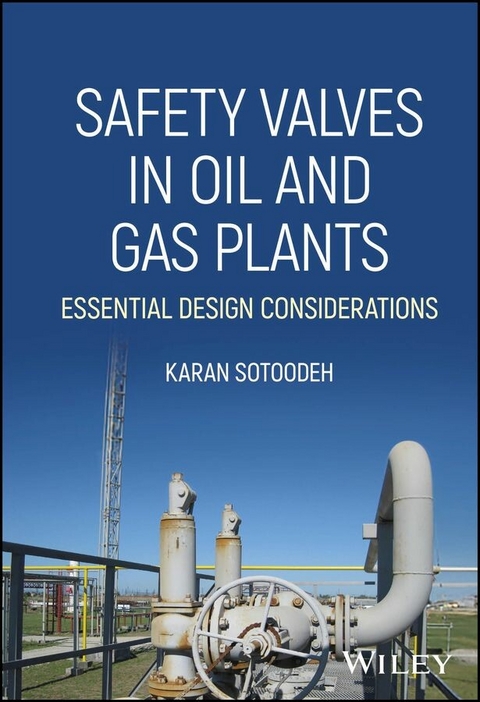
Safety Valves in Oil and Gas Plants (eBook)
428 Seiten
Wiley (Verlag)
978-1-394-29492-3 (ISBN)
Comprehensive approach to designing safety valves used in oil and gas plants, featuring case studies throughout the text
Safety Valves in Oil and Gas Plants delivers a comprehensive overview of the various aspects of safety valves in the oil and gas industries, including their design and accessories. To help reinforce learning, case studies included throughout the text and multiple-choice questions and answers are included at the end of each chapter.
Written by an industry veteran with extensive publishing and speaking experience, this book includes information on:
- Design details such as sizing and reaction forces, inspection, maintenance, codes and standards, and packing and preservation
- Daily industrial challenges regarding the resizing of existing pressure safety valves (PSVs) or the proper sizing of new PSVs
- Process safety standards for all new operative installations or existing ones in the chemical industry
- Catalysts that can increase the pressure of fluids, including human error and equipment and component failure
- The role of safety valves in protecting properties, the environment, and human life
This is an excellent reference on the subject for engineers and advanced students in chemical and process engineering, mechanical engineering, piping and valve engineering, and safety and instrument engineering.
Karan Sotoodeh is a valve and actuator Senior Engineer at Baker Hughes in Oslo, Norway with close to two decades of experience in the oil and gas industry. He has been selected to speak at international conferences in the USA, Germany, and China on subjects including valves, piping, actuators, and material engineering. He has written 15 books and published more than 50 papers in peer-reviewed journals.
Comprehensive approach to designing safety valves used in oil and gas plants, featuring case studies throughout the text Safety Valves in Oil and Gas Plants delivers a comprehensive overview of the various aspects of safety valves in the oil and gas industries, including their design and accessories. To help reinforce learning, case studies included throughout the text and multiple-choice questions and answers are included at the end of each chapter. Written by an industry veteran with extensive publishing and speaking experience, this book includes information on: Design details such as sizing and reaction forces, inspection, maintenance, codes and standards, and packing and preservationDaily industrial challenges regarding the resizing of existing pressure safety valves (PSVs) or the proper sizing of new PSVsProcess safety standards for all new operative installations or existing ones in the chemical industryCatalysts that can increase the pressure of fluids, including human error and equipment and component failureThe role of safety valves in protecting properties, the environment, and human life This is an excellent reference on the subject for engineers and advanced students in chemical and process engineering, mechanical engineering, piping and valve engineering, and safety and instrument engineering.
1
Basic Safety Valves Principles
1.1 Introduction and History
In the oil and gas industry, various service fluids are used, including hydrocarbons that are flammable, toxic, and corrosive. The pressure of fluids in pressurized systems such as pressure vessels and piping can be increased by various factors, including human error, equipment failure, or component failure, such as damage to control valves. In pressurized systems, safety valves are required to handle and release the overpressure fluid. Safety valves reduce excess pressure by releasing fluid from within the plant when a predetermined maximum pressure is reached.
In the earliest days of mankind, when water was boiled to create steam, the necessity of a safety device became apparent. The safety valve was thought to have been invented by the Frenchman Papin, who applied it in 1682 for a steam digester. In 1679, a French physicist Denis Papin invented a high-pressure cooker known as the steam digester or bone digester (also known as Papin’s digester). It is a device for extracting fats from bones in a high-pressure steam environment. A lever and a movable weight were used to keep the safety valve closed; by sliding the weight along the lever as illustrated in Figure 1.1, Papin was able to maintain the valve’s position and regulate the steam pressure. It has now been discovered that Papin was only the inventor of the improvements just mentioned and that the German Glauber had already been utilizing safety valves some fifty years earlier. The valve opened once the pressure from the steam pressure acting on the valve exceeded the pressure from the weight acting on the lever arm. For designs that require a greater relief pressure setting, an extended lever arm and/or heavier weights are required. Although this simple system worked, additional space was required. There was also the disadvantage of unintended opening of the valve when the device was subjected to the bouncing movements of the weight. In the early 19th century, boiler explosions on ships and locomotives often resulted from defective safety devices, which led to the development of the first safety relief valves for industrial use. Between 1905 and 1911, there were 1700 boiler explosions in the United States, resulting in 1300 deaths.
Figure 1.1 The old-style safety valve was operated by sliding a weight along the lever
(Courtesy: Shutterstock).
1.2 Maximum Allowable Working Pressure (MAWP)
There is a requirement to install safety valves on piping and equipment (e.g. pressure vessels) where it is expected that their working pressure will exceed the MAWP. An MAWP is a designation established by the American Society of Mechanical Engineers (ASME) for pressure-relief components in vessels. At specific operating temperatures, it determines the maximum amount of pressure that can be applied to the weakest part of the vessel. In addition to the establishment of safety protocols, industrial facilities use the MAWP to prevent explosions by ensuring the system does not exceed a safe operating pressure. The maximum operating pressure (MAWP) of a vessel refers to the maximum level of pressure the vessel may be exposed to, whereas the design pressure refers to the maximum level of pressure it should be exposed to during normal operation. It is generally accepted that the design pressure of a pressurized system is lower than or equal to the maximum acceptable working pressure of the system’s vessel. The MAWP is calculated based on the physical limitations of the weakest part of the vessel, whereas the design pressure of a system is determined by the type of pressure system used. The MAWP also differs from the design pressure since the former characteristic changes over the course of the vessel’s lifetime. A vessel’s MAWP is gradually lowered as a result of wear, use, and corrosion of carbon steel elements.
It was explained that MAWP focuses on the weakest part of the pressure vessel. Using this example, we can identify the weakest part of a vertical pressure vessel. It is assumed that the weakest part of this vessel is located on its body, rather than on the top or bottom dishes. The thickness of the vertical pressure vessel is not constant. Typically, the lower parts of a pressure vessel are thicker than the upper parts. This is due to the fact that the lower parts of the pressure vessel are in direct contact with a larger column of fluid. In spite of this, the upper part of the vessel may have the lowest thickness due to the absence of head pressure. Accordingly, the top of the vessel is the weakest part with the lowest thickness that must be considered when determining MAWP.
The maximum allowable accumulated pressure (MAAP) is specified for vessels protected by pressure relief devices. It is the maximum allowable pressure during discharge from the relieving device. When all relief devices are fully closed, accumulation pressure refers to the maximum pressure that can build within a vessel. In most cases, this pressure is expressed as a percentage of the MAWP. The governing case for opening the relief valve protecting the vessel determines this percentage. A vessel protected against fire has an MAAP of 121% of the MAWP. In other words, the pressure inside the vessel is allowed to rise to 121% of its MAWP before the relief valve opens in order to release the pressure.
1.3 The Importance of Safety Valves and Safety Devices
A safety valve is primarily designed to protect life, property, and the environment. The purpose of a safety valve is to open and relieve excess pressure from vessels or equipment and to prevent further fluid release once normal conditions have been restored. Safety valves are a part of safety systems, which include safety devices such as safety valves, as well as associated piping systems and process equipment used to handle fluids released under excessive pressure. It is important to understand that safety valves are safety devices and are often the last line of defense. The safety valve must be capable of operating at all times and under all conditions so it should be completely reliable. A safety valve should not be misunderstood as a process valve or pressure regulator. Overpressure protection should be its sole purpose.
It is unavoidable to use pressure relief devices in a number of industrial processes. There are safety valves installed on boilers and reactors, pipes and pipelines, pumps and compressors as well as cooling and heating circuits. In safety systems, safety valves are not the only component. Generally, rupture disks as non-reclosing or one-time used safety devices consisting a thin metallic diaphragm are used to protect pressure vessels, equipment, and systems from over pressurization. They are also called pressure safety disks, burst disks, or bursting disks. When the inlet pressure reaches the rupture disk set pressure, the disk bursts. Due to the fact that it is a one-time-use device, it will need to be replaced after it bursts. Rupture disks are either installed directly between flanges or inserted into a corresponding rupture disk holder, which is then mounted between flanges (see Figure 1.2). Typically, rupture disks are designed to relieve pressure at 1.5 times the vessel’s MAWP. In addition to being simple and requiring no moving parts, rupture disks are also inexpensive and leak-tight. In spite of this, it is not possible to test them, as they degrade with age and corrosion, and in order to reinstall them, the process area must be shut down. There is the possibility of using a rupture disk in place of a safety valve or of using a rupture disk in conjunction (parallel or series) with a safety valve. If the fluid relief must occur rapidly or if the fluid could disturb the proper functioning of the valve, a rupture disk can be preferred over a safety valve as the primary relief method. For instance, some fluids can freeze during pressure drops and block the safety valve or connected inlet and outlet lines. In comparison with the safety valve, the rupture disk has a higher response pressure. In combination with the safety valve, a rupture disk could be installed upstream of the valve in order to prevent valve plugging, corrosion, leakage, and wear caused by pressure fluctuations and frequent opening and closing of the valve. Therefore, the lifecycle of safety valves can be extended, and the need for maintenance on the safety valves can be reduced. Whenever the pressure rises significantly and rapidly, the rupture disk serves as a reliable backup system for relieving the pressure if the safety valve cannot respond quickly or fails to open. It should be noted that the reasons mentioned above that rupture disks can be installed in place of safety valves are also true when rupture disks are installed in parallel with safety valves.
Figure 1.2 Rupture disk between holders and flanges
(Credit: Faiz/Adobe Stock).
1.4 Overpressure Scenarios and Examples in the Plant
There is a detailed discussion of the potential for overpressure in American Petroleum Institute (API) 521 and International Organization for Standardization (ISO) 23251. It is important to note that the pressure vessels, heat exchangers, operating equipment, and piping are designed to contain the system pressure. In designing the system, the following factors are taken into account: (a) the normal operating pressure at operating temperatures, (b) the effects of any combination of process upsets that may occur, (c) the differential between the operating and set pressures of the...
| Erscheint lt. Verlag | 27.11.2024 |
|---|---|
| Sprache | englisch |
| Themenwelt | Naturwissenschaften ► Chemie |
| Technik | |
| Schlagworte | Backpressure • Bellows Design Safety Valves • Blowdown Rings • diaphragm seal • non recoverable pressure loss • Rupture Disk • Safety Valve Body • safety valve Bonnet • Safety Valve Dismantling • Spring Force • static pressure loss |
| ISBN-10 | 1-394-29492-1 / 1394294921 |
| ISBN-13 | 978-1-394-29492-3 / 9781394294923 |
| Informationen gemäß Produktsicherheitsverordnung (GPSR) | |
| Haben Sie eine Frage zum Produkt? |
 EPUB (Adobe DRM)
Kopierschutz: Adobe-DRM
Adobe-DRM ist ein Kopierschutz, der das eBook vor Mißbrauch schützen soll. Dabei wird das eBook bereits beim Download auf Ihre persönliche Adobe-ID autorisiert. Lesen können Sie das eBook dann nur auf den Geräten, welche ebenfalls auf Ihre Adobe-ID registriert sind.
Details zum Adobe-DRM
Dateiformat: EPUB (Electronic Publication)
EPUB ist ein offener Standard für eBooks und eignet sich besonders zur Darstellung von Belletristik und Sachbüchern. Der Fließtext wird dynamisch an die Display- und Schriftgröße angepasst. Auch für mobile Lesegeräte ist EPUB daher gut geeignet.
Systemvoraussetzungen:
PC/Mac: Mit einem PC oder Mac können Sie dieses eBook lesen. Sie benötigen eine
eReader: Dieses eBook kann mit (fast) allen eBook-Readern gelesen werden. Mit dem amazon-Kindle ist es aber nicht kompatibel.
Smartphone/Tablet: Egal ob Apple oder Android, dieses eBook können Sie lesen. Sie benötigen eine
Geräteliste und zusätzliche Hinweise
Buying eBooks from abroad
For tax law reasons we can sell eBooks just within Germany and Switzerland. Regrettably we cannot fulfill eBook-orders from other countries.
aus dem Bereich