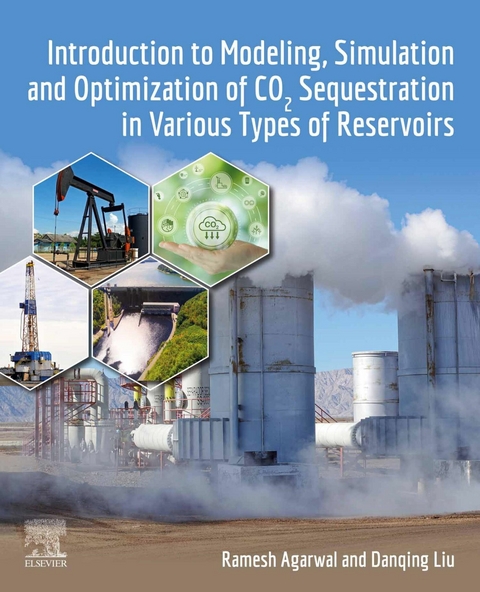
Introduction to Modeling, Simulation and Optimization of CO2 Sequestration in Various Types of Reservoirs (eBook)
400 Seiten
Elsevier Science (Verlag)
978-0-443-15330-3 (ISBN)
Ramesh Agarwal is currently the William Palm Professor Chair at Washington University in St. Louis. Previously, he was the Sam Bloomfield Distinguished Professor and Executive Director of the National Institute for Aviation Research at Wichita State University, Kansas and the Program Director and McDonnell Douglas Fellow at McDonnell Douglas Research Laboratories in St. Louis. Dr. Agarwal received his PhD from Stanford University, M.S. from the University of Minnesota and B.S. in Mechanical Engineering from the Indian Institute of Technology, Kharagpur, India. He is the author and coauthor of over 600 publications. He has given many plenary, keynote and invited lectures in over sixty countries. He is a Fellow of 24 professional societies American Society of Mechanical Engineers (ASME), Institute of Electrical and Electronics Engineers (IEEE), Society of Automotive Engineers (SAE). He has received many prestigious national/international awards including the SAE Medal of Honor, ASME Honorary Fellowship and Honorary Fellowship from Royal Aeronautical Society.
Carbon capture and sequestration has become an essential technology for addressing the mitigation of global warming and adverse climate change due to increasing CO2 emissions from fossil fuel combustion worldwide. However, the scientific/engineering community still lacks thorough and practical knowledge about various types of reservoirs capable of effective long-term CO2 sequestration. Introduction to Modeling, Simulation, and Optimization of CO2 Sequestration in Various Types of Reservoirs pulls together the relevant basic scientific knowledge and applications to help reservoir engineering practitioners learn and utilize the potential of CO2 sequestration in saline, oil, gas, shale, basalt, and geothermal reservoirs. After presenting the fundamental properties of various reservoirs, the authors describe each type of reservoir and explain basic parameters, benchmark cases, experimental data, optimization strategies for CO2 sequestration, prospects, and outlook. Rounding out the text with a glossary and consideration of future developments, this book delivers the necessary tools for engineers to better understand carbon sequestration and advance the energy transition. - Introduces the physical characteristics of saline, oil, gas, shale, basalt, and geothermal reservoirs- Describes the physics and chemistry of CO2 sequestration in different types of reservoirs and their modeling- Applies numerical simulation and optimization methodology to various reservoirs with real-world examples- Reviews machine learning applications to carbon capture and sequestration
| Erscheint lt. Verlag | 23.11.2024 |
|---|---|
| Sprache | englisch |
| Themenwelt | Technik ► Elektrotechnik / Energietechnik |
| ISBN-10 | 0-443-15330-2 / 0443153302 |
| ISBN-13 | 978-0-443-15330-3 / 9780443153303 |
| Informationen gemäß Produktsicherheitsverordnung (GPSR) | |
| Haben Sie eine Frage zum Produkt? |
 EPUB (Adobe DRM)
Kopierschutz: Adobe-DRM
Adobe-DRM ist ein Kopierschutz, der das eBook vor Mißbrauch schützen soll. Dabei wird das eBook bereits beim Download auf Ihre persönliche Adobe-ID autorisiert. Lesen können Sie das eBook dann nur auf den Geräten, welche ebenfalls auf Ihre Adobe-ID registriert sind.
Details zum Adobe-DRM
Dateiformat: EPUB (Electronic Publication)
EPUB ist ein offener Standard für eBooks und eignet sich besonders zur Darstellung von Belletristik und Sachbüchern. Der Fließtext wird dynamisch an die Display- und Schriftgröße angepasst. Auch für mobile Lesegeräte ist EPUB daher gut geeignet.
Systemvoraussetzungen:
PC/Mac: Mit einem PC oder Mac können Sie dieses eBook lesen. Sie benötigen eine
eReader: Dieses eBook kann mit (fast) allen eBook-Readern gelesen werden. Mit dem amazon-Kindle ist es aber nicht kompatibel.
Smartphone/Tablet: Egal ob Apple oder Android, dieses eBook können Sie lesen. Sie benötigen eine
Geräteliste und zusätzliche Hinweise
Buying eBooks from abroad
For tax law reasons we can sell eBooks just within Germany and Switzerland. Regrettably we cannot fulfill eBook-orders from other countries.
aus dem Bereich