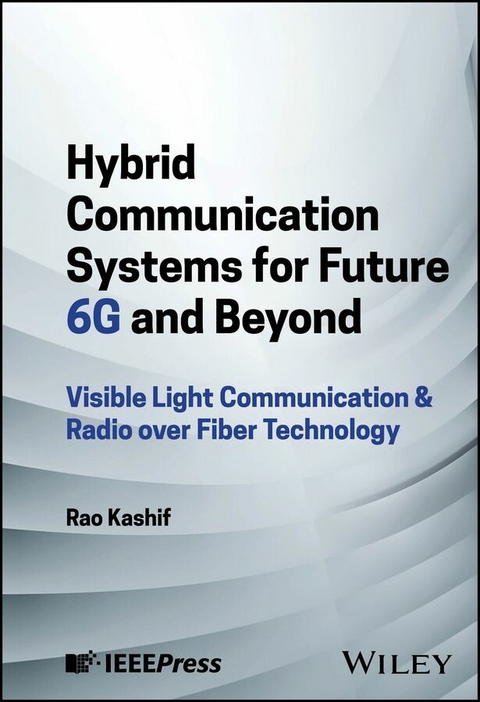
Hybrid Communication Systems for Future 6G and Beyond (eBook)
231 Seiten
Wiley-IEEE Press (Verlag)
978-1-394-23029-7 (ISBN)
Comprehensive guide to hybrid communication systems using visible light communication, radio over fiber, and auto channel switching technologies
Hybrid Communication Systems for Future 6G and Beyond explores the future of wireless communication and discusses how we can create more efficient and reliable ways to communicate by unlocking the potential of three specific technologies: visible light communication (VLC), radio over fiber (RoF) technology, and auto channel switching.
This book begins by exploring the potential of VLC technology, which is currently considered the best alternative to wireless communication. It then moves on to describe how RoF technology can provide a powerful backhaul solution for VLC. Later chapters cover auto channel switching and how it can facilitate data traffic sharing between WiFi and LiFi technologies.
Case studies of successful hybrid communication system implementations are included throughout the text to showcase real-world applications and aid in reader comprehension.
Written by a highly qualified author with experience in both academia and industry, Hybrid Communication Systems for Future 6G and Beyond includes information on:
- The evolution, advantages, and disadvantages of hybrid systems, as well as their current limitations and potential solutions to these limitations
- RoF modulation techniques, including direct and external modulation, and RoF configuration, including intermediate frequency over fiber, baseband over fiber, and millimeter-wave signal generation
- RoF system level analysis, covering encoding formats, PIN and APD photodiodes, and various experiments and simulations
- Hybrid communication technology that incorporates wireless Wi-Fi and Visible Light Communication (VLC) such as Li-Fi, to support the upcoming 6G and beyond high-speed communication networks
Hybrid Communication Systems for Future 6G and Beyond is an invaluable resource for students, researchers, and professionals in the fields of telecommunications and electronic networking who are interested in designing and implementing hybrid communication systems.
Rao Kashif, PhD, is an Assistant Professor and Head of the Computer Science & Information Technology Department with the Faculty of Engineering & Computing at the National University of Modern Languages, Islamabad, Pakistan, a federal government university. He has over seven years of industry and academia experience, including serving as a Technical Project Manager in the Network Technology Department of Huawei Technologies.
Comprehensive guide to hybrid communication systems using visible light communication, radio over fiber, and auto channel switching technologies Hybrid Communication Systems for Future 6G and Beyond explores the future of wireless communication and discusses how we can create more efficient and reliable ways to communicate by unlocking the potential of three specific technologies: visible light communication (VLC), radio over fiber (RoF) technology, and auto channel switching. This book begins by exploring the potential of VLC technology, which is currently considered the best alternative to wireless communication. It then moves on to describe how RoF technology can provide a powerful backhaul solution for VLC. Later chapters cover auto channel switching and how it can facilitate data traffic sharing between WiFi and LiFi technologies. Case studies of successful hybrid communication system implementations are included throughout the text to showcase real-world applications and aid in reader comprehension. Written by a highly qualified author with experience in both academia and industry, Hybrid Communication Systems for Future 6G and Beyond includes information on: The evolution, advantages, and disadvantages of hybrid systems, as well as their current limitations and potential solutions to these limitations RoF modulation techniques, including direct and external modulation, and RoF configuration, including intermediate frequency over fiber, baseband over fiber, and millimeter-wave signal generation RoF system level analysis, covering encoding formats, PIN and APD photodiodes, and various experiments and simulations Hybrid communication technology that incorporates wireless Wi-Fi and Visible Light Communication (VLC) such as Li-Fi, to support the upcoming 6G and beyond high-speed communication networks Hybrid Communication Systems for Future 6G and Beyond is an invaluable resource for students, researchers, and professionals in the fields of telecommunications and electronic networking who are interested in designing and implementing hybrid communication systems.
1
Introduction
1.1 Overview
Over the past 30 years, mobile networks have revolutionized the way in which we are connected. Mobile is and continues to be the world’s most rapidly adopted technology, from education and entertainment to innovative new applications and services that are transforming how business is conducted around the world. Mobile is boosting our economies, transforming our communities, and empowering people in ways impossible to predict just a few years ago. The spectrum is the lifeblood that fuels this mobile connectivity; however, it is a finite resource. Every four years, the world’s governments come together to agree on how the radio spectrum may be used during treaty negotiations of the World Radiocommunication Conference. It can take a decade before any new mobile spectrum can be used in new services and devices. With increasing smartphone adoption and advances in mobile technology enabling faster networks, people are using an ever-increasing amount of data. This always-on, always-connected demand will require access to a much wider mobile spectrum. The growth prediction of the Internet of Things (IoT) is illustrated in Figure 1.1. According to reference [1], there will be approximately 28 billion connected devices by 2021. The IoT will connect all indoor devices to the Internet, and we can imagine that the number of indoor communication devices will increase by a substantial amount.
1.2 Radio Frequency Communication
Radio frequency (RF) is a form of energy in the modification of time-dependent electronic and magnetic fields. In short, it is an electromagnetic wave that propagates readily in a vacuum, in space, or in solid-state media such as metal on a circuit board or through a coaxial cable, or it can propagate out of an antenna into space. In former times, people referred to it as a medium to carry electromagnetic waves; however, that notion was incorrect – it simply takes space. Our three-dimensional world carries these types of waves. We said RF is an electromagnetic wave; more specifically, only wave frequencies between 1 MHz and 3 GHz are called RF. Waves above 3 GHz and up to 30 GHz are referred to as microwaves. Higher frequencies between 30 and 300 GHz are termed as millimeter waves. Figure 1.2 [2] presents a chart of the electromagnetic spectrum. Along with frequency and wavelength, power is another crucial parameter to consider. The power of waves is directly proportional to the coverage. From cellular communication to Wi-Fi, Zigbee, BLE, and RF are serving the modern world in all fields of life. RF is currently the most widely used medium of communication. However, as we are moving toward faster and more secure communication for the IoT and other applications, there are several issues that the RF industry is facing. Researchers are always trying to provide the best solutions with updates to the spectrum and technologies. Figure 1.3 illustrates a typical RF transceiver.
Figure 1.1 Growth of wireless connected devices.
Figure 1.2 Electromagnetic spectrum chart.
Figure 1.3 Radio frequency system block diagram.
1.2.1 Limitations for Future RF Communication
In future 6G communication networks, RF communication may encounter several limitations, including.
1.2.1.1 Spectrum Congestion
With the increasing demand for wireless connectivity and the proliferation of connected devices, the available RF spectrum is becoming increasingly congested. This congestion can lead to interference and reduced network performance.
1.2.1.2 Limited Bandwidth
RF communication is constrained by the available bandwidth in the RF spectrum. As data rates continue to increase with emerging applications such as virtual reality, augmented reality, and high-definition video streaming, the limited bandwidth of RF communication may become a bottleneck.
1.2.1.3 Line-of-Sight Requirements
RF communication typically requires line-of-sight between the transmitter and receiver, particularly at higher frequencies. This can pose challenges in urban environments with obstacles such as buildings, foliage, and terrain, limiting the coverage and reliability of RF-based networks.
1.2.1.4 Signal Attenuation and Interference
RF signals are susceptible to attenuation and interference from environmental factors such as buildings, weather conditions, and electromagnetic noise. This can result in signal degradation and reduced network performance, particularly in outdoor environments.
1.2.1.5 Security Concerns
RF communication may be vulnerable to security threats such as eavesdropping, jamming, and unauthorized access. As cyberattacks become more sophisticated, ensuring the security and integrity of RF-based communication networks becomes increasingly challenging.
1.2.1.6 Energy Efficiency
RF communication technologies often require significant power consumption, particularly for long-range communication and high data rates. This can impact the energy efficiency of devices and infrastructure in future 6G networks, particularly in battery-powered devices and IoT deployments.
Overall, while RF communication has been the backbone of wireless networks for decades, addressing these limitations will be crucial for future 6G communication networks to meet the growing demand for high-speed, reliable, and secure wireless connectivity.
1.3 Optical Communication
Since the mid-1970s, optical fiber captured the interest of researchers. Due to limited bandwidth, sensitivity to crosstalk, radio and electrical interference, and security issues, researchers believed that copper would not be able to hold the future communication. The high bandwidth of a fiber channel offers more data flow compared to the other available communication mediums. As an increasing number of people utilize the Internet in their neighborhoods, the flow of data can slow to a trickle in comparison to the flow of data over fiber-optic broadband. Fiber optics technology is critical because only fiber optics can handle the increasing Internet bandwidth; technologies such as DSL and cable will not be able to keep up. Fiber is also a safe mode of transmission, and it is unaffected by environmental conditions. The cost of optical fiber continues to fall.
Similarly to other transmission systems, an optical fiber system also consists of a transmitter, a medium, and a receiver. Figure 1.4 presents a typical block diagram of the optical system. In the transmitter, a modulator converts the electrical signal to an optical signal. At the receiver, the light signal is downconverter to an electrical signal by a photodetector.
Figure 1.4 Optical system block diagram.
1.3.1 Future Opportunities for Optical Communication
In future 6G and beyond communication networks, optical communication technologies are poised to play a significant role and present several opportunities, including.
1.3.1.1 High Data Rates
Optical communication offers the potential for extremely high data rates, surpassing those achievable with traditional RF communication. This is especially crucial as future applications such as ultrahigh-definition video streaming, virtual reality, and augmented reality demand increasingly higher bandwidths.
1.3.1.2 Low Latency
Optical communication systems can provide lower latency compared to RF systems, which is essential for real-time applications like autonomous vehicles, telemedicine, and industrial automation. Reduced latency enhances responsiveness and improves overall user experience.
1.3.1.3 Large Bandwidth
Optical communication systems operate over a wide spectrum of optical frequencies, providing a vast bandwidth for data transmission. This large bandwidth enables the support of multiple users and devices simultaneously, facilitating the massive connectivity requirements of future networks.
1.3.1.4 Immunity to Electromagnetic Interference
Unlike RF communication, optical communication is immune to electromagnetic interference, making it ideal for deployment in environments with high electromagnetic noise levels, such as industrial facilities, urban areas, and dense urban environments.
1.3.1.5 Secure Communication
Optical communication offers inherent security advantages, as it is difficult to intercept or eavesdrop on optical signals without physical access to the transmission medium. This makes optical communication systems inherently more secure than RF systems, particularly for sensitive data transmissions.
1.3.1.6 Energy Efficiency
Optical communication systems can be more energy-efficient compared to RF systems, particularly for long-distance communication and high data rates. This is beneficial for reducing power consumption and extending the battery life of devices in future wireless networks.
Overall, optical communication technologies present significant opportunities for addressing the evolving requirements of future 6G and beyond communication networks, including high data rates, low latency, security, and energy efficiency. By leveraging these opportunities, optical communication can enable the development of more advanced and reliable wireless communication systems...
| Erscheint lt. Verlag | 26.11.2024 |
|---|---|
| Sprache | englisch |
| Themenwelt | Technik ► Elektrotechnik / Energietechnik |
| Schlagworte | APD photodiodes • baseband over fiber • communication mediums • intermediate frequency over fiber • Li-Fi • millimeter-wave signal generation RoF system level analysis • PIN photodiodes • RoF encoding formats • VLC backhaul solution |
| ISBN-10 | 1-394-23029-X / 139423029X |
| ISBN-13 | 978-1-394-23029-7 / 9781394230297 |
| Informationen gemäß Produktsicherheitsverordnung (GPSR) | |
| Haben Sie eine Frage zum Produkt? |
 EPUB (Adobe DRM)
Kopierschutz: Adobe-DRM
Adobe-DRM ist ein Kopierschutz, der das eBook vor Mißbrauch schützen soll. Dabei wird das eBook bereits beim Download auf Ihre persönliche Adobe-ID autorisiert. Lesen können Sie das eBook dann nur auf den Geräten, welche ebenfalls auf Ihre Adobe-ID registriert sind.
Details zum Adobe-DRM
Dateiformat: EPUB (Electronic Publication)
EPUB ist ein offener Standard für eBooks und eignet sich besonders zur Darstellung von Belletristik und Sachbüchern. Der Fließtext wird dynamisch an die Display- und Schriftgröße angepasst. Auch für mobile Lesegeräte ist EPUB daher gut geeignet.
Systemvoraussetzungen:
PC/Mac: Mit einem PC oder Mac können Sie dieses eBook lesen. Sie benötigen eine
eReader: Dieses eBook kann mit (fast) allen eBook-Readern gelesen werden. Mit dem amazon-Kindle ist es aber nicht kompatibel.
Smartphone/Tablet: Egal ob Apple oder Android, dieses eBook können Sie lesen. Sie benötigen eine
Geräteliste und zusätzliche Hinweise
Buying eBooks from abroad
For tax law reasons we can sell eBooks just within Germany and Switzerland. Regrettably we cannot fulfill eBook-orders from other countries.
aus dem Bereich